The most powerful computer can still be the wrong choice for an industrial AI deployment. Selecting ai edge computing hardware means matching the workload to site conditions, existing OT and data platforms, and long-term operating needs, rather than simply choosing the highest processing capacity.
Start by asking whether a platform can support the intended AI workload and connect to the systems already in place. This guide compares Industrial PCs, Embedded Systems, GPU Edge Computer, and Industrial Servers against processing needs, integration dependencies, environmental constraints, and lifecycle considerations relevant to industrial deployments in the UAE.
Each category has a different potential role. Build a defensible shortlist by defining the task first, then checking interfaces, model requirements, power and thermal limits, and maintenance responsibilities. The sections ahead cover common selection challenges and practical ways to address them, helping you plan an architecture for current operations and future development.
Key Takeaways
- Assess how local AI processing could support the intended industrial task, keeping the workload and operating conditions central to hardware selection.
- Map data sources, gateways, computing devices, and connected platforms to clarify how information moves through the architecture.
- Compare ai edge computing hardware categories by workload fit, installation context, integration requirements, maintainability, and lifecycle ownership.
- Reduce deployment risk by documenting interfaces and protocols, validating shortlisted hardware, and planning ongoing operation before procurement.
- NET WIZARDS L.L.C lists AI Edge systems, GPU Edge Computer, Industrial PCs, Embedded Systems, and Industrial Servers. Evaluate them alongside relevant networking, gateway, protocol-conversion, and cloud-platform requirements.
Table of Contents
- What AI edge computing hardware does for industrial operations
- How AI edge hardware components fit together in an industrial architecture
- How to compare AI edge computing hardware options
- How to manage AI edge hardware challenges before deployment
- How NET WIZARDS can support an industrial AI edge hardware decision
What AI edge computing hardware does for industrial operations
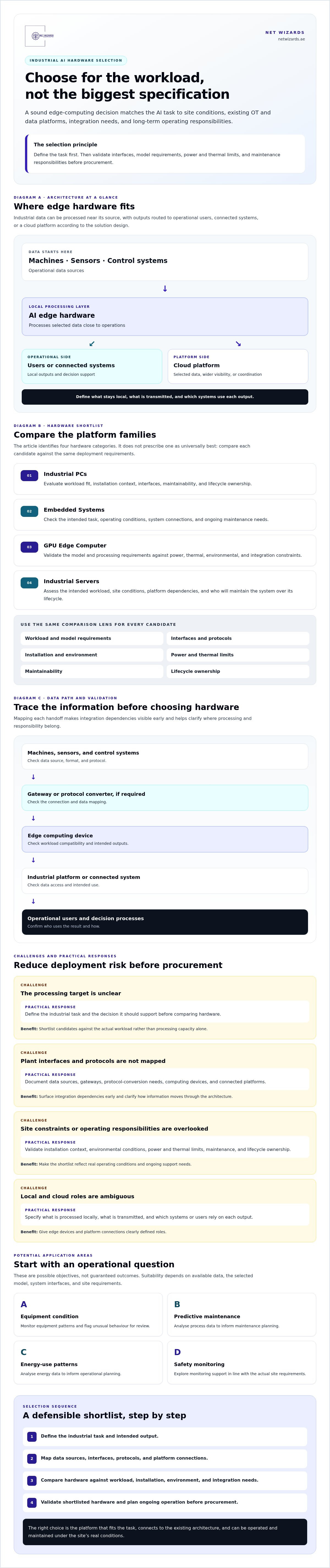
AI edge computing hardware places industrial computing close to the machines, sensors, and control systems that generate operational data. Rather than sending every input to a remote platform for initial processing, an edge device can analyse selected data near its source and provide outputs to connected systems or users. This architecture can support local monitoring and decision-making. The broader Edge computing concept includes different ways of distributing processing across devices and platforms.
Potential manufacturing applications include monitoring equipment condition, analysing process data to inform predictive maintenance, identifying energy-use patterns, and supporting safety monitoring. These are possible objectives, not guaranteed results. Suitability depends on the available data, selected model, system interfaces, and site requirements. Check each use case against its actual operating conditions before choosing hardware.
Diagram 1. Conceptual industrial edge architecture
Industrial data sources
Machines, sensors, control systems
↓
AI edge hardware
Local data processing and analysis
↙ ↘
Operational users or systems Cloud platform
Local outputs and decisions Selected data, wider visibility, or coordination
Which industrial workloads may benefit from AI at the edge?
Begin with the decision the plant needs to make. A workload might flag an unusual equipment pattern for review, help operators monitor a process, or analyse energy data to inform operational planning. Edge processing may suit a task when data needs assessment near its source, but it is not automatically right for every model or workflow. Check data quality, model requirements, integration points, and environmental and operational constraints before selecting a platform.
How does edge hardware relate to industrial cloud platforms?
Edge devices and cloud platforms can serve complementary roles when the architecture assigns responsibilities clearly. Edge hardware can process data near operations, while a cloud platform may support broader data access or coordination, depending on the solution design. Define what is processed locally, what is transmitted, and which systems use the resulting information. NET WIZARDS L.L.C lists an Industrial-grade IoT Cloud Platform among its offerings. For related evaluation guidance, see Industrial Cloud Platform UAE: A Practical Guide to Evaluating and Deploying an Industrial IoT Cloud.
Deployment challenge: Unclear boundaries between plant equipment, edge devices, and cloud services can complicate integration. Practical response: Map data flows and operational responsibilities before procurement, then check interfaces and workload compatibility against the proposed architecture.
How AI edge hardware components fit together in an industrial architecture
An industrial AI architecture is a chain of connected roles, not a single device. Machines, sensors, and control systems produce data. Gateways may connect equipment or help bridge protocols; edge computing devices process selected data close to operations; and platform connections can provide wider access to information. Operators and other authorized systems then use the outputs for monitoring or decision support. The arrangement depends on the workload and the plant’s existing interfaces.
Plan the data path before selecting ai edge computing hardware. Record where each input originates, which protocol it uses, where processing should happen, and which system or user needs the result. This reveals integration dependencies early. The NIST Edge AI program provides context on Edge AI challenges and the need for suitable algorithms and measurement methods.
Diagram 2. Industrial data flow and validation points
Machines, sensors, and control systems
↓ Validate data source, format, and protocol
Gateway or protocol converter, if required
↓ Validate connection and data mapping
Edge computing device
↓ Validate workload compatibility and outputs
Industrial platform or other connected system
↓ Validate data access and intended use
Operational users and decision processes
What role can an AI Edge system or GPU Edge Computer play?
NET WIZARDS L.L.C lists AI Edge systems and GPU Edge Computer among its hardware families. Evaluate them as candidate computing options against the intended workload, integration plan, and operating conditions. Do not treat the category names as interchangeable or as confirmation of a particular performance level. Ask the supplier to confirm the available configuration and workload compatibility, then test relevant interfaces and expected outputs within the proposed system.
Where do Industrial PCs and Embedded Systems fit?
NET WIZARDS L.L.C also lists Industrial PCs, Panel PCs, Embedded Systems, Industrial Servers, and Data Acquisition Systems. Assess each for its proposed role. For example, consider whether a Panel PC suits an operator-facing installation or an Embedded System suits a compact, dedicated computing task. Evaluate Industrial PCs and Industrial Servers against other site computing needs. These are selection prompts, not confirmed product specifications. Check each option’s interfaces, environmental ratings, maintainability, and lifecycle arrangements before making a choice.
Include Data Acquisition Systems in the review when collecting or interfacing with equipment data is part of the project. A common mistake is assuming that existing protocols and devices will connect without additional work. Avoid this by creating an interface and protocol inventory, then verifying the proposed connections and responsibilities across each system layer. To review potential hardware and integration requirements, discuss your industrial computing requirements with NET WIZARDS L.L.C.
How to compare AI edge computing hardware options
Compare platforms against a defined plant workload, not a category label alone. NET WIZARDS L.L.C lists the hardware families below, but the available information does not confirm model-specific features or specifications. Treat each category as a candidate for evaluation, not proof of capability. Request documented features and configuration details from the supplier, then assess them against workload, integration, installation, and lifecycle requirements.
| Hardware category | Confirmed feature information | Fit and details to verify |
|---|---|---|
| Industrial PCs | Listed as an industrial computing hardware family. | Confirm workload compatibility, interfaces, installation conditions, maintainability, and lifecycle support. |
| Panel PCs | Listed as an industrial computing hardware family. | Verify whether the proposed configuration suits the installation, required connections, software, and servicing access. |
| Embedded Systems | Listed as an industrial computing hardware family. | Check workload fit, interfaces, operating conditions, maintenance requirements, and support arrangements. |
| Industrial Servers | Listed as an industrial computing hardware family. | Ask for documented workload compatibility, network and software dependencies, installation requirements, and lifecycle details. |
| GPU Edge Computer | Listed as a hardware family. No specific GPU or performance features are confirmed here. | Request the exact configuration, supported workload details, interfaces, operating conditions, and support scope. |
Which selection criteria should industrial buyers prioritize?
Start with the intended workload, data sources, required outputs, and system boundaries. Assess protocol, network, software, and cloud integration with the OT, IT, and operations teams responsible for those systems. Include site conditions, servicing access, security responsibilities, and lifecycle support in procurement questions. This gives teams a consistent basis for comparing ai edge computing hardware without assuming that similarly named categories share the same features.
How should buyers handle missing or unverified specifications?
Separate confirmed product-family names from features that remain unverified. Request product-specific documentation for each shortlisted configuration, including evidence of workload and interface compatibility. Record assumptions and acceptance criteria before committing to a deployment design. If a feature is essential, make its confirmation and validation part of the procurement review instead of treating it as included by default.
Diagram 3. Decision path to a hardware shortlist
Define workload and required outputs
↓
Map data sources, protocols, and system boundaries
↓
Check site conditions, installation, and service access
↓
Request documented features and configuration details
↓
Validate candidates against agreed acceptance criteria
↓
Shortlist options that meet confirmed requirements
How to manage AI edge hardware challenges before deployment
Deployment risk often begins before equipment arrives. Fragmented data sources, protocol dependencies, unclear workload boundaries, and uncertain maintenance ownership can make a device a poor fit for plant operations. Turn these unknowns into documented requirements, test criteria, and assigned responsibilities before procurement.
What challenges can complicate industrial edge hardware selection?
Different machines may expose data through different interfaces, while the intended AI task may not yet have clearly defined inputs, outputs, or system boundaries. A requirements list focused only on computing capacity can overlook network dependencies, servicing access, or ownership of updates and support. The result may be hardware that appears suitable on paper but cannot be integrated or operated as intended.
Address network dependencies as part of device selection. The Mission Critical Industrial Networking article is a related resource for reviewing the communications layer. Confirm actual network requirements with the plant’s technical teams rather than assuming existing connections will support a new workload.
What practical solutions reduce selection and integration risk?
Use a staged review that involves OT, IT, and operations. Assign an owner to each dependency and agree on acceptance criteria before testing. This gives procurement a traceable basis for comparing options and helps project teams identify unresolved issues before committing to a deployment design.
- Define the workload. Specify the operational objective, data inputs, expected outputs, and where decisions will be used.
- Map dependencies. Inventory interfaces, protocols, network paths, software, platform connections, and system responsibilities.
- Validate hardware. Obtain supplier-confirmed configurations and documented compatibility details. Test the proposed workload and connections against agreed criteria.
- Plan operation. Assign responsibility for installation, servicing, security tasks, updates, and lifecycle support.
- Review evidence. Record test results, open assumptions, and acceptance decisions. Do not treat unverified specifications as confirmed.
This process distinguishes confirmed requirements from assumptions, reduces avoidable integration surprises, and creates a clear record of why a device made the shortlist. It also keeps the choice of ai edge computing hardware tied to operational needs rather than product labels alone.
Challenge-to-mitigation map
Fragmented data sources → Build an interface and protocol inventory → OT and controls team
Unclear workload boundaries → Document inputs, outputs, and intended decisions → Operations and AI project team
Unverified hardware fit → Request configuration evidence and run agreed tests → Supplier and technical owners
Unclear maintenance ownership → Assign support and lifecycle responsibilities → IT, OT, and procurement
How NET WIZARDS can support an industrial AI edge hardware decision
NET WIZARDS L.L.C lists AI Edge systems, GPU Edge Computer, Industrial PCs, Embedded Systems, and Industrial Servers for evaluation against industrial workloads. The confirmed information identifies these as hardware families but does not specify model-level features, interfaces, or performance. Before shortlisting a device, request current configuration details and documented compatibility with the intended workload.
The wider offering provides useful architecture context: Industrial Networking Equipment, Industrial IoT sensors, gateways, and protocol converters, alongside an Industrial-grade IoT Cloud Platform. The platform supports multiple protocols, including MQTT, Modbus, NB-IoT, LoRaWAN, and TCP/UDP. Confirm which features, interfaces, and integrations apply to the proposed configuration. NET WIZARDS L.L.C has 20 years in business.
A properly scoped solution may support operational objectives such as efficiency, predictive maintenance, energy optimization, and enhanced safety. These are objectives, not guaranteed outcomes. Define the target use case and acceptance criteria, then confirm how the proposed hardware and connected systems address them.
What should buyers prepare before discussing an AI edge solution?
Prepare the intended workload and operational objective, relevant data sources, current systems, and known protocols. Document network dependencies, installation conditions, integration constraints, ownership roles, and the evidence required for acceptance. This gives the supplier a practical basis for confirming applicable features and configuration instead of relying on assumptions about a product category.
How does an industrial supplier fit into the evaluation process?
NET WIZARDS L.L.C can be considered as a supplier of listed industrial computing and networking hardware and related gateway and platform offerings. Ask for product-specific documentation confirming configuration, workload compatibility, interfaces, and support scope. Keep OT, IT, and operations stakeholders involved, and verify critical requirements before procurement.
Build a Defensible AI Edge Hardware Shortlist
Selecting ai edge computing hardware starts with the workload, but a sound decision also accounts for data sources, OT and platform integration, site conditions, and lifecycle ownership. Compare hardware categories against those requirements, document interfaces and protocols, and request supplier-confirmed compatibility and configuration details before finalizing the design.
NET WIZARDS has 20 years in business and lists AI Edge systems and GPU Edge Computer alongside Industrial PCs, Embedded Systems, and Industrial Servers. Its wider offering includes industrial computing, networking, gateways, protocol converters, and an Industrial-grade IoT Cloud Platform. Evaluate these options in the context of your architecture. Confirm specifications and support scope rather than assuming product categories are interchangeable.
Bring your workload, data sources, interfaces, operating context, and acceptance requirements into the discussion. A clear brief helps your technical teams and supplier review integration dependencies and develop a practical shortlist.
With clear requirements and evidence-led validation, you can develop an edge architecture grounded in plant needs and ready for considered future development.
Frequently Asked Questions
Is AI edge computing hardware suitable for every industrial AI workload?
No. Suitability depends on the workload, data sources, operating environment, integration requirements, and required outputs. Define these conditions before comparing hardware categories. For example, a system intended to analyse equipment data needs to be checked against the relevant inputs, model and software compatibility, and plant interfaces. Ask the supplier to confirm the proposed configuration, then evaluate it against acceptance criteria agreed by the project team.
What is the difference between an AI edge computer and an industrial IoT gateway?
An AI edge computer is evaluated for local computing workloads, while an Industrial IoT Gateway may support connectivity between devices and systems. Their roles can vary by architecture, so do not assume they are interchangeable. First map data acquisition, protocol conversion, processing, and platform integration needs. Then confirm each proposed device’s functions, interfaces, and configuration against the plant’s requirements.
How do I choose between an Industrial PC, Embedded System, and GPU Edge Computer?
Compare each category against the intended workload and installation context. Assess computing requirements, interfaces, available space, operating conditions, service access, and lifecycle ownership. NET WIZARDS lists Industrial PCs, Embedded Systems, and GPU Edge Computer among its hardware families, but a category name does not confirm a specific capability. Request product-specific specifications and documented workload compatibility before deciding which options belong on the shortlist.
Can AI edge computing hardware connect to an industrial cloud platform?
It can be evaluated as part of an architecture that also includes an industrial cloud platform, but compatibility depends on the selected devices, software, interfaces, and integration design. NET WIZARDS lists AI Edge Computing and an Industrial-grade IoT Cloud Platform among its offerings. Ask suppliers to document proposed data flows, protocols, configuration requirements, and security responsibilities for the architecture under consideration.
What should I verify before buying AI edge computing hardware?
Verify the workload, software compatibility, interfaces, protocols, operating conditions, network dependencies, and integration scope. Also establish who owns security responsibilities, maintenance, and lifecycle support. Request documentation for the exact product configuration and clarify which features depend on configuration. Record critical requirements as procurement acceptance criteria, then validate them before deployment rather than relying on a broad product-family description.
Does NET WIZARDS provide AI edge computing hardware for industrial applications?
NET WIZARDS lists AI Edge systems, GPU Edge Computer, Industrial PCs, Embedded Systems, Industrial Servers, and Data Acquisition Systems among its hardware families. The suitable option depends on the workload and wider system requirements. Share the intended task, data sources, interfaces, operating context, and integration needs, then ask the supplier to confirm relevant configuration, compatibility, and support details before procurement.