
Coverage proven before rollout
RF planning and propagation modelling are followed by a site survey with test nodes, so coverage is measured rather than assumed.
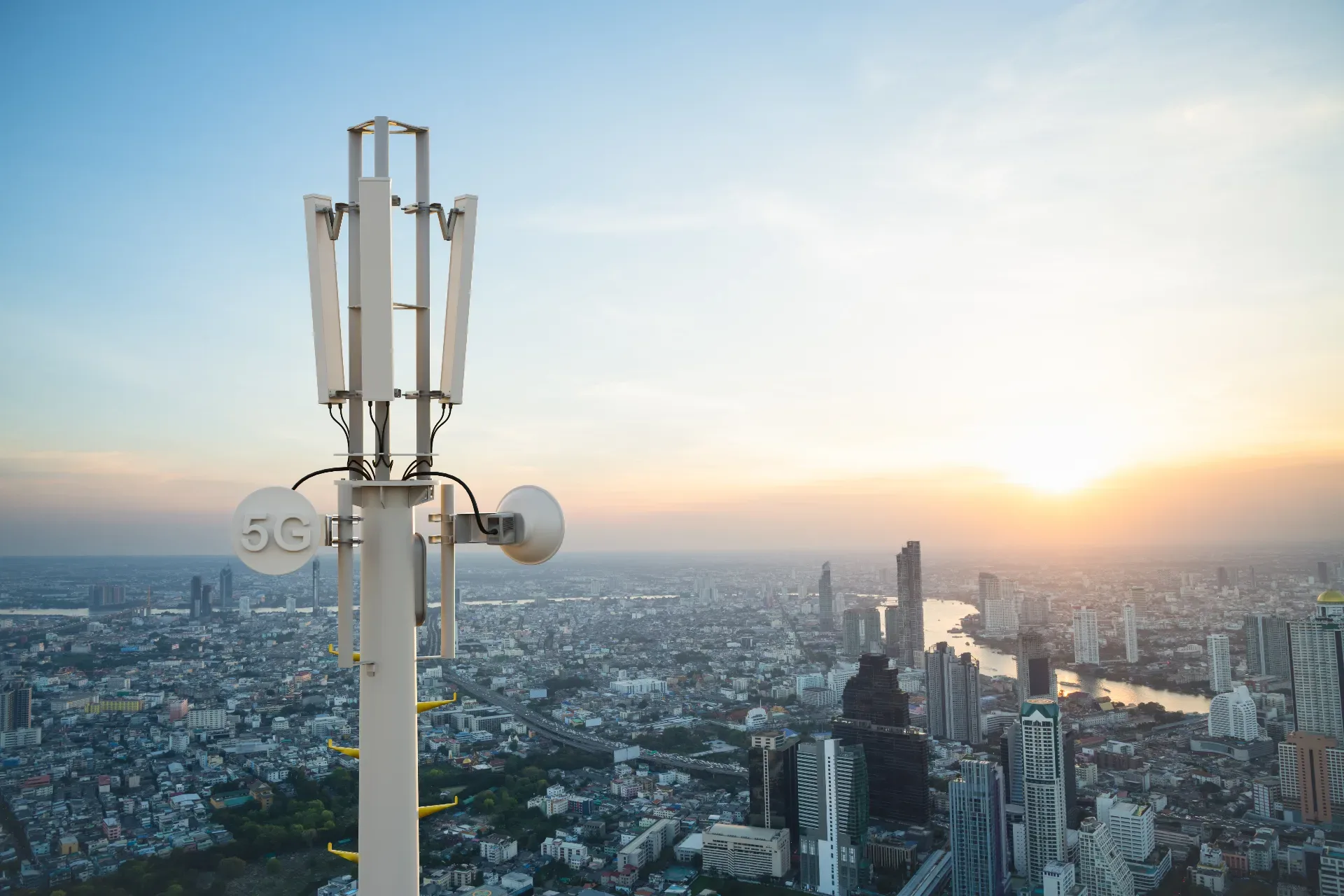
Wireless network engineering
NET WIZARDS plans, deploys and operates LoRaWAN, NB-IoT, long range radio, industrial Wi-Fi, private 5G and satellite connectivity across the UAE and the wider GCC, so sensors, machines and remote assets stay reachable in places where coverage is never turnkey.
Most failed IoT projects fail at the radio layer. Devices that cannot report, gateways placed by guesswork and batteries that drain in months all trace back to a network that was never designed.
RF planning and propagation modelling are followed by a site survey with test nodes, so coverage is measured rather than assumed.
Low power wide area links let field sensors report for several years on a single battery, which removes most site visits.
Parking, metering, environment, lighting and industrial sensors share the same wireless layer instead of each vendor adding its own.
Heat, dust, humidity, salt air and dense concrete are part of the design inputs for antennas, enclosures and link budgets.
The challenge
Wireless coverage across industrial sites, utilities, and remote infrastructure is rarely turnkey, especially at city scale. As one of the region’s few specialized R&D and deployment centers, we design and build carrier‑grade LPWAN networks, including city‑wide LoRaWAN, long‑range wireless communication systems, industrial Wi‑Fi networks, and private 5G solutions.
Our expertise ensures reliable connectivity for sensors, machines, and mission‑critical operations across factories, smart‑city assets, and hard‑to‑reach environments. From planning and RF design to deployment, optimization, and lifecycle management, we deliver wireless networks engineered for industrial performance, low latency, and high availability.
Whether enabling thousands of IoT sensors, connecting SCADA and OT systems, or powering next‑generation automation, our solutions provide the resilient communication backbone required for digital transformation across the MENA region.
A sensor in a basement car park, a meter inside a riser, a level probe in a manhole and a transmitter on a desert wellhead all present different radio problems. Each needs a link budget, an antenna choice and a gateway position that reflect the real environment, which is why we treat network design as an engineering task with measured results rather than a hardware order.
Technology selection
A single site often uses several of these at once. The selection is driven by device count, payload size, latency, power source and who should own the network.
City wide and campus LPWAN
Public or private LoRaWAN networks built for large sensor populations over long distances. Gateways are placed from a propagation model and verified on site, and a network server manages device joining, keys, adaptive data rate and payload routing to the platform.
Carrier connected devices
Cellular low power links for devices spread across a city or a country where a carrier already has coverage. Useful where no private network is justified, with SIM management, data plans and coverage verification handled as part of the design.
Point to point and point to multipoint
Licensed and licence exempt radio links that carry telemetry, video or SCADA traffic between sites where fibre is not available. Link budgets, antenna alignment, line of sight analysis and interference checks are produced during design.
High density plant and warehouse coverage
Industrial grade access points and controllers engineered for interference, metal structures and moving equipment. Roaming is designed for handheld terminals, AGVs and cranes so a session survives movement across the facility.
Deterministic high bandwidth automation
Private cellular networks for applications that need predictable latency and bandwidth across a large site, including machine vision, remote control of mobile equipment and dense video backhaul.
Where no terrestrial service exists
Non terrestrial connectivity for assets beyond any network, including desert wellheads, pipeline corridors and vessels. Payloads are kept small and scheduled, with edge buffering so a pass or an outage does not lose history.
Capabilities
We build large‑scale LPWAN networks optimized for long‑range, low‑power IoT communication across municipalities and industrial zones.
Custom RF planning, antenna design, and propagation modeling ensure stable connectivity across remote and challenging terrains.
High‑density, interference‑resistant Wi‑Fi networks designed for factories, warehouses, ports, and high‑mobility industrial environments.
Deployment of secure, low‑latency 5G networks enabling robotics, AGVs, video analytics, and real‑time operational control.
Continuous performance monitoring, predictive maintenance, and optimization ensure long‑term reliability and uptime.
Seamless connectivity between sensors, gateways, SCADA, cloud platforms, and enterprise systems for unified operational visibility.
Design and deployment
Six stages, each producing a document or a measurement you can review before the next one starts.
Device count, report interval, payload size, latency tolerance, power source and the geographic spread of every asset group.
Terrain and building data, propagation modelling, link budgets, antenna selection and candidate gateway or cell sites.
Test nodes and reference gateways are installed temporarily, then signal strength and packet delivery are measured at real device locations.
Gateways, access points or cells are installed with power, backhaul, grounding and lightning protection, then commissioned per site.
Data rate, spreading factor, channel plan, antenna tilt and cell parameters are tuned against measured performance rather than defaults.
Coverage, packet loss, device battery levels and gateway health are monitored continuously, with periodic review as the site changes.
Where we deploy
City wide LoRaWAN and NB-IoT layers that carry parking, waste, lighting, metering, manhole and environment sensors on one shared network.
Interference resistant Wi-Fi, private cellular and wired industrial networking engineered around machinery, metal structures and moving equipment.
Metering and substation communication across dense urban areas and long rural feeders, with mixed LoRaWAN, cellular and radio link backhaul.
Wellheads, pipelines, pumping stations and reservoirs connected with long range radio or satellite links, with edge buffering during outages.
The same wireless layer carries our smart city solutions, Industry 4.0 programmes and industrial cloud platforms.