Built around your data model
Assets, sites, zones, meters, permits and work orders are modelled the way your operation already describes them, not forced into a vendor template.
Industrial cloud platforms
NET WIZARDS builds tailored industrial cloud platforms for each use case. Parking, asset tracking, metering, facility operations and delivery programmes each get their own data model, their own screens and their own integrations, engineered to the exact requirement and fully customisable for the client.
Generic software makes your team translate the operation into someone else's structure. A tailored platform removes that translation step, which is where most reporting errors and adoption problems start.
Assets, sites, zones, meters, permits and work orders are modelled the way your operation already describes them, not forced into a vendor template.
Each role gets the view it needs, from a control room wall board to a supervisor tablet, instead of a single generic dashboard for everyone.
The platform reads from field gateways and writes to the CMMS, MES, ERP and reporting tools already in use.
Data structures, interfaces and documentation are yours, with no dependency on a licence tier to unlock a report.
The challenge
Off‑the‑shelf SaaS platforms rarely align with the complexity of industrial operations. Every factory, utility, and infrastructure operator has unique data models, workflows, KPIs, and compliance requirements that generic cloud tools simply cannot accommodate.
Our Industrial Cloud Platform is engineered to bridge this gap by delivering a fully customized, scalable environment built around your existing CMMS, MES, ERP, and OT systems. Designed for organizations undergoing digital transformation, our platform unifies machine data, operational processes, and enterprise systems into a single, real‑time operational layer.
Whether you operate in manufacturing, utilities, smart infrastructure, or industrial automation, we tailor the cloud architecture to your exact needs, enabling predictive insights, seamless integrations, and data‑driven decision‑making across the entire operation.
The gap usually appears in the detail. An asset hierarchy that cannot express your zones. A permit flow that skips the approval your safety procedure requires. A billing export that has to be corrected by hand every month. A licence model that charges per seat for people who only need to read one screen. Each of these is small on its own, and together they decide whether a platform is used or abandoned.
Platforms we have built
Every screen below comes from a platform our team designed and engineered for a specific operational use case. Screens are shown with demonstration data. Client deployments and client data are never published.
Smart parking and parking lock operations
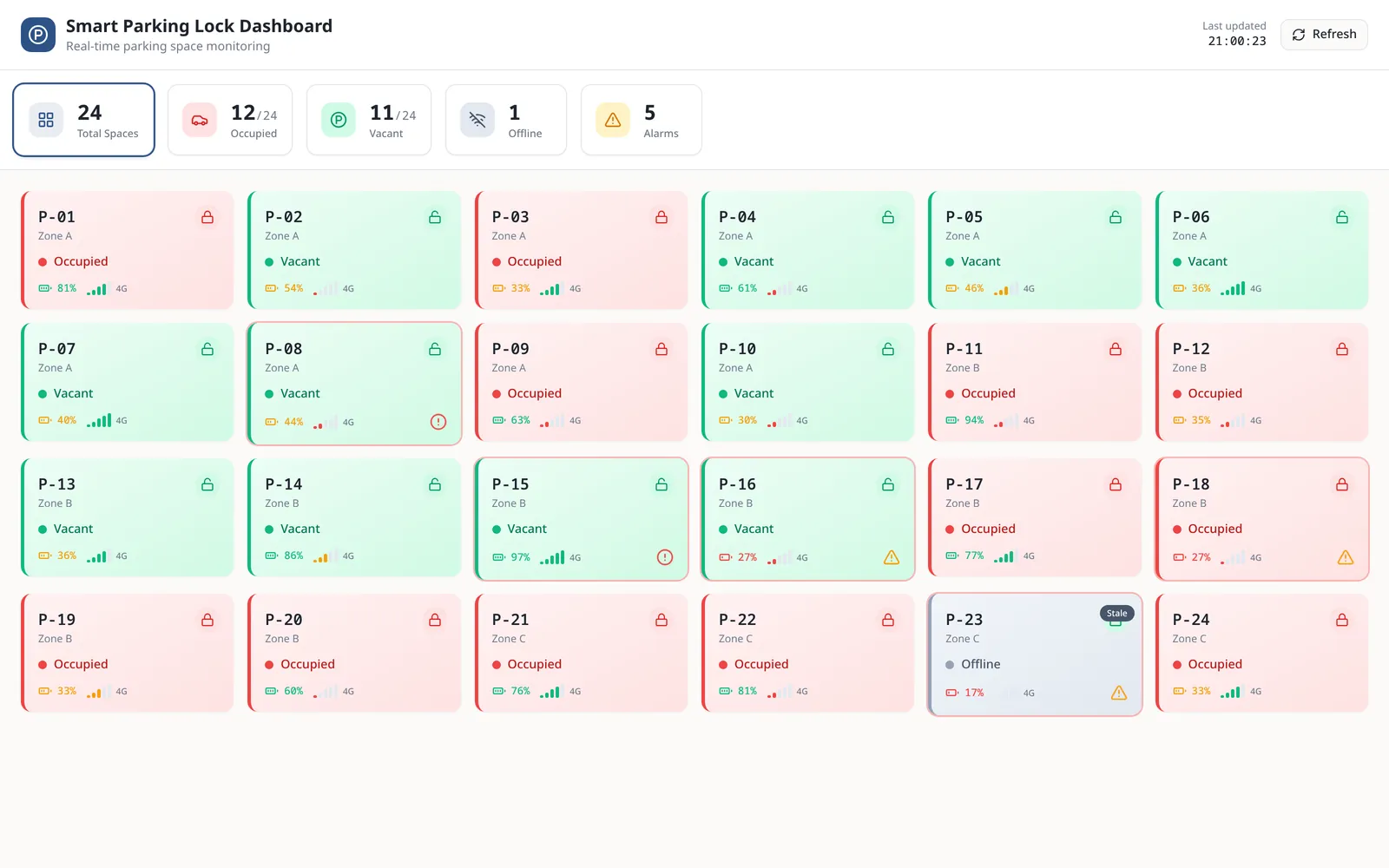
A control room view of every parking bay in a site. Each bay tile carries occupancy state, lock position, battery level and signal quality, so an operator can see a stale or offline device immediately instead of discovering it from a complaint. Zone counters at the top summarise total, occupied, vacant, offline and alarm states for shift handover.
Asset tracking and rental fleet management
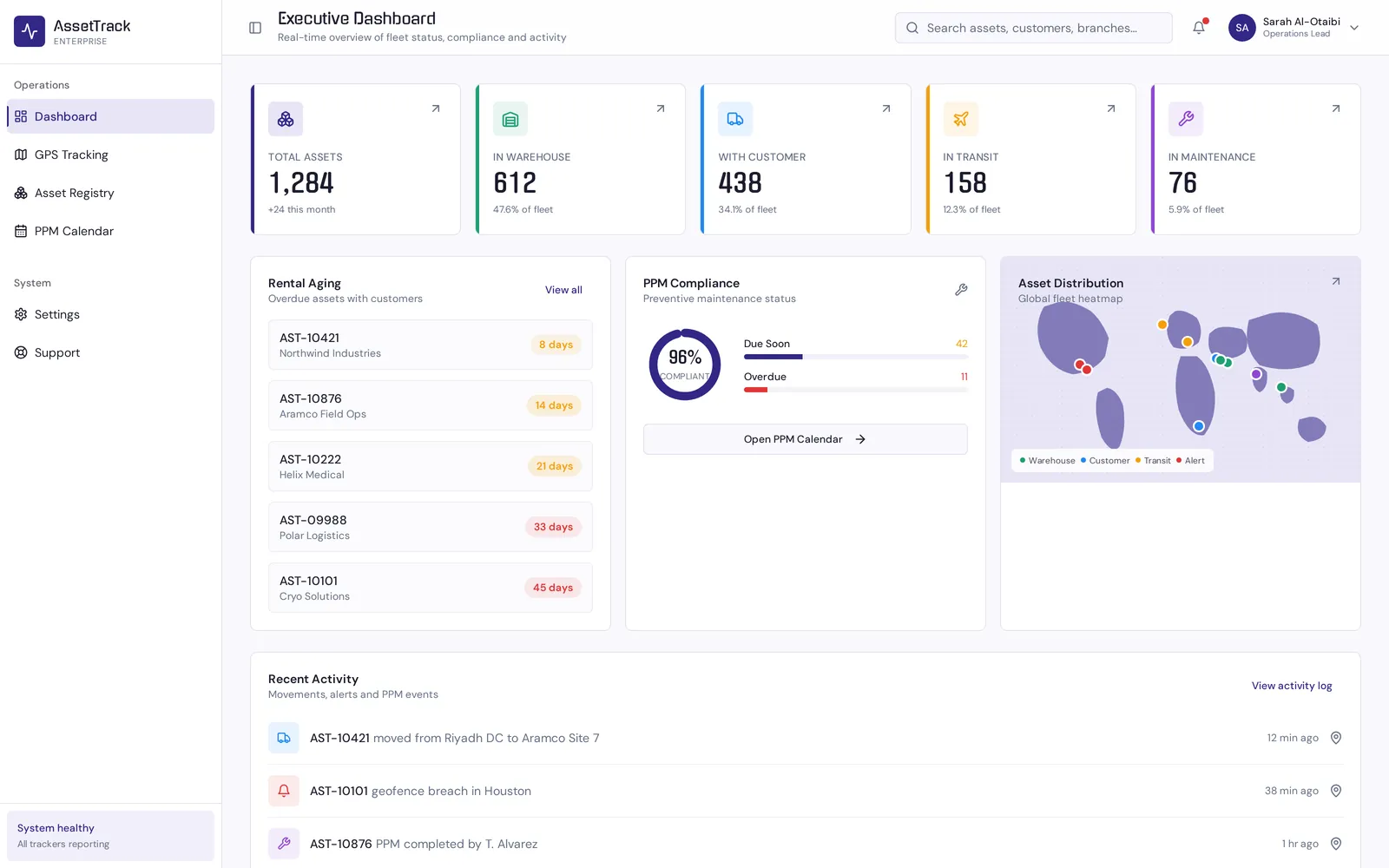
An executive layer above asset tracking. Fleet totals split by warehouse, customer, transit and maintenance, rental aging that surfaces units overdue with a customer, preventive maintenance compliance and a distribution map with an activity feed of movements and alerts.
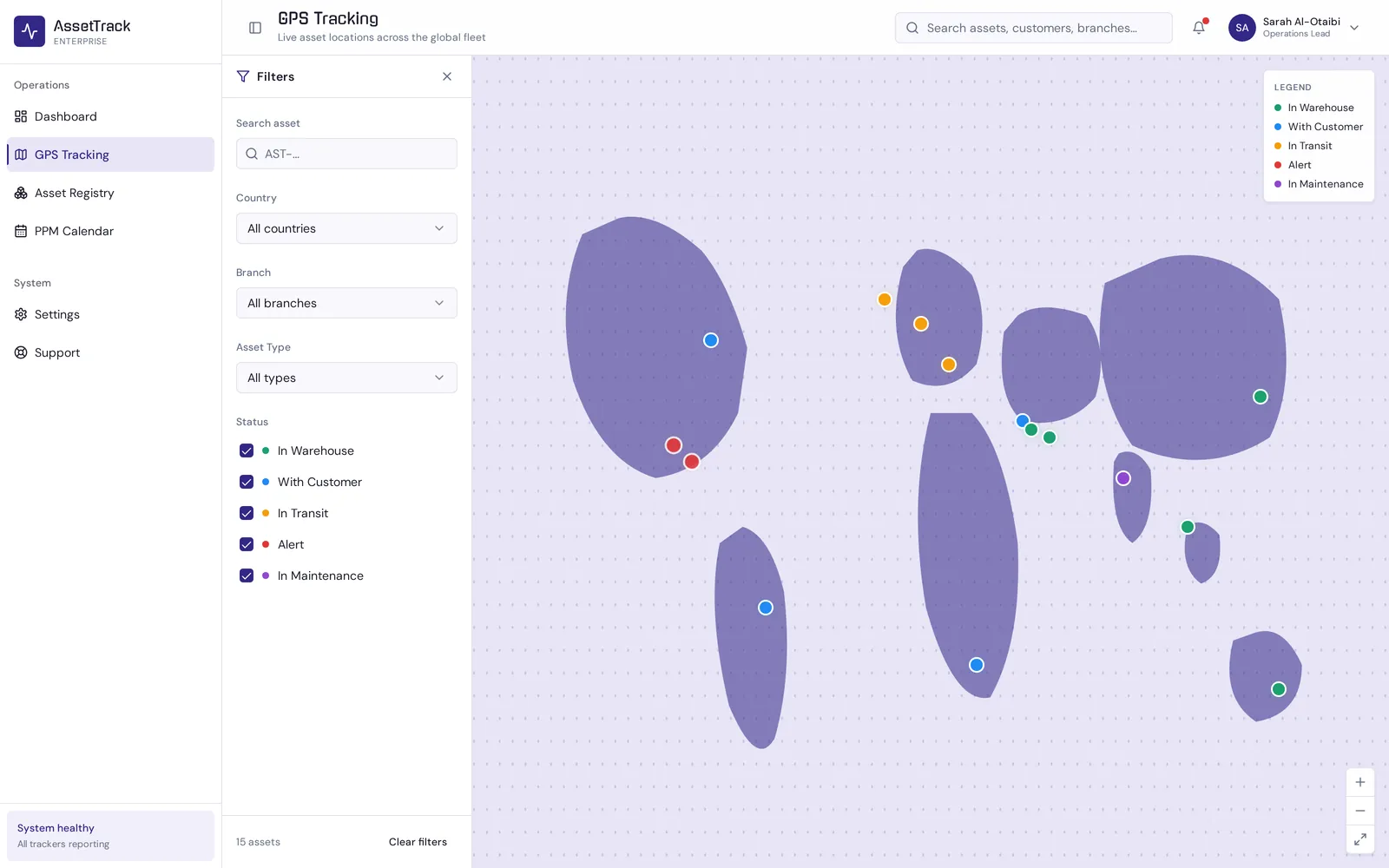
GPS and geofence monitoring
Position, last report time and geofence state per tracked unit, with the map and the list kept in step so a dispatcher can move from a map pin to the asset record in one click.
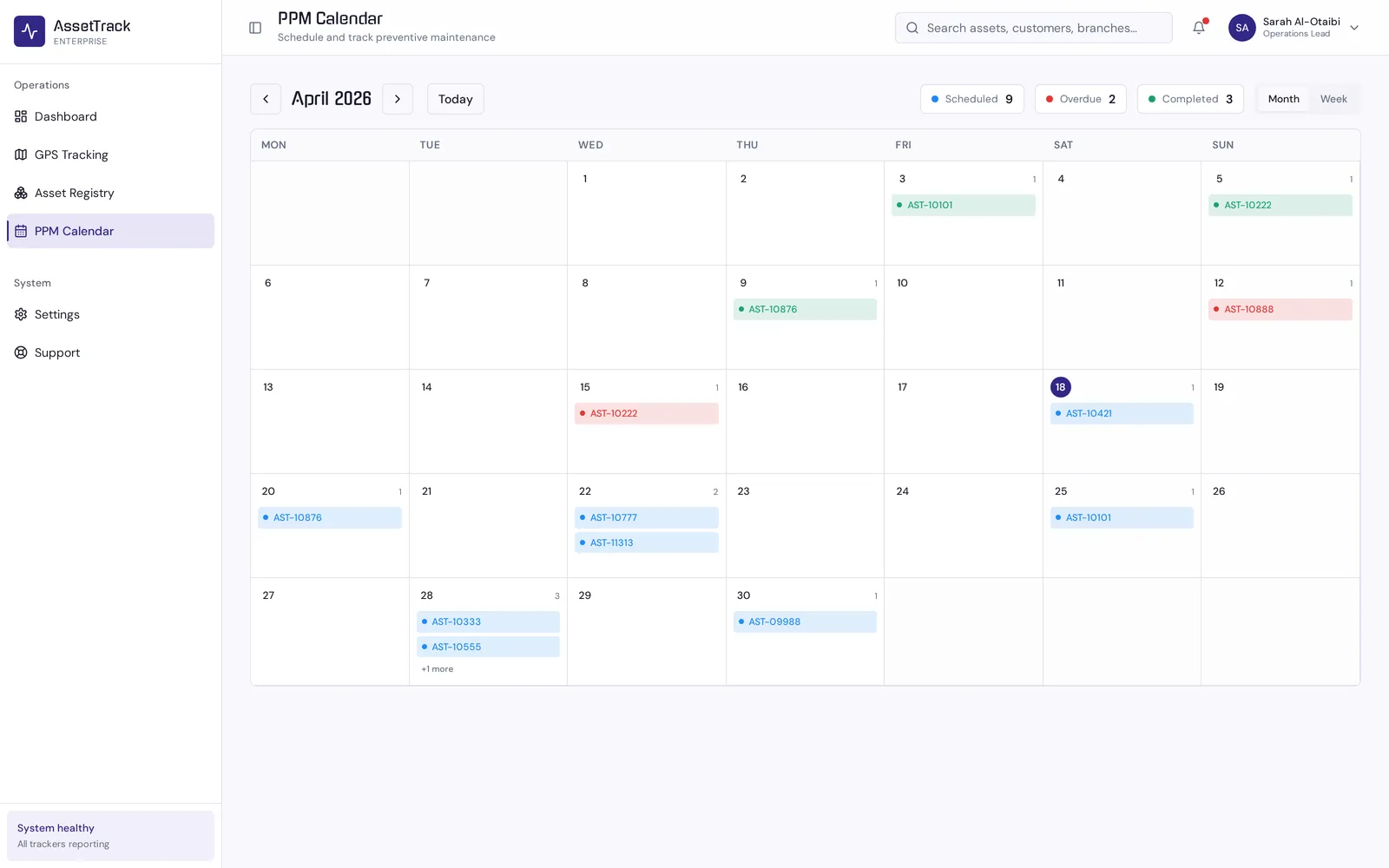
Planned maintenance scheduling
Preventive maintenance planned per asset class, with due and overdue work visible to the team that has to resource it, and completion recorded against the asset history.
Further platform builds covering delivery and project execution, sub metering with monthly billing and facility operations are available for review during a technical session.
Customisation
Customisation is not a theme colour and a logo. These are the parts of the platform we design with your engineers, and they are the reason the result matches the operation.
Asset hierarchies, site and zone structures, meter registers, event types and status values are defined with your engineers so every record matches how the operation is actually run.
Operator, supervisor, engineer, executive and tenant views are designed separately, each with the fields, filters and actions that role needs and nothing else.
Alarm routing, escalation timers, approval steps, permit flows and work order creation follow your procedures, including sign off requirements and audit needs.
Gateways, meters, cameras and controllers feed in through MQTT, Modbus, OPC-UA or REST, while CMMS, MES, ERP, billing and BI tools are connected through documented interfaces.
Operational, compliance and billing reports are built to the format your teams and regulators already accept, with scheduled delivery and API access.
Cloud hosted, on premise or hybrid, single tenant or multi tenant with parent and child accounts, decided by data residency, latency and commercial model.
Capabilities
A single platform that consolidates machine data, workflows, and enterprise systems for real‑time insight.
Custom-built around your KPIs, processes, and existing CMMS/MES/ERP landscape.
Transforms legacy operations into connected, data‑driven environments without disrupting existing systems.
Designed to support manufacturing, utilities, smart infrastructure, and complex multi‑site operations.
Leverages sensor data, machine learning, and historical trends to prevent downtime and optimize performance.
Built with robust security, access control, and compliance standards suitable for industrial and government environments.
Reference architecture
The same six layers appear in every build. What changes per client is the data model, the rules, the screens and the systems connected at each end.
Device and system connectors accept MQTT with Sparkplug payloads, Modbus and M-Bus through gateways, OPC-UA from plant systems, REST and file drops from business systems.
Time series storage for readings and events, relational storage for assets, people and documents, and object storage for images, clips and attachments.
Validation, unit conversion, derived values, thresholds, rate of change rules, anomaly detection and model scoring run per asset class with results written back as events.
Role based screens, maps, schedules, work queues, evidence views and report builders, delivered as a responsive web application with a mobile friendly field view.
Outbound interfaces to CMMS, MES, ERP, billing and BI platforms, with retry handling, message logs and reconciliation views so nothing is lost silently.
Single sign on where required, role based access control, tenant isolation, encrypted transport and storage, and an audit trail of who changed what and when.
The field and edge side of this architecture is covered by our Industry 4.0 solutions and wireless technologies.
Delivery path
Six stages, each with an output you can review. Nothing is built before the data model and the interfaces are agreed in writing.
We map the operation, the systems in place, the reporting obligations and the decisions each role has to make. The output is a written scope with a data dictionary.
Asset structures, event types and integration contracts are agreed before any screen is built, so later changes do not break history or reporting.
Clickable screens are reviewed with the people who will use them daily. Layout, terminology and actions are corrected at this stage rather than after delivery.
The platform is built in increments, connected to field devices and business systems, and tested against the acceptance criteria written during scoping.
One site, zone or asset group runs in production while data quality, alert behaviour and report accuracy are verified against the real process.
The validated configuration is rolled out to remaining sites, with training, documentation, support and a periodic review of what the data is showing.
Tailored platforms are usually delivered together with smart city solutions, smart community and connected buildings and AI video analytics. They are in daily use across manufacturing, utilities and energy, logistics and smart cities.