
More meter data does not automatically produce better operational decisions. When readings are spread across devices, protocols and disconnected systems, an ami sub metering platform must do more than collect them. It needs to connect meters, communications and operational applications through a defined data flow.
Facility teams often face two related challenges: manual collection makes readings harder to use consistently, and unclear system boundaries complicate deployment and ongoing operations. A practical starting point is to identify where each reading originates, how it reaches the receiving system and which teams or applications use it.
This article explains the core platform components, from meters and communication networks to Head-End Systems and operational software. It also outlines what to define before deployment, including protocol support, data access and operational responsibilities. NET WIZARDS’ documented multi-utility AMI project provides a practical reference: it covered water and electricity metering, custom Head-End System integration, DLMS and M-Bus support, on-demand reading and OTA firmware updates. The aim is to show how a well-integrated platform can make consumption data more useful for energy optimization and operational efficiency.
Key Takeaways
- Separate the sub-meter’s role from the platform’s role: the meter measures consumption, while the platform organizes readings for operational use.
- Map the ami sub metering platform data path from field meters to the systems that use the readings, including each integration boundary.
- Compare manual collection, basic monitoring and AMI by how data moves and what work remains for operational teams.
- Plan deployment around utility scope, the installed meter inventory, protocol compatibility and the people who need to use the data.
- Use structured consumption data to identify opportunities for energy optimization and more efficient facility operations.
Table of Contents
- What an AMI Sub-Metering Platform Does for Facility Operations
- How AMI Architecture Moves Meter Data into Operational Systems
- AMI Sub-Metering Compared with Manual Reading and Basic Monitoring
- How to Plan an AMI Sub-Metering Deployment
- NET WIZARDS AMI Sub-Metering Platform in a Multi-Utility Context
What an AMI Sub-Metering Platform Does for Facility Operations
An ami sub metering platform brings together the equipment and software used to collect, communicate, organize and present data from utility sub-meters. A meter measures consumption at a defined point. The platform manages the readings so facility teams can review usage across separate areas, assets or utility flows instead of relying only on a site-wide total.
This distinction matters in multi-utility environments. Electricity and water readings may come from different meter types and follow different communication paths, yet operational teams need a coherent view of consumption. The platform provides the data-management layer. Its practical value depends on whether readings reach the workflows people use and remain connected to the metering points they represent.
The Advanced Metering Infrastructure (AMI) overview describes the broader relationship between meters, communications and information systems. The same principle applies to facility sub-metering: define each component’s responsibility and preserve the link between a reading and its source.
Meter, communications and platform responsibilities
Meter: Measures electricity or water consumption at a defined point.
Communications: Carries meter readings to the receiving system.
AMI platform: Receives and organizes readings for operational review and use.
How sub-metering differs from a single utility meter
A single utility meter provides an overall measurement at its connection point. Sub-meters add visibility inside a site, such as by recording electricity use for a particular area or water consumption on a separate branch. This detail can help teams compare consumption between operational zones and investigate where usage changes, rather than seeing only a combined total.
That visibility supports analysis, but it does not determine how costs are allocated or billed. Those outcomes depend on wider organizational processes, including how metering points are assigned, readings are validated and billing arrangements are applied. A clear meter register and defined responsibilities help prevent readings from becoming detached from the area or utility flow they represent.
Who uses AMI sub-metering data
Facility and building management teams can use organized readings to understand consumption patterns, review changes and identify areas for further investigation. Utilities and infrastructure operators can use the same approach to manage multiple metering points across a broader estate. The challenge is turning separate readings into information that supports consistent operational decisions. A documented data path and clear ownership help address it.
Better visibility can inform energy optimization by helping teams examine where and when electricity is used. Water data can support reviews of consumption across distinct flows. AMI does not guarantee a particular reduction. It provides structured information that teams can assess alongside operational requirements and use to guide action.
How AMI Architecture Moves Meter Data into Operational Systems
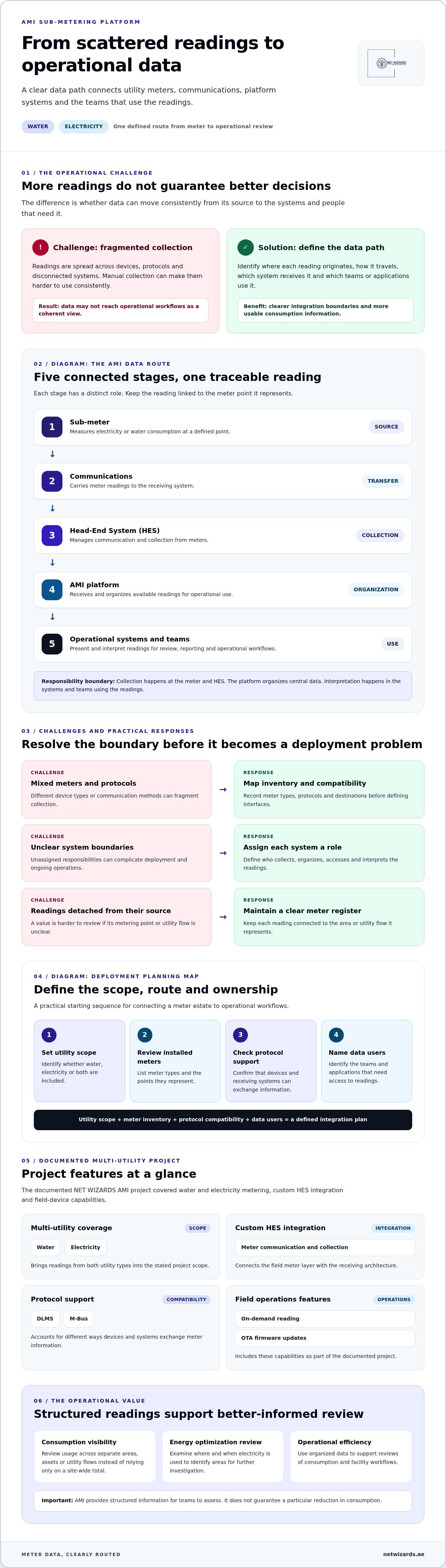
A useful AMI architecture defines a complete route for each reading, from its source in the field to the operational system where staff review it. The meter records consumption. A communications layer carries the reading, and a Head-End System (HES) manages communication with the meters. The platform organizes available data for operational workflows and reporting. Keeping these functions distinct makes integration boundaries easier to define and troubleshoot.
Protocol support is central to that route. Field devices and receiving systems need a compatible way to exchange meter information. NET WIZARDS’ documented multi-utility AMI project integrated water and electricity metering with a custom HES and support for DLMS and M-Bus. This illustrates why architecture must account for the actual devices and protocols in scope instead of assuming every meter communicates in the same way.
AMI data path
Sub-meter records consumption → Communications carries readings → Head-End System manages meter exchange → AMI platform organizes data → Operational dashboard presents information for review
Responsibility boundary: Collection happens at the meter and HES; the platform organizes central data; operational interpretation happens in the systems and teams using the readings.
Meters, communications and the Head-End System
The meter is the source of a consumption reading, but that reading becomes operationally useful only when the receiving architecture can identify and process it. Communications carry readings between field devices and the HES. The HES handles meter communication and collection, while protocol support governs how devices and systems exchange information. NET WIZARDS’ documented project included DLMS and M-Bus support as part of its custom HES integration.
A common challenge is a mixed meter estate. If devices use different communication methods or protocols, collection can become fragmented. Map each meter type, protocol and destination before defining the interfaces. This inventory can reveal compatibility gaps early and clarify which system is responsible for receiving each reading.
From platform data to operational visibility
Once the platform receives readings, it can organize them around the metering points and utility data included in the project scope. Dashboards and reports depend on that scope and on integration with operational applications. A display is useful only when teams can understand what each reading represents and how it relates to facility processes. For water operations, the EPA overview of AMI benefits discusses how improved data visibility can support utility management, including leak detection and water resource management.
Reading methods also need clear definition. On-demand reading means a user or workflow requests a reading when needed. It does not, by itself, mean readings are collected continuously or at a fixed interval. NET WIZARDS’ documented project included on-demand reading, so collection timing should be specified according to the intended operational use rather than assumed from the presence of a platform.
For an ami sub metering platform, this architecture links field data to operational decisions without conflating collection, management and reporting. Defining those interfaces is a practical starting point for an AMI integration discussion.
AMI Sub-Metering Compared with Manual Reading and Basic Monitoring
Choosing an approach is an operational decision, not a contest in which the most connected system is always best. The right fit depends on the number and distribution of metering points, how often teams need readings and whether consumption data must pass into other operational systems. Manual collection and basic monitoring can serve defined needs. An integrated AMI layer is more relevant when teams need readings organized across devices, utilities or workflows.
Installing meters alone does not create an integrated capability. Meters produce readings, but a defined method is still needed to collect, interpret and use them. Without that method, information may remain separated by device or require staff to transfer it between processes. Specify the intended data flow and operational owner alongside the meter inventory.
Comparison infographic: responsibility at each approach level
Manual reading: Staff access meters → record readings → transfer and review data
Basic monitoring: Meter data reaches a limited monitoring view → users review readings within that system
AMI: Compatible meters and communications feed a central platform → readings are organized for agreed operational workflows
When manual readings or basic monitoring may be sufficient
For a limited number of metering points and straightforward reporting needs, manual readings may be manageable if the team has a clear schedule, recording method and review process. Basic monitoring can suit teams that need visibility within a defined system but do not require broader integration. Neither approach is inherently unsuitable. The key is to account for the effort required to collect, check and distribute readings consistently.
As the scope grows, repeated handling can become a challenge: staff may spend more time consolidating data, and inconsistent records can make comparisons harder. Define who captures readings, how teams validate them and where the approved record is stored. This process can establish a baseline before a facility expands monitoring or connects additional systems.
What an integrated AMI layer adds
An ami sub metering platform adds a shared layer for receiving and organizing readings, subject to meter compatibility, protocol support and the integration scope. Where the required interfaces are implemented, it can connect collection with operational workflows and reduce reliance on separate data-handling steps. Protocol interoperability is a design requirement, not a universal guarantee. Assess the devices and receiving systems as part of the architecture.
This distinction matters in multi-utility environments. NET WIZARDS’ documented project connected electricity and water metering through an integrated AMI approach. The benefit is a shared operational context for reviewing different utility readings, not an assumption that both utilities use identical meters or communication paths. Teams can define which readings they need together and how each supports analysis.
Compare approaches against practical criteria before selecting a scope:
- Coverage: Number and distribution of metering points.
- Handling: Staff effort to collect, check and share readings.
- Integration: Systems and operational workflows that need the data.
- Compatibility: Meter protocols and communication paths included in the design.
This comparison keeps the decision grounded in operational requirements. Start with the process and data destinations, then determine whether manual collection, basic monitoring or an integrated AMI layer fits the facility.
How to Plan an AMI Sub-Metering Deployment
Plan deployment around the operating decisions it must support, not just the meters to be installed. A clear scope links utility coverage, the meter inventory, communications, the existing Head-End System (HES), reporting workflows and accountable users. This exposes integration dependencies before rollout and helps teams set realistic acceptance criteria. For an ami sub metering platform, define how each reading will move from its source to the people or systems that need it.
Start by documenting the current setup and the changes the deployment needs to make. Record the utility and location for each metering point, available device and protocol details, and the operational destination for readings. Include existing HES connections and reports in the architecture discussion. This prevents a platform from being scoped as a standalone dashboard when the requirement is to support an established facility workflow.
Define meters, utilities and integration requirements
Build an inventory of in-scope electricity, water and other utility metering points. For each, record its identifier, location, purpose and available communication or protocol information. Map protocols such as DLMS or M-Bus where applicable, and identify how data currently reaches the HES. Then document which operational systems need readings, who uses them and what reporting outputs support their work.
Keep performance expectations tied to project requirements. Specify the required reading method, data handling and reporting needs without assuming a universal collection interval or device capability. Acceptance criteria should describe what the integrated system must demonstrate, such as whether required readings reach the intended workflow in a usable form.
Resolve data and workflow challenges before rollout
Many planning risks appear at system boundaries. A challenge-to-response map helps project teams assign ownership before configuration and deployment begin.
- Disconnected readings: Define the target data path from meter through communications and HES to the platform. Assign responsibility for each interface and for resolving missing or unusable data.
- Mixed protocols: Document meter protocols and organize integration around the interfaces included in the project scope. This exposes compatibility questions early and reduces reliance on assumptions.
- Unclear reporting needs: Identify the operational users, the decisions they make and the views or reports that support those decisions. Align access and presentation requirements with the intended workflow.
- Existing HES or reporting dependencies: Map current connections and outputs before introducing new integrations. Define where data is managed and which system remains responsible for each operational function.
Deployment planning sequence
Utility scope → meter inventory → protocol and HES mapping → operational users and reports → integration tests against agreed requirements
This sequence makes the design reviewable and gives facility, technical and operational teams a shared basis for decisions. It also helps distinguish necessary integration work from features outside the stated need. Record assumptions and acceptance requirements together, then use them to guide implementation and handover.
NET WIZARDS AMI Sub-Metering Platform in a Multi-Utility Context
NET WIZARDS’ AMI Sub-Metering Platform is part of its facility management and industrial IoT offering, alongside its Industrial-grade IoT Cloud Platform. Its role is best understood through the documented integration work and operational scope. A multi-utility project brought water and electricity metering into one AMI context, addressing the practical need to manage different utility readings within a defined system architecture.
Documented multi-utility AMI deployment capabilities
The project combined dual water and electricity metering with custom Head-End System (HES) integration. DLMS and M-Bus protocol support formed part of its integration scope. These details describe a documented implementation; they do not mean that every meter, protocol or existing system connects universally without project-specific integration.
On-demand reading and OTA firmware updates were also included. On-demand reading supports requesting readings as needed in the project workflow, while OTA updates enable remote firmware updates as implemented in that deployment. These capabilities show why meter communication and device management should be considered alongside utility coverage when defining an AMI project.
In multi-utility settings, readings need to remain identifiable and useful across distinct metering systems. Match the meter and protocol scope to the intended HES and platform workflows. This clarifies where data is collected, how it is organized and what operational use the integration supports. It defines the implementation scope without assuming that platform functions eliminate the need to specify system interfaces.
Engineering depth behind the platform
NET WIZARDS has 20 years in business and in-house engineering capability. This supports its work across industrial IoT and facility management solutions. AMI engineering requirements can span field devices and software interfaces, with the implementation shaped around the metering environment and operational needs.
For facilities assessing a multi-utility approach, the documented project provides a practical reference: water and electricity metering, custom HES integration, DLMS and M-Bus support, on-demand readings and OTA firmware updates. These are specific elements of that implementation, not universal specifications for every project. Clear requirements help determine which integrations and functions suit a facility’s operating model.
Turn Metering Requirements into an Implementation Brief
Turn operational priorities into a practical project brief. Identify which decisions better consumption data should support, who will use the readings and which existing systems must receive them. Then define the boundaries: metering points in scope, data ownership, integration responsibilities and the conditions for accepting the completed deployment.
This discipline keeps an ami sub metering platform aligned with facility needs as the project moves from architecture to implementation. It also gives technical and operational teams a shared basis for handling changes, assigning responsibilities and assessing whether the delivered data supports the intended workflows. Treat the brief as a working reference, not a one-time procurement document, and update it when project scope or operational requirements change.
A clear starting point makes the next decisions more manageable. NET WIZARDS can discuss how your metering environment and integration objectives shape the project scope.
With defined requirements and accountable ownership, your team can move forward with greater clarity and a stronger foundation for operational use.
Frequently Asked Questions
What is an AMI sub-metering platform?
An AMI sub-metering platform manages data from utility sub-meters across connected equipment and software workflows. Its role extends beyond measuring consumption: it helps turn readings into records facility teams can use. Before defining a deployment scope, identify the meter points, the information users need and the systems that must receive it. Those requirements determine which platform functions and integrations are relevant.
How is AMI different from AMR?
AMR generally refers to automated meter reading, while AMI describes a broader arrangement of meters, communications and management systems. The terms may be used differently across projects, so define the required operating model in practical terms. For example, specify whether staff need readings collected automatically, centrally managed data or information passed into existing facility workflows. That scope provides a clearer basis for comparing solutions than labels alone.
Can an AMI platform combine electricity and water sub-metering?
Yes. A multi-utility system can present electricity and water readings in a shared operational environment when the meters, interfaces and integrations support the design. NET WIZARDS has a documented deployment covering both utilities. When planning a similar environment, preserve each meter’s identity and utility type in the data model. This lets users review information together without confusing distinct measurement points or treating the utilities as interchangeable.
How often does an AMI platform collect meter readings?
Reading frequency depends on the meter, communications arrangement and operational requirement. A facility reviewing consumption for routine management may have different needs from a team investigating a specific change in usage. Define whether readings are requested on demand or collected according to a planned schedule, then align the workflow with supported equipment. Do not assume that installing a platform means readings arrive continuously or at a particular interval.
Can an AMI platform work with existing meters and systems?
It can integrate with existing equipment when the meter interfaces, protocols and system architecture support the required data exchange. NET WIZARDS’ documented work includes DLMS and M-Bus support and custom Head-End System integration, demonstrating a project-specific integration scope rather than universal compatibility. Test representative meter connections and data transfers against agreed requirements before extending the design across the deployment.
How can AMI sub-metering data support energy optimization?
An ami sub metering platform can help operational teams examine consumption by metering point and identify patterns that warrant investigation. For example, a team can compare readings before and after a change to equipment schedules, then assess whether usage aligns with the intended operation. The data supports analysis, not guaranteed savings. Reliable conclusions depend on data quality, suitable comparisons and follow-through by the people responsible for energy management.