
An edge node in a SCADA system is best defined by its place in the data path and the work assigned to it, not by the length of its feature list. Choosing edge computing nodes for SCADA starts with three questions: what must happen near the equipment, what remains under PLC or RTU control, and what information needs to reach supervisory or cloud platforms?
It is reasonable to ask whether another layer will make integration and maintenance harder, or what happens to telemetry when a network connection drops. An edge node does not automatically replace a controller or guarantee uninterrupted data delivery. Its responsibilities depend on the architecture, configuration, and agreed operating requirements.
This article explains how an edge node fits between field devices and supervisory systems, which workloads may suit local processing, and how to assess protocol compatibility, cybersecurity boundaries, data buffering, and ongoing ownership before choosing hardware. It also shows how edge processing can support monitoring and operational insight without shifting control responsibilities or promising results the design cannot deliver.
Key Takeaways
- Define edge computing nodes for SCADA by their place in the data path and the specific processing tasks they need to perform.
- Map how field devices, PLCs or RTUs, edge nodes, SCADA systems, and optional cloud services exchange data before selecting hardware.
- Keep control responsibilities with the PLC or RTU assigned those duties by the validated system design. Treat edge processing as a separate, clearly bounded role.
- Plan for integration complexity and connectivity loss by checking interfaces, telemetry handling, failure modes, and support ownership before deployment.
- Compare Edge Computing Devices, AI Edge systems, and Industrial IoT gateways against deployment requirements. Verify protocol and software compatibility for the specific SCADA environment.
Table of Contents
- What Are Edge Computing Nodes for SCADA, and What Problem Do They Solve?
- How Do Edge Computing Nodes Fit into a SCADA Data Path?
- Edge Node vs PLC, RTU, Gateway, and Cloud: Where Does Each Fit?
- How to Plan SCADA Edge Deployment: Challenges, Checks, and Responses
- How NET WIZARDS Supports SCADA Edge Integration and Operational Insight
What Are Edge Computing Nodes for SCADA, and What Problem Do They Solve?
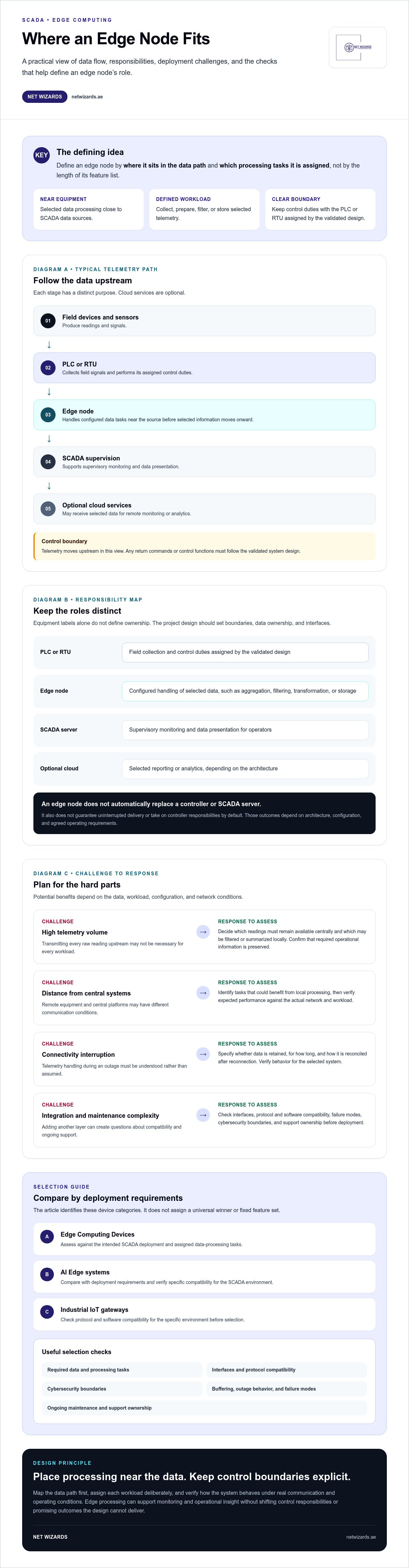
An edge node places selected data processing close to SCADA data sources. It can collect, prepare, filter, or store telemetry near equipment before selected information moves to supervisory systems or optional cloud services. The term describes a position and assigned workload in the architecture, not a fixed feature set. Supervisory control and data acquisition (SCADA) systems combine field data collection with supervisory monitoring. Distributed assets and growing volumes of telemetry can make the path to central systems harder to manage.
That distance can matter when teams need timely local visibility, handle large volumes of readings, or rely on communications links that may be interrupted. Edge processing can help organize data closer to its source. It complements an existing SCADA architecture; it does not automatically replace the SCADA server, PLC, or RTU, and it does not assume control duties that the validated design assigns elsewhere.
Diagram 1. A typical SCADA telemetry path
Field devices and sensors → PLC or RTU → Edge node → SCADA supervision → Optional cloud services
Telemetry moves upstream. Any return commands or control functions depend on the validated system design.
How Is a SCADA Edge Node Different from a SCADA Server?
An edge node is defined by its location near data sources and the processing tasks assigned to it, such as preparing telemetry for onward reporting. A SCADA server supports supervisory monitoring and data presentation, giving operators a view of system conditions. These roles can be separate or combined in some architectures. The project design should define their boundaries, data ownership, and interfaces rather than relying on equipment labels alone.
Which SCADA Challenges Can Edge Processing Address?
Edge processing can reduce the need to transmit every raw reading upstream, but whether that is useful depends on the data and workload. Local handling may also support timely access to selected information from distributed equipment. Neither benefit is automatic. Before deployment, confirm processing capacity, data requirements, communication behavior, and the effect on operator visibility.
- Challenge: High telemetry volume. Decide which readings must remain available centrally and which can be filtered or summarized locally. Check that the approach preserves information required for operations.
- Challenge: Distance from central systems. Identify tasks that benefit from local processing, then confirm expected performance under the actual network and workload conditions.
- Challenge: Connectivity interruption. Specify what happens to telemetry during an outage, including whether data is retained, for how long, and how it is reconciled after reconnection. Verify these behaviors for the selected system.
How Do Edge Computing Nodes Fit into a SCADA Data Path?
A SCADA telemetry path typically starts at a sensor or other field equipment. A PLC or RTU collects signals and performs the control duties assigned by the validated control-system design. An edge node can then handle selected data tasks before information reaches SCADA supervision. The SCADA system presents information for monitoring, while an optional cloud platform may receive selected data for remote monitoring or analytics.
Diagram 2. Typical data direction and processing points
Sensor or field equipment → Controller (field collection and assigned control) → Edge node (configured data handling) → SCADA (supervisory monitoring and presentation) → Optional cloud (selected reporting or analytics)
Connectivity boundaries: Confirm each interface between field equipment, controller, edge, SCADA, and cloud. Any return commands must follow the validated control-system design.
These stages have distinct purposes, even if a deployment combines some functions. Data collection acquires readings; protocol integration allows compatible systems to exchange them; local processing may aggregate, filter, or transform selected data; storage retains information according to the configured design; and upstream reporting forwards the required output. The IEEE reference for edge computing nodes can inform standards research, but it does not replace checking device documentation and integration requirements for the specific project.
What Data Should an Edge Node Process Locally?
Choose processing tasks to answer operational questions, not simply because a node offers a feature. Aggregation can summarize readings for a reporting interval. Filtering can limit routine values sent upstream while preserving exceptions. Event handling can identify conditions that require attention, and format conversion can prepare data for a downstream consumer. Each task depends on the selected system’s supported functions and must preserve information SCADA operators need.
- Reporting volume: Would a summary meet the requirement, or must SCADA receive each reading?
- Operational events: Which conditions should be forwarded, and how will operators see them?
- Data exchange: What format does each receiving system require?
How NET WIZARDS Supports SCADA Edge Integration and Operational Insight
Before selecting an edge node, inventory field protocols, physical interfaces, data consumers, existing gateways, and each network boundary. NET WIZARDS L.L.C states that its Industrial-grade IoT Cloud Platform supports MQTT, Modbus, NB-IoT, LoRaWAN, TCP, and UDP. These are platform capabilities, not confirmation that every edge device supports them. Verify protocol and interface compatibility for the specific hardware, SCADA software, and deployment.
For a planned SCADA data path, discuss edge integration requirements after documenting the systems, data flows, and interfaces that need validation.
Edge Node vs PLC, RTU, Gateway, and Cloud: Where Does Each Fit?
These components may exchange data, but they do not have interchangeable responsibilities. Define each role by the work the system requires, its location in the architecture, and its boundaries with other components. This helps prevent an edge node from being treated as a controller or a gateway from being assumed to provide local processing.
| Component | Primary role | Typical data responsibility | Integration boundary |
|---|---|---|---|
| PLC or RTU | Field control and data acquisition as assigned by the engineered design | Reads field signals and performs defined control functions | Interfaces with field equipment and the systems receiving its data |
| Edge node | Selected processing near data sources | May prepare, filter, aggregate, or store telemetry if supported and configured | Receives data from defined sources and passes selected outputs to consumers |
| Gateway | Connectivity or protocol integration | May transfer or convert data between compatible interfaces | Bridges specified devices, networks, or protocols |
| SCADA server | Supervisory monitoring | Supports system monitoring, data presentation, and related supervisory functions | Connects controller and edge data to operator-facing SCADA functions |
| Cloud platform | Centralized services | May support remote monitoring, analytics, or integration, depending on design | Receives selected data through defined network and application interfaces |
A single device may combine gateway and edge functions or provide other capabilities. Its label alone does not confirm that it supports the required protocols, workload, environmental conditions, or operational boundaries. Check functions against product documentation and validate each interface in the deployment.
When Should Control Stay with a PLC or RTU?
Keep control-loop decisions with the PLC or RTU assigned those duties by the validated control-system design. An edge node may provide data for supervisory analytics, but analytics and monitoring are not substitutes for engineered control functions. If a change would move or add control responsibility, assess its functional behavior, operational impact, and failure response, then validate it within the control architecture before implementation.
When Is an Edge Node More Relevant than a Gateway or Cloud Service?
Choose the component that fits the requirement. A gateway suits a defined connectivity or protocol-conversion need. An edge node is more relevant when the system requires supported local data handling, such as preparing telemetry before onward reporting. A cloud service suits centralized monitoring, analytics, or integration requirements. Some deployments need more than one component, but each addition creates interfaces and ownership that need to be documented and validated.
For example, if a remote asset sends data in a format the SCADA environment cannot consume, first determine whether protocol conversion alone resolves the issue. If local aggregation is also required, assess that edge workload separately and confirm it will not remove readings needed for supervision. This requirement-led approach makes edge computing nodes for scada easier to evaluate without confusing data processing with control.
How to Plan SCADA Edge Deployment: Challenges, Checks, and Responses
Plan the deployment around operational requirements, not the edge device specification alone. For edge computing nodes for SCADA, define the intended data path, the interfaces involved, and the behavior operators should expect in normal and degraded conditions. Resolve ownership before commissioning so integration, maintenance, and recovery tasks do not fall between teams.
- Step 1: Define the use case. State the operational question the node must address, such as preparing selected telemetry for reporting. Challenge: an unclear use case can create unnecessary processing and interfaces. Response: specify required inputs, outputs, timing, and who uses the resulting data.
- Step 2: Map the architecture. Document field devices, PLCs or RTUs, gateways, the edge node, SCADA, and any cloud services. Mark data direction and boundaries. Challenge: overlapping responsibilities can complicate fault diagnosis. Response: assign each component and team a defined role.
- Step 3: Check interfaces. Inventory protocols, hardware interfaces, data formats, and existing gateway functions. Challenge: assumed compatibility can block integration. Response: verify the proposed configuration and each SCADA integration against relevant product documentation and system requirements.
- Step 4: Assess failure modes. Consider loss of the central connection, device restart, invalid or delayed data, and reconnection. Challenge: teams may have different assumptions about missing telemetry. Response: document expected behavior and assign recovery decisions before choosing a node.
- Step 5: Validate operation. Test representative workloads and document results, fallback behavior, and commissioning acceptance. Review who controls access, handles data, applies patches, monitors the edge environment, and leads recovery. Challenge: support ownership may be unclear after handover. Response: name responsible parties and record procedures.
Diagram 3. Normal and degraded data paths
Normal: Field equipment → Controller → Edge node → SCADA → Optional cloud
Central connection lost: Field equipment → Controller → Edge node → Central path unavailable
Reconnection: Edge node → SCADA or cloud, according to configured and verified behavior
Test: Confirm what data is collected, whether local storage or store-and-forward is required, how reconnection is handled, and what operators can observe. Do not assume retention, recovery, or uninterrupted control without verified specifications.
What Happens If Connectivity to the Central System Is Lost?
Ask whether the use case needs local collection or store-and-forward during a disconnection. Define which data matters, what the system should do while offline, and how it should behave when communication returns. Verify these functions for the selected hardware and configuration. A network interruption does not prove that data will be retained or control will continue unchanged.
Which Integration and Lifecycle Risks Should Teams Resolve?
Document protocol compatibility, commissioning responsibilities, access ownership, data handling, patching, monitoring, and recovery procedures. Test representative operating conditions, including the agreed connectivity-loss scenario, and record fallback behavior. This reduces uncertainty during handover and gives operations teams a clear basis for maintaining the edge environment.
How NET WIZARDS Supports SCADA Edge Integration and Operational Insight
A practical SCADA edge design starts with the existing system, not a product label. NET WIZARDS L.L.C supplies Edge Computing Devices, AI Edge systems, Industrial IoT gateways, and Industrial IoT sensors, gateways, and protocol converters. These product categories can help teams assess where data originates, how it needs to move, and whether local processing or protocol integration belongs in the architecture. They do not, by themselves, confirm that a specific device supports a required workload or interface.
NET WIZARDS L.L.C also provides an Industrial-grade IoT Cloud Platform. Its stated protocol support includes MQTT, Modbus, NB-IoT, LoRaWAN, TCP, and UDP. Confirm compatibility for the selected hardware and SCADA deployment rather than assuming that platform support applies to every edge node. NET WIZARDS L.L.C has 20 years in business and capabilities in industrial networking and multi-protocol integration.
What Should Buyers Confirm Before Selecting an Edge Solution?
Set the evaluation criteria before comparing devices. Document the workload, required protocols and interfaces, environmental needs, data consumers, and ownership boundaries. Then request confirmation of each capability for the specific device and configuration. A product category is a starting point, not a specification. If standard options do not fit, discuss project requirements with the engineering team before considering a tailored solution.
- Workload: Identify what the node must do and what remains with the PLC or RTU.
- Compatibility: Verify interfaces, protocol support, and integration with the existing SCADA environment.
- Operations: Agree who manages access, data handling, updates, and recovery after commissioning.
How Can an Integrated Approach Support Operational Benefits?
Aligning sensors, gateways, protocol converters, edge processing, and cloud requirements can give project teams a clearer view of data flows and integration responsibilities. Depending on the validated design, this foundation may support objectives such as operational efficiency, predictive maintenance, energy optimization, or enhanced safety. These are project goals, not guaranteed results. Their value depends on suitable data, correctly scoped workloads, compatible systems, and how operators use the information.
NET WIZARDS’ solution categories can inform an engineering review of the existing SCADA environment and the requirements for edge computing nodes for scada. Confirm specific device capabilities and protocol integration before finalizing the design.
Build an Edge Design Around Your SCADA Requirements
Effective edge deployment begins with clear boundaries. Keep control responsibilities with the PLC or RTU assigned by the validated design, define the edge node’s data-processing role, and confirm how telemetry moves between field equipment, SCADA, and any cloud services. Check interfaces, data handling during connectivity loss, and ongoing support ownership before choosing hardware.
The value of edge computing nodes for scada depends on the workload and the architecture they must fit. Local processing may support more focused reporting and operational insight, but benefits such as predictive maintenance or energy optimization remain project objectives, not automatic outcomes.
NET WIZARDS L.L.C has 20 years in business and provides Industrial IoT sensors, gateways, and protocol converters, as well as Edge Computing Devices and AI Edge systems. These categories can inform integration planning, with each device’s specific capabilities verified against deployment requirements.
With a defined data path and validated responsibilities, your team can assess edge integration with greater clarity and confidence.
Frequently Asked Questions
What is an edge computing node in a SCADA system?
An edge computing node is a device or computing resource that handles selected data tasks near SCADA data sources. Depending on its verified capabilities and configuration, it may prepare, filter, aggregate, or store telemetry before selected information moves to SCADA or another platform. Its role is defined by its location and assigned workload, not its product label. It does not automatically replace a SCADA server, PLC, or RTU.
How does edge computing work with SCADA?
Edge computing works alongside SCADA by processing selected data closer to field equipment. A typical data path sends readings from sensors to a PLC or RTU, then to an edge node and SCADA supervision. Optional cloud services may receive selected information for centralized monitoring or analytics. The exact arrangement depends on the project architecture. Define data direction, processing responsibilities, and interfaces, and keep control functions aligned with the validated design.
Can an edge node replace a PLC or RTU?
An edge node should not be assumed to replace a PLC or RTU. The controller performs the control duties assigned by the engineered control-system design, while an edge node typically handles selected data processing. A device may combine functions, but its label alone does not establish suitability for control. Any proposed change to control responsibilities requires functional and operational assessment, confirmation of device capabilities, and validation within the control architecture.
What happens to SCADA data if connectivity is lost?
Data handling during a connection loss depends on the selected system and its configuration. An edge node might continue local collection or store data for later forwarding only if the device supports those functions and the design enables them. Before deployment, define what data is required during an outage, what should happen after reconnection, and how operators will identify missing or delayed information. Verify retention and recovery behavior. Do not assume it.
Which protocols should a SCADA edge node support?
The node should support the protocols and interfaces required by the connected field devices, controllers, SCADA software, and downstream platforms. Inventory existing protocols and gateway roles, then verify compatibility for the specific hardware and deployment. NET WIZARDS L.L.C states that its Industrial-grade IoT Cloud Platform supports MQTT, Modbus, NB-IoT, LoRaWAN, TCP, and UDP. That platform support does not confirm that every edge node supports those protocols.
Does edge computing improve SCADA system security?
Not automatically. An edge node adds another component and connection to assess, so its security effect depends on architecture, configuration, and ongoing management. Review network boundaries, access controls, data handling, patching responsibilities, and recovery procedures as part of a layered security approach. Confirm how the node connects to controllers, SCADA, and cloud services, and assess the risks of each interface before deployment.
How do I choose an edge computing node for SCADA?
Choose a node against a documented use case, not a feature list. Specify the data tasks, required protocols and interfaces, environmental conditions, connectivity-loss behavior, and ownership responsibilities. Confirm each capability for the exact device and configuration, then test representative operating conditions and document fallback behavior. For edge computing nodes for SCADA, also establish how the node fits with existing PLCs or RTUs, gateways, SCADA supervision, and any cloud services.