
A nominal 75°C rating on a spec sheet won't protect mission-critical telemetry when direct solar radiation turns a sealed field cabinet into an oven. Component-level thermal dissipation, not the ambient label on the box, determines whether your high temperature industrial router survives severe thermal stress or drops offline during peak mid-day heat spikes.
If you deploy remote telemetry across unconditioned outdoor environments, you already know the operational headache of heat-induced packet loss. Thermal throttling degrades cellular throughput right when operations demand uninterrupted visibility, while relentless ambient heat destroys capacitors and accelerates silicon degradation. Solving this operational vulnerability requires moving past generic marketing claims to address how internal layouts handle localized heat generation.
This engineering guide details the architectural, electrical, and thermal engineering specifications required to maintain continuous telemetry in extreme operating environments. You'll explore component derating curves, structural heat sink designs, and physical layout criteria to deploy industrial 4G and 5G routers capable of continuous uptime under punishing thermal conditions.
Key Takeaways
- Continuous field operations demand a verified high temperature industrial router rated to sustain unthrottled routing performance above +70°C.
- Passive, fanless cooling using heavy extruded aluminum chassis eliminates mechanical failure risks while conducting heat away from sensitive silicon.
- Outdoor enclosure thermal derating must factor in solar radiation spikes that drive sealed cabinet internal temperatures 20°C to 30°C above ambient levels.
- Strategic DIN rail layout, including dedicated vertical convection spacing and locating communication nodes below power supplies, prevents localized thermal trapping.
- Enterprise deployments require independent test certification up to +85°C and dual-SIM cellular failover to guarantee uninterrupted telemetry under extreme environmental stress.
Table of Contents
- Thermal Realities: Defining the High Temperature Industrial Router Standard
- Core Hardware Architecture: Engineering for Extreme Ambient Thresholds
- Enclosure Physics and Thermal Derating in Unconditioned Cabinets
- Deployment Framework: Integrating Cellular Routers in High-Heat Telemetry Nodes
- Enterprise Hardware Selection: Specifying Mission-Critical Industrial Routers
Thermal Realities: Defining the High Temperature Industrial Router Standard
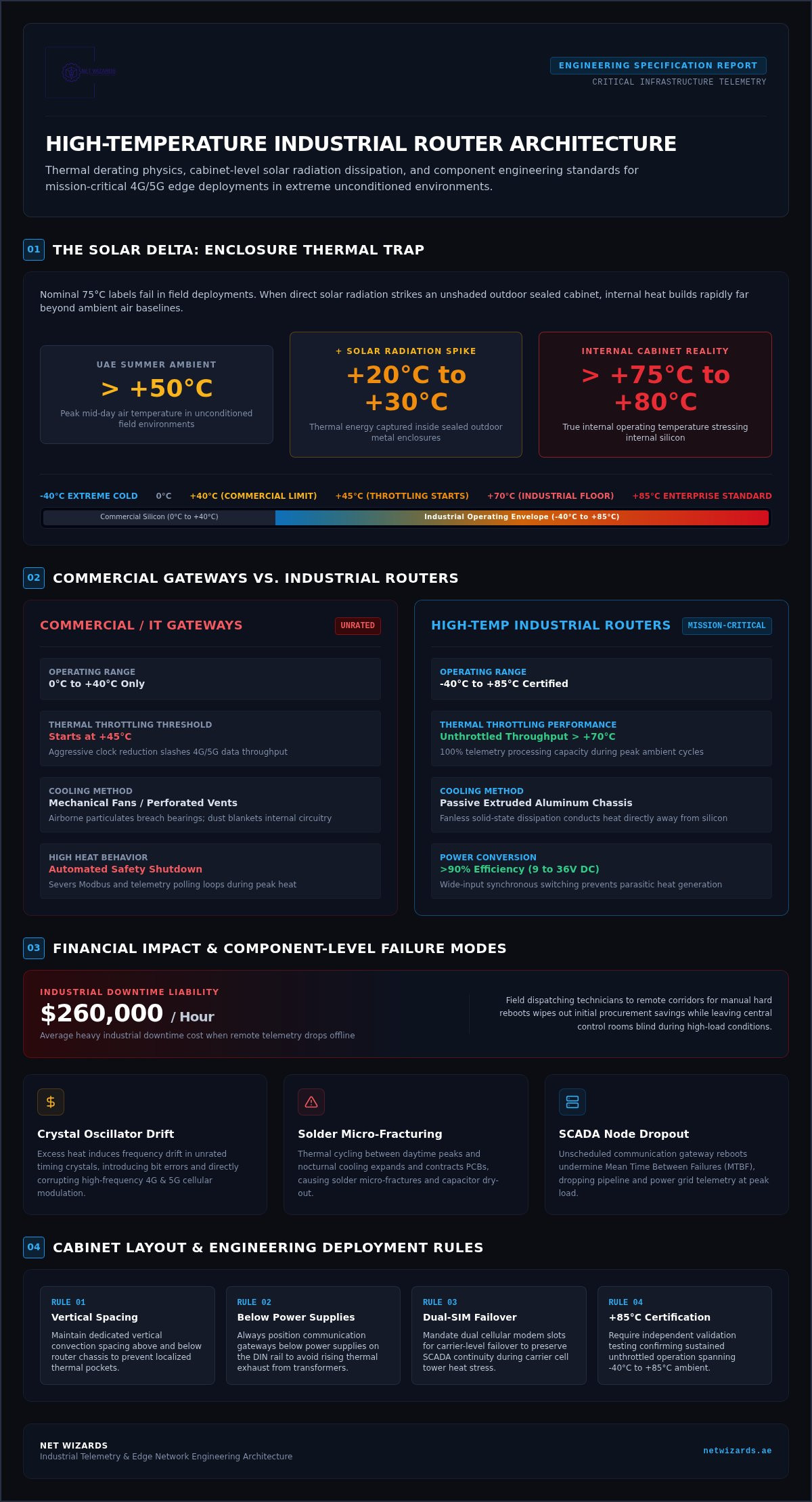
Operating temperature ratings printed on commercial datasheets represent laboratory baselines, not survivable field conditions. A true high temperature industrial router must maintain continuous full-throughput routing at temperatures exceeding +70°C without shedding active cellular interfaces or triggering safety restarts. In harsh desert installations across the United Arab Emirates, ambient air temperatures frequently surpass +50°C during peak summer months. When solar radiation strikes an unshaded, sealed metal enclosure, internal cabinet temperatures quickly exceed +75°C, transforming basic communication hardware into an immediate single point of failure.
Surviving these conditions demands robust thermal derating protocols where internal silicon operates well within safe structural thresholds despite external thermal saturation. Deployments across mission-critical utility, transport, and energy networks mandate full operational validation spanning from -40°C to +85°C. Without this wide operating envelope, thermal degradation directly undermines the Mean Time Between Failures (MTBF) of remote SCADA nodes, causing unscheduled communication dropouts precisely when electrical distribution networks or pipeline assets experience maximum load.
Operational Thresholds: Commercial Versus Industrial Thermal Tolerances
Commercial network gateways rely on consumer-grade silicon rated exclusively between 0°C and +40°C. Once surrounding ambient air hits +45°C, commercial units initiate aggressive processor throttling to limit power dissipation, slashing data throughput. Industrial routers, by contrast, use semiconductor dies and passive circuit traces designed for sustained operation up to +85°C ambient, preventing core junction temperatures from exceeding safety limits.
- Clock Stability: Excessive heat induces crystal oscillator drift in unrated components, introducing bit errors and corrupting high-frequency 4G and 5G cellular modulation.
- Polling Integrity: Commercial hardware triggers automated thermal shutdown sequences under extreme heat, severing Modbus and telemetry polling loops.
- Sustained Throughput: Industrial processors process edge telemetry at 100% capacity without thermal throttling during peak ambient load cycles.
The True Cost of Thermal Failure in Critical Infrastructure
Hardware failure in remote environments carries compounding operational penalties. With the average cost of industrial downtime reaching $260,000 per hour across heavy industrial sectors, sudden communication loss across remote infrastructure becomes an immediate financial liability. Field dispatching technicians to remote utility corridors for manual hard reboots instantly wipes out any initial savings achieved by procuring low-cost networking equipment.
Worse still, telemetry blackouts leave central control rooms blind during high-stress conditions when grid or pipeline monitoring is critical. Relentless thermal cycling between daytime peaks and nocturnal cooling expands and contracts printed circuit boards. This mechanical expansion promotes solder joint micro-fracturing and accelerates capacitor dry-out, resulting in persistent packet loss, intermittent gateway reboots, and premature capital equipment replacement.
Core Hardware Architecture: Engineering for Extreme Ambient Thresholds
Mechanical cooling fans guarantee system breakdown in desert environments. Airborne particulates quickly breach fan bearings, while fine dust builds insulating blankets across internal circuitry that trap thermal energy. Eliminating these vulnerabilities requires a completely fanless architecture. In an enterprise-grade high temperature industrial router, heat mitigation shifts entirely to solid-state passive dissipation, relying on structural thermal conduction rather than forced air movement.
High-efficiency power management stages further reinforce this architecture. Stepping down industrial voltages (typically 9 to 36V DC) generates parasitic heat if handled by inefficient linear regulators. Industrial routing platforms implement wide-input synchronous switching topologies yielding over 90% power conversion efficiency. This directly suppresses internal thermal waste before it stresses neighboring communications processors.
Fanless Conduction Cooling and Enclosure Thermodynamics
Heavy extruded aluminum housings serve a dual operational purpose: physical chassis protection and primary thermodynamic heat sink. High-conductivity thermal interface pads couple system-on-chip processing dies and cellular basebands directly to the interior casing wall. External chassis surfaces feature extruded convection fins oriented vertically. This structural fin geometry harnesses natural convection currents within sealed cabinets, drawing thermal energy outward without introducing mechanical failure risks.
Industrial Component Selection: Solid Electrolytes and Wide-Temp Silicon
Standard liquid electrolytic capacitors represent the most vulnerable failure point in high-heat electronics. Constant exposure to internal cabinet temperatures above +60°C vaporizes wet electrolytes, altering capacitance values and inducing sudden board reset loops. As outlined in historical high-temperature electronics research, sustained thermal margins require component chemistry engineered to resist dielectric breakdown.
- Polymer Solid Capacitors: Solid-state conductive polymer and tantalum capacitors eliminate liquid evaporation, retaining baseline filtering characteristics across decades of thermal stress.
- Hardened Cellular Modems: Industrial RF front-ends maintain stable transmit power without thermal throttling or dropped carrier aggregation channels.
- Automotive-Grade Silicon: Core processing units retain clock synchronization without silicon leakage currents disrupting kernel threads.
PCB Layering and Thermal Vias for Internal Heat Dissipation
Thermal management begins on the printed circuit board itself. Standard commercial boards rely on two or four substrate layers that isolate thermal pockets around the central processing core. Ruggedized industrial routers leverage multi-layer boards embedded with dedicated two-ounce copper distribution planes. Dense matrixes of plated thermal vias sit directly beneath high-wattage components, shunting heat vertically into internal ground planes to distribute energy evenly across the full surface area.
Thoroughly sealed units also feature thick conformal coatings. This protective barrier seals micro-soldered leads against accelerated oxidation and environmental condensation during rapid nocturnal cooling cycles. For engineering teams deploying mission-critical utility links, evaluating specialized industrial networking equipment engineered specifically for severe operational climates remains essential to ensure infrastructure longevity.
Enclosure Physics and Thermal Derating in Unconditioned Cabinets
Weather forecasts measure shaded ambient air, but communications equipment lives inside sealed metal boxes exposed to punishing solar flux. In typical desert deployments across the country, ambient air temperatures reaching +50°C represent only the baseline. Direct solar radiation absorption routinely drives internal cabinet temperatures 20°C to 30°C higher than the surrounding atmosphere. An unshaded carbon steel or dark polyester enclosure easily reaches internal sustained temperatures past +75°C. Specifying a high temperature industrial router based on local meteorological data rather than internal enclosure physics guarantees field failures during peak sun hours.
Calculating Total Thermal Load: Ambient, Solar, and Internal Dissipation
Engineering reliable cabinet deployments requires balancing heat input against available passive surface dissipation. Calculate the total enclosure heat load using the thermal balance equation:
Q_total = P_internal + (α × A_roof × S) - (U × A_total × ΔT)
Here, P_internal represents internal electrical wattage converted to heat, including parasitic losses from neighboring switch-mode power supplies; α is the enclosure exterior solar absorptivity; A_roof is the irradiated surface area; S is peak solar irradiance (often exceeding 1,000 W/m²); and U is the overall heat transfer coefficient across total cabinet area A_total. Because sealed IP66 enclosures permit zero air exchange, internal heat from adjacent power supplies compounds direct solar gain. Omitting solar radiation from this thermodynamic equation leaves processors heat-soaked, forcing severe packet drops.
Mitigating Enclosure Heat Without Power-Hungry Air Conditioning
Deploying active compressor-driven air conditioning units introduces catastrophic maintenance overhead in remote environments. Active coolers demand substantial electrical power, and fine airborne silt quickly clogs intake filters, causing compressor lockouts. Passive thermal mitigation provides far superior lifecycle reliability:
- Solar Radiation Canopies: Installing external aluminum sunshields with a 50 mm convective air buffer blocks direct UV exposure, drastically suppressing radiative thermal loading on the enclosure body.
- Double-Walled Architecture: Dual-skin cabinets utilize solar chimneys, where heated air between wall layers rises and vents out the top, drawing cooler air upward naturally.
- Thermal Decoupling: Isolating internal mounting plates prevents conductive heat transfer from outer cabinet skins to delicate communication components.
Combining passive enclosure shielding with an enterprise-grade high temperature industrial router certified for continuous +85°C execution eliminates the need for active cooling, securing round-the-clock SCADA uptime across national infrastructure corridors.
Deployment Framework: Integrating Cellular Routers in High-Heat Telemetry Nodes
Physical mounting practices and cable routing dictate whether hardened communications hardware delivers on its engineering rating. Even the most capable high temperature industrial router will experience performance degradation if improper cabinet integration restricts airflow or subjects RF transmission lines to unchecked solar breakdown. Executing a resilient installation requires disciplined thermal zoning across the entire enclosure layout.
DIN-Rail Placement and Convection Clearance Guidelines
Densely packed DIN rails create localized thermal traps. Maintain a minimum of 25 mm lateral clearance between adjacent devices to preserve vertical natural convection channels along the router's heatsink fins. Mount the chassis strictly within its tested operational orientation; mounting an industrial unit horizontally when engineered for vertical heat sinking severely impedes airflow. Always locate high-wattage DC power supplies and solar charge controllers at the absolute top of the DIN rail so their rising thermal plume never washes over cellular gateways mounted above them.
Antenna Isolation and RF Cable Environmental Durability
External antenna runs experience direct solar radiation where exterior mast temperatures run significantly hotter than ambient air. Standard PVC-jacketed coaxial cables dry out and crack under continuous UV exposure, allowing moisture ingress that attenuates signal power.
- Jacket Material: Specify low-loss coaxial cabling with cross-linked polyethylene or PTFE jackets rated to +105°C to resist jacket embrittlement.
- Impedance Matching: Thermal expansion in poor-quality RF connectors changes internal tolerances, causing impedance mismatches and lost cellular packets.
- Surge Decoupling: Bond RF coaxial surge arrestors directly to a low-impedance external earth busbar outside high-heat enclosure pathways.
Software-Level Thermal Monitoring and Remote Diagnostic Architecture
Hardware durability must be reinforced with intelligent runtime supervision. Modern industrial firmware continuously polls on-die thermal sensors across the CPU and cellular baseband. Configure automated SNMP traps or MQTT telemetry packets to flag elevated temperatures to central operations before components approach safety thresholds. Dedicated hardware watchdog timers must independently supervise system processes, executing automated module power cycles if thermal stress locks up the cellular stack.
When extreme environmental heat causes transient cellular carrier degradation, firmware-level automated failover must transition traffic immediately to a secondary SIM carrier. To protect your remote operations against unexpected communication drops, deploy industrial 4G and 5G routers engineered specifically to deliver uninterrupted telemetry across demanding regional infrastructure.
Enterprise Hardware Selection: Specifying Mission-Critical Industrial Routers
Selecting communications hardware for desert-grade operational environments requires scrutinizing vendor claims against rigorous empirical validation. Procuring an enterprise high temperature industrial router can't be treated as an off-the-shelf IT transaction; it is a foundational infrastructure decision. Independent laboratory testing certificates must verify sustained packet processing under full processor and cellular load up to +85°C, ensuring the device won't degrade when internal cabinet temperatures peak.
Essential Hardware Specifications Checklist for Hostile Climates
Telemetry infrastructure operating across remote national corridors demands strict adherence to electrical and physical survivability baselines:
- Verified Thermal Tolerance: Insist on environmental test reports confirming continuous routing from -40°C to +85°C, rather than brief non-operational exposure limits.
- Ingress and Chassis Integrity: Specify heavy-gauge, extruded aluminum housings carrying an IP30 or IP40 rating to prevent fine sand infiltration while maintaining passive heatsink conduction.
- Electrical Protection: Require wide-range 9V to 36V or 48V DC power stages featuring integrated reverse polarity protection and transient surge suppression.
- Substation-Grade EMC Immunity: Verify electromagnetic compatibility compliance to prevent inductive surges and motor interference from corrupting data lines.
- Industrial Interface Density: Secure native RS-485 serial ports alongside Ethernet to maintain legacy Modbus RTU telemetry without adding external protocol converters.
Architectural Ownership and Regional Engineering Support
Hardware procurement must extend beyond spec sheets to include lifecycle accountability and local integration expertise. Sourcing hardware through established domestic engineering partners guarantees direct access to field-ready replacement stock and specialized technical support, avoiding lengthy international supply chain disruptions.
Tailored firmware builds ensure stable cellular handshakes, persistent VPN tunnels, and automated multi-carrier fallback across national private APNs. Engineering specialists can also evaluate enclosure thermodynamic dynamics before site commissioning, ensuring field cabinets dissipate total operational heat effectively. Review your mission-critical networking requirements with NET WIZARDS to deploy verified industrial communications infrastructure designed to endure regional environmental extremes.
Engineering Uncompromising Telemetry at Thermal Extremes
Sustained communication uptime under peak solar radiation demands an uncompromising approach to hardware physics. Nominal ambient labels won't protect unconditioned field nodes; continuous telemetry requires calculating enclosure heat loading, implementing fanless conduction thermodynamics, and enforcing strict cabinet convection clearance. Specifying an independently certified high temperature industrial router ensures your edge infrastructure maintains full routing throughput while eliminating catastrophic field dispatch costs.
With over two decades of industrial networking engineering experience across national infrastructure, NET WIZARDS delivers turnkey industrial 4G and 5G router deployments engineered to withstand severe environmental stressors. Backed by comprehensive Industry 4.0 and edge telemetry integration capabilities, our platforms de-risk critical operations from the ground up. Partner with NET WIZARDS for hardened industrial networking hardware that secures dependable operational continuity across your remote field assets.
Frequently Asked Questions
What is the difference between operating temperature and ambient temperature for an industrial router?
Operating temperature refers to the air temperature immediately surrounding the device chassis inside an enclosure, whereas ambient temperature measures the unconfined outside air. Inside a sealed field cabinet, trapped heat often runs 20°C to 30°C hotter than external weather conditions. A true high temperature industrial router is rated to execute continuous full-throughput routing based on this elevated internal microclimate, rather than external forecasts.
Can high temperatures degrade cellular data throughput and connectivity on 4G and 5G routers?
Intense thermal buildup forces cellular baseband processors to down-throttle clock speeds to avoid physical silicon burnout. This thermal rollback limits modulation rates, collapses carrier aggregation channels, and increases packet latency. When extreme heat causes RF front-end components to drift outside calibrated impedance tolerances, the router drops connection bands entirely, causing unscheduled drops in mission-critical remote telemetry.
Why do commercial routers fail when deployed in outdoor industrial enclosures?
Commercial hardware relies on commercial-grade components rated strictly between 0°C and +40°C. Once placed inside sealed outdoor cabinets under direct sunlight, these devices encounter temperatures well above their engineered thresholds. The resulting thermal load rapidly triggers automatic thermal shutdown cutoffs, destabilizes internal clock oscillators, and accelerates memory read-write corruption, creating persistent field network blackouts.
How do fanless industrial routers dissipate heat without active ventilation?
Fanless hardware relies on conduction and natural convection cooling rather than forced air circulation. Internal high-performance thermal pads conduct heat directly from processor dies and power stages to a heavy extruded aluminum chassis. The outer casing features engineered vertical fins that shed this accumulated heat into the surrounding cabinet air via natural thermal buoyancy, removing dust-clogging mechanical points of failure.
What happens to electronic components when enclosure temperatures exceed +70°C?
Sustained heat above +70°C quickly degrades low-grade electronic assemblies. Standard liquid electrolyte capacitors boil off fluid and suffer dielectric failure, while silicon leakage currents spike across processing cores, causing kernel crashes. Repeated thermal expansion cycles between blistering days and cool desert nights introduce severe solder fatigue, leading to intermittent signal failures and micro-fractures across internal circuit traces.
How much additional heat does direct solar radiation add to an industrial field cabinet?
Direct solar radiation can easily add 20°C to 30°C of internal heat gain above the local ambient baseline. On a sunny +45°C afternoon, an unshaded carbon steel cabinet absorbing radiant solar energy regularly reaches internal operating temperatures past +75°C. Without engineered sunshades, dual-skin venting, or high-temperature communications hardware, internal active electronics rapidly overheat.
Does high ambient heat impact the lifespan of industrial router power supplies and cabling?
Sustained thermal exposure accelerates insulation aging and increases electrical component strain. Standard external PVC antenna cables become brittle and crack under combined UV and thermal stress, allowing moisture intrusion that degrades signal transmission. Internally, operating switch-mode power supplies near peak temperature thresholds degrades internal switching transistors, reducing operational lifespans unless systems are engineered with heavy thermal derating margins.