
Deploying commercial networking gear in remote field enclosures isn't an economical shortcut; it's an operational liability when high ambient temperatures push unventilated cabinet interiors past critical thresholds. You already know the disruption of unexplained packet loss, thermal throttling, and missed SCADA polling cycles caused by single-SIM connections and fragile plastic enclosures. Selecting an authentic industrial 4G router UAE operational teams can depend on requires looking beyond generic throughput ratings to verify physical component isolation, dual-carrier resilience, and compliance with national regulatory mandates.
This deployment guide provides enterprise OT engineers with the precise technical criteria required to build fail-safe telemetry architectures across critical infrastructure in the UAE. You'll master how to evaluate verified -40°C to 85°C operating envelopes, implement zero-loss dual-SIM carrier failover, and securely bridge legacy serial Modbus RTUs to central control platforms over encrypted IP tunnels.
Key Takeaways
- Distinguish genuine OT hardware from repurposed commercial equipment through die-cast aluminum enclosures, wide operating temperature thresholds, and galvanic isolation.
- Establish continuous connection uptime across critical field sites by deploying dual-SIM automatic failover configurations across domestic cellular carriers.
- Ensure legacy automation resilience by bridging serial RS-232 and RS-485 Modbus networks directly to central SCADA systems over secure IP tunnels.
- Select a compliant industrial 4G router UAE infrastructure teams can standardize on while aligning procurement with mandatory national wireless regulations and TDRA type approval standards.
- Eliminate operational deployment risks by leveraging single-source industrial networking hardware backed by local engineering support and specialized telemetry R&D.
Table of Contents
- What Distinguishes an Industrial 4G Router from Commercial Cellular Gateways?
- Essential Technical Specifications for Industrial 4G Routers in the UAE
- Industrial Telemetry and Protocol Integration: SCADA, Modbus, and Serial Convergence
- Evaluation Framework: Selecting the Optimal Cellular Router for Critical Infrastructure
- Deploying Enterprise Cellular Infrastructure with NET WIZARDS
What Distinguishes an Industrial 4G Router from Commercial Cellular Gateways?
Commercial consumer gateways found on retail shelves are engineered for domestic convenience, not operational survival. Placing a consumer-grade cellular unit inside a remote control cabinet invites catastrophic failure. Industrial routing architectures manage continuous, unmanned communication across remote assets, serving as a resilient data pipeline back to enterprise Supervisory Control and Data Acquisition (SCADA) hosts. When an unhardened gateway fails in the field, the true expense isn't the replacement hardware; it's the operational downtime, emergency dispatch logistics, and lost telemetry that jeopardize plant safety.
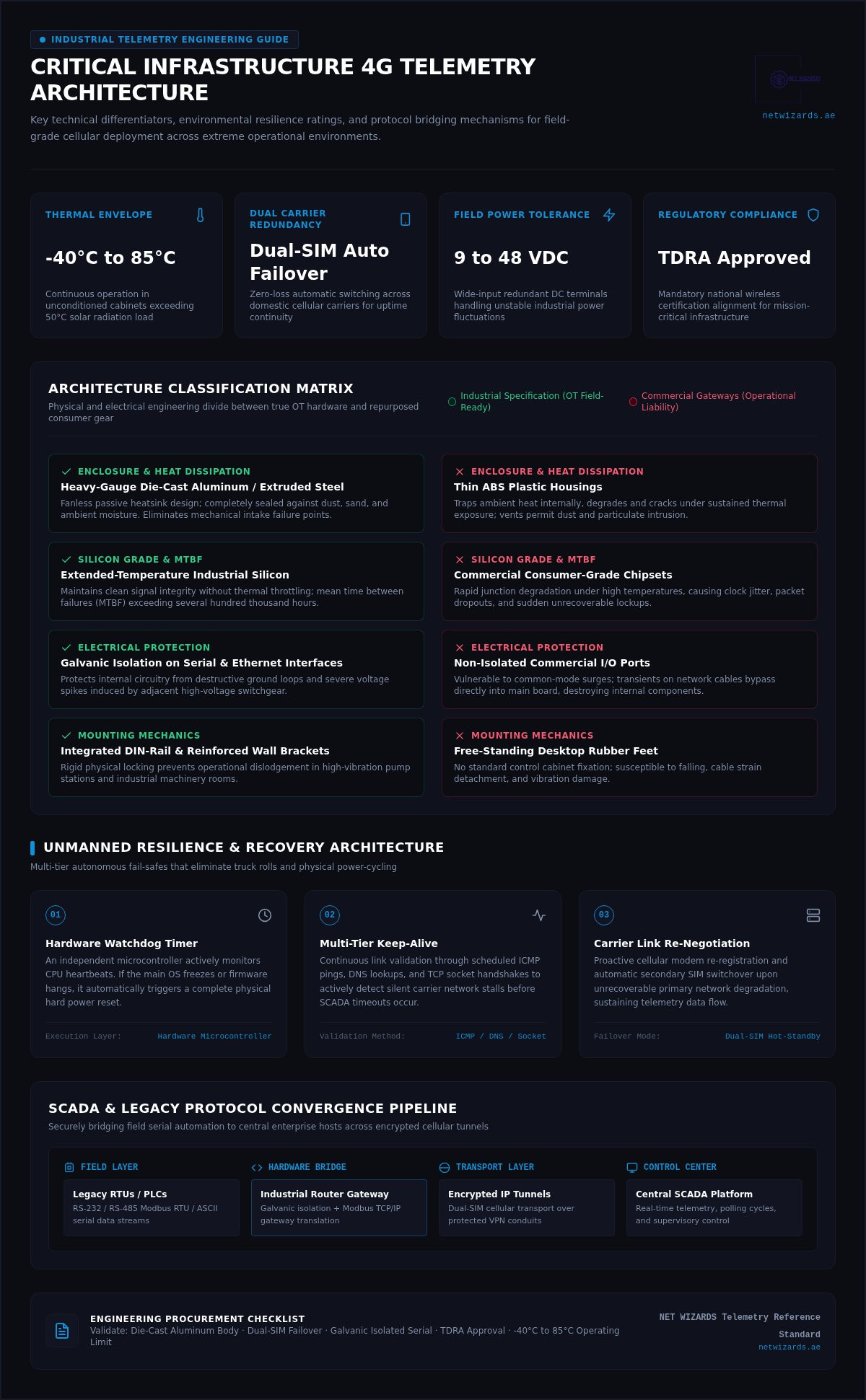
Specifying a true industrial 4G router UAE engineering teams can rely on means evaluating the fundamental divide between consumer-grade chipsets and extended-temperature industrial silicon. Consumer silicon degrades rapidly under elevated junction temperatures, causing clock jitter, packet dropouts, and sudden processor lockups. Industrial components maintain clean signal integrity under continuous thermal stress, delivering predictable mean time between failures (MTBF) exceeding several hundred thousand hours.
Hardware Architecture and Physical Hardening
Physical construction dictates how field equipment handles environmental hostility. Repurposed consumer devices use thin ABS plastic housings that trap ambient heat and crack under prolonged thermal exposure. Genuine industrial hardware utilizes heavy-gauge, die-cast aluminum or extruded steel enclosures that double as passive heatsinks. This fanless heat dissipation strategy eliminates mechanical intake points, keeping internal assemblies completely sealed against dust, sand, and ambient moisture.
- Mounting integrity: Integrated DIN-rail and reinforced wall-mounting brackets prevent operational dislodgement in high-vibration machinery rooms and pump stations.
- Electrical isolation: Galvanic isolation on serial and Ethernet interfaces protects internal circuitry against voltage spikes and destructive ground loops caused by adjacent switchgear.
- Wide input voltages: Redundant DC power terminals handle wide operational ranges (typically 9 to 36 VDC or 9 to 48 VDC) to tolerate unstable field power supplies.
Continuous Operation and Hardware Watchdogs
Field installations operate without human intervention. If an operating system hangs or an internal cellular modem drops registration, a consumer router remains offline until a technician physically cycles its power. Genuine industrial units incorporate dedicated hardware watchdog timers. These independent microcontrollers monitor processor heartbeats and trigger a complete physical power-reset sequence if software fails to respond within set intervals.
Multi-tier keep-alive mechanisms complement this hardware recovery. The router continuously evaluates link integrity using scheduled ICMP pings, DNS lookups, and socket handshakes. Should domestic cellular links stall, the operating system attempts proactive connection re-negotiation. Paired with long-term enterprise firmware maintenance rather than rapid consumer product obsolescence, an authentic industrial 4G router UAE deployment ensures long-term cyber protection and persistent operational connectivity.
Essential Technical Specifications for Industrial 4G Routers in the UAE
Procuring telemetry hardware for regional infrastructure demands an engineering audit against severe operational realities. Standard networking data sheets cite laboratory test environments, but field deployments inside unconditioned roadside cabinets confront ambient solar radiation that rapidly exceeds 50°C. Specifying an authentic industrial 4G router UAE operators can depend on requires validating uncompromising hardware thresholds that safeguard operational integrity under sustained environmental load.
Thermal Resilience and Ingress Defense
Solar loading elevates internal control enclosure temperatures well above ambient outdoor conditions, often pushing internal air to 65°C or higher. An operational rating of -40°C to +75°C represents an absolute minimum engineering threshold. Passive aluminum fin configurations dissipate heat through natural convection without mechanical cooling fans, which choke on particulate matter within weeks.
Cabinet seals degrade under extreme thermal cycling, allowing airborne dust and fine desert sand to breach field enclosures. Hardware rated to IP30 or IP40 prevents solid particulate ingress from settling onto printed circuit boards, eliminating conductive dust tracks that cause short circuits across high-density microprocessor traces.
Carrier Redundancy and Spectrum Compatibility
Relying on a single cellular network creates an unacceptable single point of failure. Redundant dual-SIM architectures deliver automated, carrier-agnostic failover across domestic operators such as Etisalat and du. Hardware modems must support regional FDD and TDD LTE frequency bands, specifically Band 3 (1800 MHz), Band 1 (2100 MHz), Band 8 (900 MHz), Band 20 (800 MHz), and Band 41 (2500 MHz).
- Dual-SIM multi-carrier failover: The operating system initiates sub-second interface failovers upon detecting continuous packet loss or sudden cellular degradation.
- Hysteresis link policies: Intelligent dwell-time algorithms prevent rapid ping-pong switching between unstable cellular towers in fringe coverage corridors.
- Cryptographic tunnels: End-to-end data encryption adheres to frameworks like the NIST Guide to Industrial Control System (ICS) Security to safeguard payload integrity over public cellular radio networks.
Industrial Electrical Protection
Industrial power grids experience heavy inductive load switching that introduces severe electrical noise. Field routing hardware requires a wide DC input envelope (typically 9V to 48V DC) combined with integrated surge suppressors, reverse polarity diodes, and overvoltage clamps. Rugged screw-down terminal blocks replace fragile consumer barrel jacks, locking DC power feeds securely against continuous mechanical vibration. For operations modernizing distributed infrastructure, procuring specialized industrial networking equipment engineered to these regional electrical and physical baselines eliminates unbudgeted field dispatches.
Industrial Telemetry and Protocol Integration: SCADA, Modbus, and Serial Convergence
Field automation architectures rarely consist of purely modern IP devices. Operating facilities rely heavily on proven programmable logic controllers (PLCs), remote terminal units (RTUs), and power meters that communicate strictly over legacy serial lines. A properly architected industrial 4G router UAE engineering teams implement serves as a protocol-transparent convergence point. It bridges air-gapped RS-232 and RS-485 physical loops directly into centralized enterprise telemetry pipelines without requiring wholesale replacement of functional field instrumentation.
Serial-to-Ethernet Bridging for Field Instruments
Rugged DB9 connectors and screw-down serial terminal blocks provide direct physical coupling to legacy RTUs. The router's software architecture maps these physical ports to virtual COM connections or executes transparent TCP/UDP socket server routines. Adjustable software baud rates ranging from 300 bps to 230,400 bps, paired with configurable hardware flow control (RTS/CTS), accommodate eccentric polling intervals from vintage instrumentation without dropping registers during burst transmissions.
Native Modbus Gateway Functionality
Operating a dedicated Modbus gateway within the router streamlines field data flow while lowering operational expenditures:
- Onboard Modbus RTU to TCP translation: The routing engine intercepts Modbus RTU serial packets, repackages register payloads into standard Modbus TCP frames, and delivers them directly to modern SCADA hosts over public cellular data streams.
- Multi-drop line management: A single RS-485 port drives daisy-chained loops containing up to 32 field nodes, polling flow meters, temperature transmitters, and motor protection relays across thousands of meters of cabling.
- Bandwidth payload compression: Local register aggregation policies restrict outbound cellular transmissions to change-of-value events or scheduled batched updates, cutting data traffic significantly over costly metered SIM plans.
OT Security, Tunneling, and Access Control
Bridging physical operational technology to public cellular transport introduces serious attack vectors. Industrial routers employ dedicated cryptographic hardware engines that maintain line-rate IPsec, OpenVPN, and GRE tunnels without overloading internal compute cores. Stateful packet inspection firewalls isolate serial-bridged subnets, blocking cross-interface lateral movement from unauthorized IP ranges.
Granular operational control aligns with established CISA security recommendations, enforcing access-control lists, strict MAC address filtering, and role-based permissions. Securing the perimeter of an industrial 4G router UAE installation guarantees that bidirectional SCADA commands reach field actuators without exposure to interception or unauthenticated manipulation over public LTE infrastructure.
Evaluation Framework: Selecting the Optimal Cellular Router for Critical Infrastructure
Engineering teams must evaluate cellular communications hardware through a structured operational lifecycle framework rather than comparing initial procurement costs. A router that drops off the network under peak midday thermal stress generates emergency maintenance costs that instantly eclipse any upfront hardware savings. Rigorous specification requires balancing bandwidth profiles, physical interface counts, radio-frequency (RF) attenuation, and centralized orchestration.
- Bandwidth sizing: Map operational data loads against cellular categories, isolating periodic telemetry from high-throughput visual inspection streams.
- Physical interface verification: Audit required physical ports, including galvanic-isolated serial connections (RS-232/RS-485), multi-port Ethernet switches, and dedicated digital input/output channels for chassis door alarms.
- RF design audit: Specify outdoor external antenna installations with low-loss cabling to overcome cabinet attenuation and heavy industrial shielding.
- Orchestration assessment: Verify zero-touch cloud or on-premises fleet management to execute mass firmware deployments without on-site truck rolls.
Throughput Modeling: Telemetry Versus High-Bandwidth Edge Video
Operational technology payloads differ fundamentally from consumer data consumption. Supervisory SCADA telemetry, Modbus registers, and MQTT packets demand tiny payloads (often under 200 bytes per cycle) but require strict packet delivery timing. An industrial LTE Cat 4 connection (delivering up to 150 Mbps downlink and 50 Mbps uplink) provides more than enough bandwidth for SCADA polling while offering superior power efficiency and thermal stability compared to complex 5G modems.
Sites running edge surveillance or AI-driven optical inspection require LTE Cat 6 or dedicated 5G modems to support sustained multi-megabit video uplinks. Integrated traffic-shaping rules and dynamic bandwidth throttling prevent non-critical video packets from consuming monthly SIM data limits or delaying critical alarm signals.
Antenna Selection and High-Gain RF Considerations
Placing stub antennas inside a grounded metallic control cabinet creates a Faraday cage, crushing cellular reception. Reliable field connectivity depends on externally mounted 2x2 or 4x4 MIMO antenna arrays positioned on the cabinet exterior or elevated masts. Vandal-resistant, IP67-rated puck antennas provide low-profile impact resistance in public spaces, while high-gain omnidirectional or directional Yagi antennas bridge long distances to fringe base stations.
Cable length directly impacts cellular signal quality. Standard RG-58 coaxial cable introduces severe signal attenuation at 1800 MHz and 2100 MHz frequencies. Long runs between routers and elevated masts require double-shielded, low-loss coaxial cabling (such as LMR-200 or LMR-400) to keep insertion losses below 3 dB across the entire RF path.
Centralized Fleet Management and Device Orchestration
Managing hundreds of geographically distributed cellular nodes via individual web interfaces creates an operational bottleneck. Enterprise-grade fleet platforms allow administrators to push standardized configuration templates, monitor real-time cellular signal metrics (RSRP, RSRQ, and SINR), and automate zero-touch provisioning when new units join the field network. To audit your field connectivity requirements against verified enterprise hardware, explore industrial 4G and 5G router solutions engineered for mission-critical reliability.
Deploying Enterprise Cellular Infrastructure with NET WIZARDS
Sourcing communications hardware through retail marketplaces or drop-shipping distributors creates profound vulnerabilities for critical systems. When an offshore gateway misinterprets proprietary register formats or drops offline under harsh field conditions, standard commercial suppliers offer no engineering recourse. Enterprise deployments require a domestic technology partner capable of taking complete architectural accountability for the entire communication stack.
NET WIZARDS bridges this capability gap across the UAE, delivering carrier-verified hardware backed by deep systems engineering. Supplying ruggedized industrial 4G and 5G routers designed for uncompromised telemetry, our organization operates as a long-term infrastructural peer rather than an unverified hardware reseller. We ensure your field connectivity aligns perfectly with operational technology standards and rigorous local site conditions.
Turnkey Industrial Hardware and Protocol Engineering
Enterprise infrastructure projects cannot tolerate protocol mismatches between field instrumentation and supervisory software. NET WIZARDS delivers end-to-end telemetry hardware convergence, uniting industrial 4G and 5G routers, M-Bus / Modbus gateways, and edge connectivity modules into single, integrated field deployments.
- Factory-validated hardware: Deploy pre-tested routing platforms confirmed to operate reliably under extreme regional thermal stress without component throttling.
- Proprietary protocol bridging: Implement onboard protocol translation that smoothly links legacy RTUs, specialized sensors, and power meters directly to modern cloud architectures.
- Specialized engineering R&D: Access dedicated in-house R&D services to develop customized firmware routines, bespoke polling drivers, and tailored edge computing behaviors.
National Engineering Support and Lifecycle Accountability
Operating as a privately held national technology group backed by over 20 years of regional operating experience, NET WIZARDS eliminates the supply risks associated with gray-market imports. Engineering teams interact directly with specialized industrial networking professionals who understand national spectrum allocations, local carrier requirements, and severe field operating environments.
Standardizing on an authentic industrial 4G router UAE operators can depend on protects assets from premature obsolescence. We support enterprise operations with long-term firmware hardening, spare-parts provisioning, and comprehensive lifecycle management. Whether your team is expanding distributed substation telemetry or upgrading municipal utility networks, partner with proven regional specialists. Explore mission-critical hardware architectures with NET WIZARDS to build a resilient, future-ready operational communications backbone.
Architecting Resilient Field Connectivity for the Next Decade
Selecting the right industrial 4G router UAE deployment strategy ensures your critical control networks withstand extreme physical environments while protecting telemetry continuity. Passive thermal dissipation, dual-carrier automated failover, and hardware-accelerated protocol translation aren't optional accessories. They're mandatory engineering baselines for operational survival across demanding field sites.
NET WIZARDS delivers unyielding lifecycle reliability backed by over 20 years of operational experience across the regional industrial technology sector. Our ruggedized hardware is built specifically for high-temperature telemetry, offering comprehensive integration that spans industrial gateways, protocol converters, and intelligent edge systems. When you build with purpose-engineered infrastructure, remote field connectivity transforms from an operational vulnerability into a durable strategic asset. Connect with NET WIZARDS to engineer your mission-critical industrial networking backbone today.
Frequently Asked Questions
What is the primary difference between an industrial 4G router and a commercial cellular router?
Physical engineering and operating longevity separate the two classes. An industrial router uses fanless, extruded aluminum chassis, wide-temperature silicon, and independent hardware watchdog timers designed for continuous, unmonitored field survival. Commercial units use cost-optimized ABS plastic housings and consumer processors that throttle or lock up under sustained high ambient heat and continuous telemetry workloads.
Can an industrial 4G router operate reliably under direct desert heat in the UAE?
Yes, provided the device carries an independently verified operating temperature rating of -40°C to +75°C or higher. An authentic industrial 4G router UAE engineering teams deploy dissipates internal heat entirely through conduction into heavy metallic chassis fins. This eliminates the need for mechanical intake fans that clog rapidly when exposed to airborne sand and fine mineral dust.
How does automated dual-SIM failover maintain continuous network connectivity on remote sites?
Automated dual-SIM routing architectures monitor cellular link health through continuous link-layer validation rather than relying solely on tower signal presence. If the primary subscriber identity module encounters packet loss, sudden data-plane stall, or network disconnects, the routing engine switches the internal radio to the secondary domestic carrier within seconds, eliminating costly site dispatches.
What types of industrial interfaces and protocols do enterprise cellular routers support?
Enterprise units integrate RS-232 and RS-485 serial interfaces alongside standard Ethernet ports to accommodate diverse industrial architectures. At the firmware layer, they feature native Modbus RTU to Modbus TCP protocol translation, virtual COM redirectors, and support for industrial protocols like DNP3 and MQTT. This enables vintage field instruments to transmit directly into central SCADA systems without external converter modules.
Why is galvanic isolation necessary on industrial router communication and power ports?
Heavy electrical equipment, large pump motors, and variable frequency drives generate intense electromagnetic fields and transient ground-potential shifts. Galvanic isolation physically separates electrical circuits across communication ports and DC power inputs. This barrier prevents destructive high-voltage spikes and ground loops from traveling through field wiring and destroying internal router microprocessors.
How do high-gain external antennas improve cellular reception in remote infrastructure installations?
Enclosing cellular equipment within metal control enclosures creates an effective radio barrier that blocks wireless signals. External MIMO antennas mount outside the enclosure or on elevated structures to access clean line-of-sight RF signals. Pairing these arrays with high-grade, double-shielded low-loss coaxial cabling delivers maximum signal-to-interference-plus-noise ratios (SINR) in fringe, long-distance coverage corridors across the country.
What centralized management capabilities are required for large-scale industrial router deployments?
Large-scale operational technology deployments demand cloud-hosted or on-premises fleet platforms that support zero-touch mass provisioning. Platforms must deliver automated cryptographic firmware distribution, bulk configuration templating, and real-time link performance tracking. Centralized orchestration ensures security patches apply consistently across distributed field endpoints without demanding physical site interventions by maintenance technicians.