
A 5G connection is only mission-critical when the router and network can support the application in the field. For operators assessing an industrial 5g router dubai, the practical questions include whether the proposed setup can handle remote-site signal changes, high ambient temperatures and data flows between field equipment, edge systems and industrial cloud platforms.
These are deployment requirements, not minor specification details. Industrial operations need connectivity that fits their equipment and operating conditions, without assuming that every router offers the same interfaces, environmental ratings or performance. This guide explains how to evaluate industrial 5G router solutions, from site conditions and network design to hardware suitability and integration.
NET WIZARDS L.L.C has 20 years in business and supplies industrial 4G and 5G routers, M-Bus / Modbus Gateways, AI edge computing and an Industrial-grade IoT Cloud Platform. The sections ahead cover common deployment challenges and practical ways to assess them, followed by the selection factors that matter for industrial environments. The aim is to help teams define requirements before choosing connectivity for their operations.
Key Takeaways
- Evaluate 5G as part of the network architecture, not simply as a speed upgrade, and match connectivity to each industrial application.
- When comparing an industrial 5g router dubai, check the model’s environmental suitability, supported network bands and required interfaces rather than assuming specifications are the same across devices.
- Plan for heat, interference and remote-site signal limitations. Assessing conditions where the equipment will be installed helps identify practical measures.
- Define how 5G routers will connect AI edge computing and industrial cloud platforms before deployment, including which systems handle protocol conversion and data processing.
- NET WIZARDS L.L.C has 20 years in business and supplies industrial networking equipment, gateways and Industry 4.0 solutions.
Table of Contents
The Evolution of Industrial 5G Networking
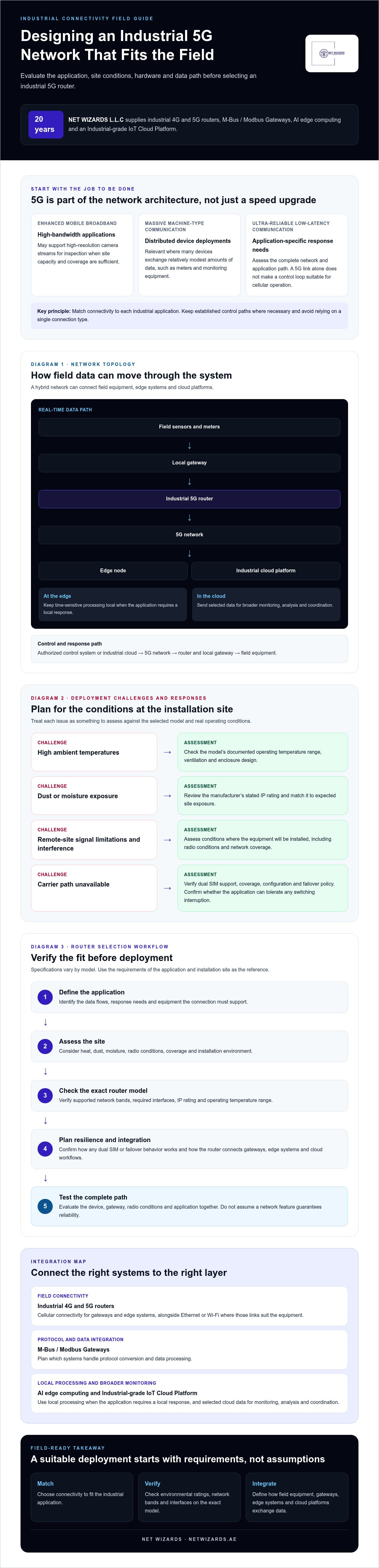
Industrial networking is expanding beyond fixed wired connections and 4G LTE to include mobile assets, larger sensor deployments and time-sensitive data. The change is not simply a faster link. 5G includes capabilities such as enhanced mobile broadband, massive machine-type communication (mMTC) and ultra-reliable low-latency communication (URLLC), as described in this overview of 5G technology. Their usefulness depends on the application, network design and conditions at the installation site.
For smart city and utility infrastructure, 5G can connect distributed meters, monitoring equipment and mobile field assets to local processing and cloud platforms. mMTC is relevant where many devices need to exchange relatively modest amounts of data. A 5G router can provide cellular connectivity for gateways and edge systems, while Ethernet and Wi-Fi serve equipment better suited to wired or local wireless links. This hybrid approach lets operators extend connectivity without assuming one technology should replace every existing connection.
For mission-critical systems, separate traffic by function, preserve established control paths where necessary, and assess how a cellular link fits with SCADA, telemetry and industrial cloud workflows. The objective is a resilient architecture with clear routes for operational data, not reliance on a single connection type.
Diagram: Industrial 5G Network Topology
Real-time data path: Field sensors and meters → local gateway → industrial 5G router → 5G network → edge node → industrial cloud platform
Control and response path: Industrial cloud or authorized control system → 5G network → router and local gateway → field equipment
Keep time-sensitive processing at the edge when the application requires a local response. Send selected data to the cloud for broader monitoring, analysis and coordination. Actual routing and response times depend on the network and system configuration.
Comparing 5G to Legacy Industrial Standards
For SCADA and remote telemetry, lower latency can support more responsive monitoring, but it does not by itself make a control loop suitable for cellular operation. Test the complete path, including the device, gateway, radio conditions and application. 5G bandwidth may also support high-resolution camera streams for inspection, provided the network has sufficient capacity and coverage at the site.
Network slicing may allow traffic to be logically separated, but it should not be treated as a guaranteed reliability feature. Availability and performance depend on operator support, deployment type and configuration. Assess these factors before assigning critical industrial traffic to a slice.
When evaluating an industrial 5g router dubai, compare the required network bands, local interfaces, environmental conditions and integration needs with the specifications for the chosen model. NET WIZARDS supplies industrial 4G and 5G routers as part of its industrial networking equipment portfolio. Consider how the router will fit into the wider Industry 4.0 architecture, including any gateway, edge computing or cloud requirements.
Critical Hardware Specifications for an Industrial 5G Router Dubai Deployment
A router’s suitability depends on more than its 5G connection. At an outdoor utility site or industrial facility, enclosure protection, power quality, interface compatibility and security controls all affect how well the device fits the operating environment. Treat each specification as a requirement to verify against the selected model, not as a feature guaranteed across all industrial routers.
Start with the enclosure. Review the manufacturer’s stated IP rating and confirm that it matches expected exposure to dust and moisture. Heat is a separate consideration: check the documented operating temperature range and installation conditions, including ventilation and enclosure design. Confirm the exact ratings for the model under consideration rather than inferring them from the product category.
Connectivity resilience also needs a clear definition. Dual SIM support and failover can help maintain a connection if the primary carrier path becomes unavailable, but only when the router, SIM configuration, network coverage and failover policy support the intended behavior. Confirm how switching works and whether the application can tolerate any interruption during transition.
Key Features of Professional 5G Routers
Match the interfaces to the equipment on site. External antennas can support better placement and signal reception, but antenna type, cable routing and the local radio environment affect results. A wide input-voltage range can accommodate variation in industrial power supplies, so compare the documented range with the actual supply and protection design.
Serial ports can connect legacy equipment, while Ethernet supports common local network connections. For Modbus and MQTT, verify where protocol handling takes place. A router may provide network transport, while a separate gateway or platform handles protocol conversion or messaging. For example, NET WIZARDS supplies an M-Bus / Modbus Gateway for protocol integration. Security review should also confirm whether the selected configuration supports the required access controls, firewall functions, VPN tunnels and credential management.
Diagram: Hardware Architecture of a Rugged Router
Indicative component path: 5G antennas → 5G module → CPU and memory → Ethernet, serial and other communication ports
Power path: Industrial supply → input protection and power regulation → system components
Design checks: Confirm component temperature ratings, including capacitors, and establish whether communication ports have isolation or surge protection suited to the installation. This is a conceptual diagram, not a claim about every router’s internal design.
These checks help teams compare industrial 5G router options against site conditions and integration needs. NET WIZARDS supplies industrial networking equipment and offers industrial R&D services for specialized automation and communication requirements. To discuss an industrial 5g router dubai deployment, outline the application and interface needs with the NET WIZARDS engineering team.
Operational Challenges and Solutions for National Deployments
National deployments expose industrial 5G routers to conditions that vary by site. An outdoor utility cabinet, a remote installation and an industrial facility can each present different thermal, radio-frequency, security and coverage constraints. Start with site-specific engineering: define the operating conditions, test connectivity where equipment will be installed, and specify how the network should behave when a link degrades.
Thermal Management and Heat Dissipation
Direct sun, enclosed cabinets and heat generated by a 5G module can combine to push components beyond their specified operating limits. Review the router’s documented temperature range alongside the enclosure, mounting position, expected workload and airflow. A fanless design can reduce reliance on moving parts, but it still needs a validated path to transfer heat away from internal components.
In a suitable design, thermal pads conduct heat from key modules to a metal chassis, which disperses it across a larger surface. This approach can support operation in dusty environments where fan openings may be undesirable. It does not remove the need to verify device limits under actual installation conditions.
Diagram: Thermal Dissipation Architecture
Indicative heat path: 5G module and processor → thermal pads → metal chassis → surrounding air
Deployment checks: Confirm module temperature limits, enclosure exposure, mounting clearance and whether the installation allows heat to leave the chassis effectively. This is a conceptual diagram, not a specification for a particular router.
Radio performance brings a separate challenge. Steel structures, machinery and nearby transmitters can affect signal quality at dense industrial sites. Assess signal conditions at the intended antenna position, check supported network bands, and plan antenna placement and cable routing accordingly. If coverage varies across an operating area, compare readings at representative locations rather than relying on a single site check.
Remote assets also need a defined response to limited public network coverage. Confirm operator coverage at each location and identify what the application should do during an outage, such as buffering data locally or using an established alternative connection where available. Do not assume that nominal coverage ensures a stable connection at the equipment.
Protecting Dispersed Industrial Assets
Each connected router expands the network’s access points. Reduce exposure through controlled device access, secure management credentials, network segmentation and appropriately configured VPN and firewall functions where supported. Establish how teams will review access and maintain security settings across remote sites. These controls help limit unnecessary access and make the security design more consistent across a distributed estate.
For an industrial 5g router dubai deployment, evaluate heat tolerance, radio conditions, coverage and security together. NET WIZARDS supplies industrial networking equipment, including industrial 4G and 5G routers, for applications where deployment conditions and integration requirements need careful review.
Strategic Benefits of 5G for Industry 4.0
5G creates value when its connectivity supports a defined operational objective. For Industry 4.0, that may mean moving selected data closer to equipment for AI edge computing, connecting mobile assets or transferring sensor readings to an industrial cloud platform. The router provides a communications path. Application design, edge processing, sensor quality and network conditions determine the result.
Enhanced Operational Intelligence
Processing data at the network edge can reduce the distance information must travel before a system responds. This can help time-sensitive monitoring and alerts, although end-to-end response depends on the complete system, not the cellular link alone. For predictive maintenance, more frequent equipment readings can reveal developing patterns sooner, provided sensors and analytics are configured to interpret those readings.
In smart utility grids, connected monitoring can help operators assess consumption and equipment status across distributed locations. 5G can also support communication with automated guided vehicles and drones where mobility, coverage and application requirements align. Evaluate each use case for latency, uplink capacity, safety procedures and the consequences of a lost connection. Increased connectivity can improve visibility, but it does not replace operational controls.
5G is designed to support dense device deployments, but practical capacity depends on the network, coverage, traffic demand and device configuration. Plan capacity around expected workloads rather than assuming a fixed number of usable IoT nodes at every site.
Operational data path: Sensors and mobile assets → industrial 5G router → edge processing → industrial cloud platform
Potential outcome: Timely data → informed monitoring and analysis → maintenance or operational decision
Assessing Connectivity Resilience and Return
Business value should be measured against the operation being supported. A connectivity outage may delay monitoring or disrupt a data-dependent workflow, but the cost varies by site and process. Rather than assuming that one hour of avoided downtime automatically justifies hardware costs, estimate the impact of disruption, the role of alternative connections and the total deployment and operating requirements.
Remote visibility may reduce some site visits when teams can diagnose issues through existing monitoring tools. That benefit depends on the connected equipment, platform capabilities and whether a physical intervention is still needed. A 5G router can also provide a foundation for future applications, but future-proofing depends on compatibility, upgrade paths and changing network requirements.
NET WIZARDS has 20 years in business and supplies industrial networking equipment, Industry 4.0 solutions and an Industrial-grade IoT Cloud Platform. For an industrial 5g router dubai deployment, align router selection with edge workloads, cloud integration, coverage and a measurable operational case.
Engineering with NET WIZARDS
Industrial connectivity requires more than selecting a router from a specification sheet. Device interfaces, operating conditions, data pathways and cloud integration all shape the architecture. NET WIZARDS has 20 years in business and supplies industrial networking equipment, gateways and Industry 4.0 systems. These offerings provide a basis for assessing deployment requirements and identifying where a standard product or a specialized engineering approach may fit.
The company’s industrial 4G and 5G routers are part of a wider portfolio that includes an Industrial-grade IoT Cloud Platform and AI edge computing. These technologies can form part of a connected system in which field data travels through suitable network hardware to local processing or cloud applications. Define integration requirements against the specific equipment, protocols, security approach and operational objectives of each project.
Bespoke R&D and Custom Hardware
Some deployments have interface, protocol or enclosure requirements that need assessment beyond a standard configuration. NET WIZARDS provides bespoke R&D engineering services for industrial automation and communication needs. Project teams can use technical discussions to identify relevant constraints, such as proprietary protocol compatibility, installation conditions and connections to existing equipment. Any proposed customization should be validated against the application and documented hardware capabilities.
For specialized environments, including hazardous areas, teams should establish the applicable site requirements and confirm that any proposed equipment is appropriate for them. Do not assume a general industrial router or enclosure is suitable without verifying the specific model and deployment conditions. Clear requirements help prevent gaps between the design intent and the equipment selected.
Regional Experience and System Integration
Experience with industrial and smart infrastructure can inform engineering decisions, but each project still needs its own assessment. NET WIZARDS’ portfolio includes industrial networking equipment, M-Bus / Modbus Gateways, fire alarm integration gateways, satellite asset trackers and weather monitoring stations. The relevant products depend on the equipment being connected, the data to be collected and the application’s integration requirements.
For an industrial 5g router dubai project, prepare a concise technical brief covering the connected assets, required interfaces, coverage conditions, environmental constraints and intended industrial cloud or edge workflows. This gives the engineering discussion a practical basis and helps identify integration dependencies early.
For help preparing those requirements, contact the NET WIZARDS engineering team.
Build a Resilient Foundation for Industrial Connectivity
Mission-critical 5G depends on more than network speed. Router selection must account for site conditions, hardware capabilities, security and integration with industrial systems. A deployment-specific assessment helps teams address heat, coverage and interference without assuming that one configuration fits every asset.
For an industrial 5g router dubai deployment, define how connectivity will support edge computing and industrial cloud workflows. The right architecture can provide a practical foundation for access to operational data, while keeping performance expectations grounded in the complete network and application design.
NET WIZARDS has 20 years in business and supplies industrial networking equipment, AI edge computing and an Industrial-grade IoT Cloud Platform. These offerings can support the evaluation of standard equipment and specialized integration requirements.
With clear requirements and careful engineering, your organization can move forward with a connectivity design suited to its operational demands.
Frequently Asked Questions
How does an industrial 5G router differ from a standard commercial router?
An industrial 5G router is selected for integration into operational environments, where power conditions, temperature, dust exposure, interfaces and network continuity need careful consideration. Depending on the model, industrial equipment may offer features such as serial connectivity or support for external antennas. Check each specification against the installation. “Industrial” alone does not confirm that a particular router will withstand a site’s conditions or meet its reliability requirements.
Can these routers operate in extreme desert temperatures?
Some industrial routers are designed for demanding environments, but suitability for high temperatures depends on the specific model and installation. Check the manufacturer’s documented operating temperature range, then assess direct sun, cabinet temperature, ventilation, mounting and heat from connected equipment. A fanless design may reduce reliance on moving parts, but it still needs an effective heat path. Do not assume all industrial 5G routers tolerate the same temperatures.
Do industrial 5G routers support legacy protocols like Modbus?
Support depends on the router’s interfaces and software, so verify the specific model and integration method. A router may transport network traffic without translating Modbus data itself. NET WIZARDS supplies M-Bus / Modbus Gateway products for protocol integration. Before deployment, document the equipment’s protocol variant, connection type and data destination, then confirm whether the design needs a separate gateway between field devices and the router or platform.
What security features are essential for industrial 5G deployments?
Start with controlled administrative access, strong credentials, secure remote access and separation between operational equipment and other network traffic. Evaluate firewall and VPN functions where supported, and define how teams will manage device configuration and access across sites. Security depends on both router capability and deployment practice. Confirm the available functions for the selected configuration and align them with the organization’s industrial cybersecurity policies before connecting operational assets.
How does 5G improve SCADA system performance?
5G can provide a wireless path for SCADA telemetry and may support more responsive communication when the application, coverage and network conditions are suitable. It can also help connect mobile or distributed assets where wired links are impractical. It does not automatically improve every SCADA system or guarantee a particular response time. Assess the full path from sensor and gateway to control application, and retain appropriate control safeguards.
Is it possible to customize the hardware for specific industrial needs?
Custom hardware development may be appropriate when standard equipment does not meet a project’s interface, protocol or physical design requirements. NET WIZARDS provides bespoke R&D engineering services for industrial communication and automation needs. Define the required connections, operating environment and integration constraints first. Then confirm the proposed design, supported functions and validation requirements with the engineering team before incorporating customized equipment into an operational network.
What is the typical range and penetration of an industrial 5G signal?
There is no single reliable range figure for every industrial 5G installation. Coverage and signal penetration depend on the network band, available service, antenna placement, structures, terrain and interference at the site. Metal walls and dense equipment can affect indoor reception. For an industrial 5g router dubai search or any national deployment, check coverage at the intended installation point and validate signal performance under representative operating conditions.
How do these routers handle network failover in mission-critical sites?
Failover behavior depends on the router’s supported features and configuration. Some models may support dual SIM or alternative network paths, but these capabilities should not be assumed without checking the specification. Confirm which events trigger a switch, how the system returns to its primary connection and whether applications tolerate an interruption. Test the complete configuration, including carrier availability and local coverage, before relying on failover for operational continuity.