
What if an automation project’s projected savings shrink once integration, maintenance, and installation downtime enter the business case? An industrial automation ROI calculator 2026 should make these assumptions visible, not hide them behind a single headline return. For UAE operators, a defensible estimate starts with the site’s actual operating baseline and records financial outcomes in AED.
Building a reliable comparison can be difficult when production, energy, maintenance, and project-cost data sit across different teams and spreadsheets. A generic estimate may also overlook industrial networking, gateways, edge computing, cloud integration, and other data infrastructure included in the project scope.
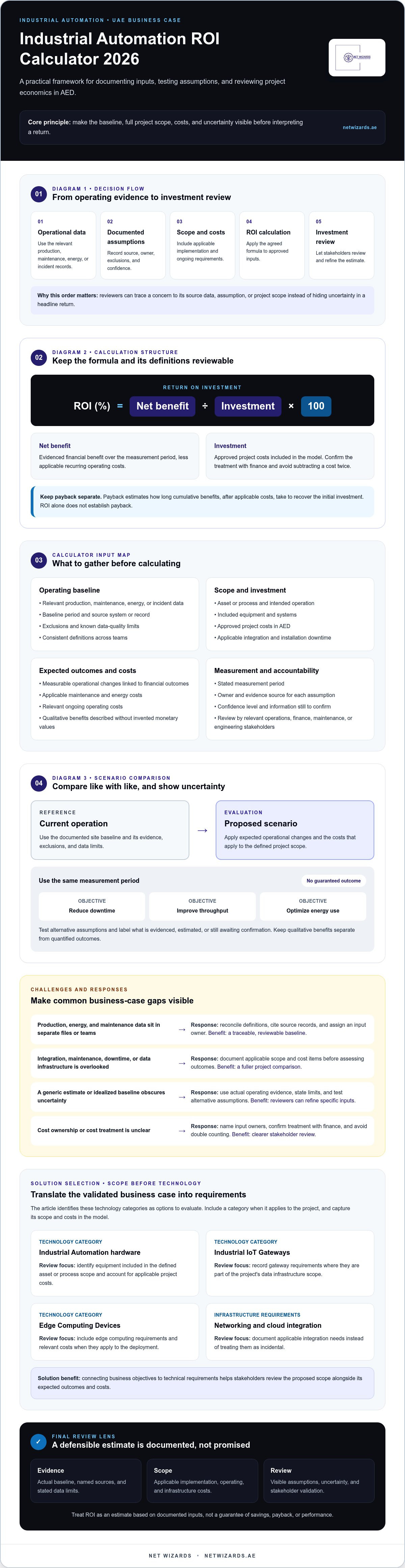
This evaluation template shows how to structure inputs, document assumptions, and compare automation scenarios using consistent measures. It connects operational objectives, such as reducing downtime, improving throughput, or optimizing energy use, to financial outcomes while accounting for the implementation and ongoing costs that apply to the deployment. Use the framework to identify information that needs confirmation, test alternative assumptions, and prepare a business case stakeholders can review and refine.
Key Takeaways
- Use an industrial automation ROI calculator 2026 to organize project inputs, formulas, assumptions, and evidence in one reviewable structure.
- Compare the current operation with proposed scenarios over the same period. Make uncertainty visible instead of presenting estimates as guaranteed results.
- Address fragmented data and unclear cost ownership by assigning input owners and recording each assumption’s source and confidence level.
- Check the full project scope, including integration, maintenance, energy, and data infrastructure requirements, before assessing financial outcomes.
- Turn the validated business case into technical requirements, then evaluate relevant options such as Industrial Automation hardware, Industrial IoT Gateways, and Edge Computing Devices.
Table of Contents
- Industrial Automation ROI Calculator 2026: Define the Decision Before the Numbers
- Build the Industrial Automation ROI Formula from Verifiable Inputs
- Compare Automation Scenarios Without Hiding Uncertainty
- Turn the ROI Calculator into an Automation Project Review
- Use the 2026 ROI Result to Select a Fit-for-Purpose Solution
Industrial Automation ROI Calculator 2026: Define the Decision Before the Numbers
A credible industrial automation ROI calculator 2026 starts with a defined decision, not a vendor quotation or equipment specification. Project ROI compares the investment required for a specific asset or process with evidenced operational or financial outcomes over a stated measurement period. It can support prioritization and approval, but it cannot guarantee savings, payback, or performance. Treat the result as an estimate based on documented inputs, not a promise.
Keep different types of evaluation separate. Vendor scoring assesses suppliers against procurement criteria. Equipment specifications describe technical characteristics. A general technology business case may cover strategic benefits across several initiatives. Project ROI tests whether a defined automation scope is expected to change a measurable outcome. The core concept follows Return on Investment (ROI), but the result is only useful if the investment and outcomes are represented accurately.
What should an industrial automation ROI calculator answer?
Specify the decision, the asset or process in scope, the intended business outcome, and the measurement period. Include the current baseline, project scope, implementation costs in AED, expected operational changes, and measurement period. Name who owns each assumption and who will review the result, such as operations, finance, maintenance, or engineering stakeholders. Separate quantified outcomes from qualitative benefits, such as improved visibility or safety, which need supporting explanation rather than an invented monetary value.
Do not use the ROI figure as a substitute for technical due diligence. A project may require industrial networking, gateways, edge computing, or cloud integration. Include applicable elements in the documented scope and cost assumptions rather than treating them as incidental.
Set a credible baseline before estimating benefits
Record current conditions using available production, maintenance, energy, or incident data relevant to the process. State the baseline period, source system or record, exclusions, and known data-quality limits. If teams maintain separate spreadsheets, reconcile definitions and assign an owner before combining figures. The baseline should describe actual operations, not an idealized target or a period selected because it makes the projected result look stronger.
An ROI result is only as reliable as its baseline. Incomplete operating records, inconsistent definitions, unexplained exclusions, or an unrepresentative measurement period can distort every benefit estimate built on them.
Decision flow
Operational data → Documented assumptions → Project costs and expected changes → ROI calculation → Investment review
This sequence makes the reasoning traceable. If reviewers challenge an estimate, they can identify whether the issue is in the source data, an assumption, or the project scope. They can then revise that input without hiding uncertainty in the final decision.
Build the Industrial Automation ROI Formula from Verifiable Inputs
An industrial automation ROI calculator 2026 should show where every figure comes from and who can validate it. Use the standard structure: ROI (%) = net benefit ÷ investment × 100. For this template, define net benefit as the evidenced financial benefit over the measurement period, less applicable recurring operating costs. Define investment as the approved project costs included in the model. Confirm this treatment with finance before comparing results, and avoid subtracting any cost twice.
ROI is not the same as payback period. Payback estimates how long it takes for cumulative benefits, after applicable costs, to recover the initial investment. Calculate it only when timing and approved inputs support a defensible estimate. Do not infer payback from ROI alone.
Editable calculator template
Copy these fields into a spreadsheet or project review document. Enter approved values in AED, identify the measurement period, and keep supporting evidence alongside each input.
- Project scope: asset or process, included equipment and systems, and intended operational change.
- Investment inputs: applicable hardware, software, engineering, integration, commissioning, and training costs.
- Recurring inputs: applicable support, connectivity, maintenance, and platform costs over the measurement period.
- Benefit inputs: measured changes linked to the baseline and post-deployment indicators.
- Assumptions and approvals: input owner, evidence source, exclusions, measurement period, and finance review status.
- Outputs: net benefit, investment, ROI percentage, and payback period only if approved inputs support it.
Which investment inputs belong in the calculator?
Include only costs that apply to the specific deployment. A project may involve industrial networking, gateways, edge computing, or cloud integration, so confirm the system boundary with engineering and procurement before entering figures. Use approved estimates or quotations for the project rather than generic prices or benchmarks. Record recurring costs separately from one-time project inputs so the cost profile is clear.
How should operational benefits be documented?
For each proposed benefit, record the baseline measure, post-deployment indicator, evidence source, and accountable owner. Include downtime, maintenance effort, energy use, throughput, and safety-related objectives in the calculation only when relevant evidence supports them. Quantify financial outcomes only when the method is approved. Describe qualitative outcomes separately and state what evidence would be needed to value them.
Input-to-evidence map
Hardware and software → approved quotations or procurement records
Integration and commissioning → engineering scope and project estimate
Recurring costs → support, connectivity, maintenance, or platform records
Operational benefits → production, maintenance, energy, or incident records, validated by the accountable operational owner
Formula and accounting treatment → finance review and approval
For projects that include Industrial Networking Equipment, Industrial IoT Gateways, or AI Edge Computing, NET WIZARDS L.L.C’s engineering team contact page can be a starting point for discussing the project scope and integration requirements.
Compare Automation Scenarios Without Hiding Uncertainty
A useful industrial automation ROI calculator 2026 compares the current operation with proposed scenarios on equal terms. Keep the measurement period, cost categories, benefit definitions, and calculation method consistent. Otherwise, the result may reflect differences in what each scenario includes rather than a meaningful difference in expected project performance.
How can teams make scenario comparisons fair?
Define each scenario’s scope, including equipment, software, integration dependencies, and required operational changes. Use the same cost and benefit categories throughout, and record one-time and recurring costs in AED. Do not compare a fully scoped proposal with an alternative that omits integration, training, or ongoing requirements. If scope is incomplete, mark the scenario as incomplete rather than implying an equivalent comparison.
| Comparison field | Current state | Proposed scenarios |
|---|---|---|
| Scope | Process and assets currently in operation | Included equipment, systems, and dependencies |
| Evidence quality | Available records and known limitations | Evidence supporting each projected change |
| One-time inputs | Applicable existing project or change costs | Applicable hardware, software, integration, and implementation inputs |
| Recurring inputs | Relevant operating costs | Applicable support, connectivity, maintenance, or platform costs |
| Expected operational changes | Measured performance during the baseline period | Projected indicators, assumptions, and confidence rationale |
Use the same table for conservative, expected, and optimistic cases. Each case should reflect a documented set of assumptions, not a promise or a forecast presented as certain. For example, if a benefit depends on operator adoption, state how the scenario treats adoption and who can validate that assumption.
Which uncertainties should decision-makers test?
Test operating hours, adoption, maintenance impact, and data availability where they could materially affect the result. Assign an owner, evidence source, and confidence rationale to each assumption. Keep missing sources and unverified estimates visible as data gaps. Do not conceal them inside a precise-looking output or add unsupported numeric estimates to compensate.
When evidence is incomplete, set a decision condition. For example, confirm the operating-hours record or verify the integration dependency before approval. This gives teams a practical way to resolve uncertainty without overstating the case.
Sensitivity check
Change one assumption → Recalculate the scenario → Compare the result with the prior case → Record the decision impact
Change one input at a time, such as the supported maintenance impact, while holding other assumptions constant. The change in the result shows which variables deserve closer validation. If a small, uncertain input changes the investment decision, flag it for review before treating the scenario as decision-ready.
Turn the ROI Calculator into an Automation Project Review
Take the calculator into a cross-functional review before making the project decision. This connects the financial estimate to delivery conditions, clarifies who owns unresolved inputs, and records what must be confirmed before approval.
Review sequence
- Define scope. Confirm the process boundary, included systems, dependencies, and exclusions.
- Capture the baseline. Verify that the operational records represent the process being evaluated.
- Validate inputs. Assign accountable reviewers for costs, expected changes, and technical assumptions.
- Calculate. Apply the agreed formula and accounting treatment.
- Test scenarios. Identify which unresolved assumptions could change the decision.
- Approve. Record the decision, approval conditions, and responsibility for tracking outcomes.
What challenges can distort an automation business case?
Fragmented records can leave teams working from inconsistent definitions. Reconcile terms such as downtime or maintenance effort with the relevant process owners before using those measures in a review. Legacy protocol integration can also introduce dependencies that a financial estimate may not capture. Map the interfaces between existing systems and proposed equipment. Document requirements for PLC, SCADA, Modbus, MQTT, or OPC UA only where applicable.
Unclear ownership can delay input validation and later benefit measurement. Assign a stakeholder to each operational data source and establish who will review the corresponding indicator after deployment. Underestimated operating requirements create another risk. Ask maintenance, IT, and engineering to identify applicable support, connectivity, and system upkeep requirements before approving the project scope.
Use this technical review to clarify the mission-critical industrial networking architecture the project depends on. Include gateways, edge computing, or cloud integration in the documented design only when they address a defined requirement.
How should teams validate the project assumptions?
Operations should confirm process conditions; engineering should verify interfaces and dependencies; maintenance should assess ongoing requirements; IT should review data and connectivity; and finance should validate cost treatment and approval criteria. Record disagreements and assign actions rather than blending unsupported estimates. This creates an audit trail from each project assumption to its accountable reviewer.
Review flow: Scope → Baseline → Input owners → Technical and financial validation → Scenario review → Approval and measurement plan
NET WIZARDS L.L.C supplies Industrial Networking Equipment and relevant gateway and edge computing capabilities that may fit defined project requirements. Confirm technical applicability against the existing systems and approved scope.
Use the 2026 ROI Result to Select a Fit-for-Purpose Solution
A validated ROI result can guide solution selection, but it should not decide it alone. Convert the business case into requirements that connect the intended operational change to the systems, data, and capabilities needed to support it. The industrial automation ROI calculator 2026 can help prioritize a project, while technical fit, integration dependencies, and evidence quality still need review.
Which solution features should the business case connect to?
Match each proposed capability to a documented objective and measurable indicator. If the objective is better equipment visibility, define what operational data decision-makers need and how they will assess whether visibility has improved. For energy optimization, identify the relevant measure and its data source before selecting supporting technology.
- Industrial Automation hardware: consider it where the project scope calls for equipment changes tied to a defined process objective.
- Industrial IoT Gateways: assess them when device connectivity or protocol conversion is a documented integration requirement.
- Edge Computing Devices: consider them where processing data closer to equipment fits the system architecture and operational requirements.
- Industrial-grade IoT Cloud Platform: evaluate whether cloud integration supports the project’s monitoring, data access, or analytics needs.
These capabilities may support operational efficiency, predictive maintenance, energy optimization, or enhanced safety when project requirements and evidence support that connection. Protocol conversion, industrial networking, edge computing, and cloud integration are not automatic inclusions. Specify them only when the existing environment and defined use case call for them.
What information should teams prepare before engaging a solution provider?
Prepare a concise project brief with the process and asset scope, baseline data, existing system interfaces, approved assumptions, and intended outcomes. List known integration challenges, data gaps, operational constraints, and stakeholders responsible for technical and financial review. This gives a potential solution provider a clear basis for discussing fit and identifying questions that need engineering validation.
NET WIZARDS L.L.C supplies Industrial Automation hardware, Industrial IoT sensors, gateways, and protocol converters, alongside industrial cloud capabilities and custom engineering. Share the required interfaces, data flow, and operational objectives so a technical discussion can focus on the project’s actual scope.
From business case to requirements
Validated objective → measurable indicator → system and interface requirements → architecture review → technical discussion
Before moving forward, confirm the scope, identify evidence gaps, validate the proposed architecture, and document open questions. Keep the ROI estimate connected to those requirements so the decision remains traceable as the project develops.
Turn a Defensible ROI Estimate into a Clear Project Direction
A sound automation decision starts with evidence, not a headline return. Use the industrial automation ROI calculator 2026 to document the baseline, define the project boundary, and connect approved cost and benefit assumptions to measurable outcomes. Compare scenarios on consistent terms, test uncertainty, and make unresolved data or integration questions visible before approving an investment.
Then translate the reviewed business case into technical requirements. NET WIZARDS L.L.C brings 20 years in business and end-to-end solution delivery from sensor design through cloud integration and analytics. This can help teams consider how relevant hardware, gateways, edge computing, and cloud capabilities fit a defined operational objective, without treating a calculated result as a guarantee.
Prepare the scope, available evidence, existing system interfaces, and open questions for a technical discussion. Clear inputs give stakeholders a stronger basis for evaluating fit and deciding what to validate next.
With traceable assumptions and a well-defined scope, your team can move forward with greater clarity and confidence.
Frequently Asked Questions
What is an industrial automation ROI calculator, and what does it measure?
An industrial automation ROI calculator estimates the financial return of a defined automation project using documented inputs. It compares project investment with evidenced benefits and applicable operating costs over a stated measurement period. The result depends on the project boundary, baseline, and assumptions entered. It supports investment review, but it cannot guarantee savings, payback, or performance. Keep qualitative outcomes, such as improved visibility, separate unless an approved method supports valuing them.
How do you calculate ROI for an industrial automation project?
Calculate ROI as net benefit divided by investment, multiplied by one hundred. First agree what counts as net benefit and which project costs belong in investment, then apply those definitions consistently across the measurement period. For example, a documented reduction in energy use may contribute only if the baseline and post-deployment measure are comparable. The industrial automation ROI calculator 2026 should show evidence sources and assumptions alongside the result. Have finance confirm the accounting treatment before approval.
Which costs should an industrial automation ROI calculator include?
Include costs that apply to the specific project, such as hardware, software, engineering, integration, commissioning, and training. Record relevant recurring support, connectivity, maintenance, or platform costs separately from one-time investment. For a UAE business case, enter approved monetary values in AED. Confirm the system boundary with engineering and procurement so necessary dependencies are not omitted, and avoid generic benchmarks when project-specific quotations or approved estimates are available.
Can a calculator estimate automation savings without a reliable baseline?
A calculator can produce a number without a reliable baseline, but that figure is not a defensible estimate of savings. Missing, inconsistent, or unrepresentative production, maintenance, energy, or incident records can distort the projected change in either direction. Document the baseline period, source, exclusions, and data limitations. If evidence is insufficient, flag the gap and identify who will resolve it before treating the result as decision-ready.
How should teams compare different industrial automation scenarios?
Compare each proposed scenario with the current state using the same measurement period, cost categories, benefit definitions, and formula. Make scope differences explicit, including integration dependencies and recurring requirements. Teams can test conservative, expected, and optimistic assumptions, but should label them as scenarios, not guaranteed outcomes. Assign an owner, evidence source, and confidence rationale to important assumptions, then identify which unresolved variables could change the investment decision.
What happens if projected automation benefits are difficult to measure?
Keep benefits that lack reliable financial evidence out of the quantified net benefit, and describe them separately as qualitative outcomes. Define a practical indicator and evidence source for each one before deployment. For example, a safety-related objective may need an agreed incident or hazard measure, while a maintenance objective may require consistent work-order records. Assign an accountable owner and review method so the project can assess the outcome without presenting an unsupported monetary value.
Is payback period the same as ROI for industrial automation?
No. ROI expresses net benefit relative to investment as a percentage, while payback estimates the time required for cumulative net benefits to recover the initial investment. They answer different questions and rely on consistent project inputs. Calculate payback only when the timing of benefits and costs is supported by approved data. A positive ROI figure alone does not establish when, or whether, the investment will be recovered.