Collecting a signal is not the same as making it useful for operations. An industrial data acquisition gateway connects equipment that may use different protocols, organizes selected data, and moves it to systems used for monitoring and analysis. The right architecture depends on the devices, data destinations, and operational requirements involved.
Industrial teams often work with a mix of legacy serial devices, Ethernet networks, and enterprise platforms. These systems may not communicate in the same way, so gateway selection affects integration effort, cybersecurity planning, and ongoing support. NET WIZARDS L.L.C provides Industrial IoT sensors, gateways, and protocol converters, as well as an Industrial-grade IoT Cloud Platform with support for MQTT, Modbus, NB-IoT, LoRaWAN, and TCP/UDP.
This article explains how data acquisition, protocol conversion, edge computing, and cloud platforms fit into an industrial data pathway. You’ll compare architecture options and practical selection criteria, including protocol fit, security, buffering requirements, and integration scope. You’ll also find common deployment challenges and ways to address them, helping you plan for data that supports operational efficiency, predictive maintenance, energy optimization, and enhanced safety.
Key Takeaways
- Assess an industrial data acquisition gateway by how well it makes field data usable across your OT systems, not simply by whether it can collect signals.
- Define separate roles for data acquisition, protocol conversion, edge processing, and cloud analytics, even when components combine more than one role.
- Compare gateway approaches against equipment compatibility, data destinations, processing requirements, manageability, and integration scope.
- Agree on protocol interfaces, data naming, context, and validation before deployment to reduce interoperability problems and improve downstream data quality.
- Align Industrial IoT sensors, gateways, protocol converters, edge computing, networking, and cloud integration with the operational outcomes your facility needs.
Table of Contents
- What an Industrial Data Acquisition Gateway Does in an OT Architecture
- How Gateway Architecture Handles Data Collection, Conversion, and Delivery
- How to Compare Industrial Data Acquisition Gateway Approaches
- Industrial Gateway Challenges and Practical Integration Solutions
- Building an End-to-End Data Acquisition Solution with NET WIZARDS
What an Industrial Data Acquisition Gateway Does in an OT Architecture
An industrial data acquisition gateway provides an integration layer between operational equipment and the systems that use its data. It collects selected signals from connected devices and forwards them to supervisory or monitoring systems in a format those systems can receive. Its role is to connect the data pathway, not simply add another device to the network.
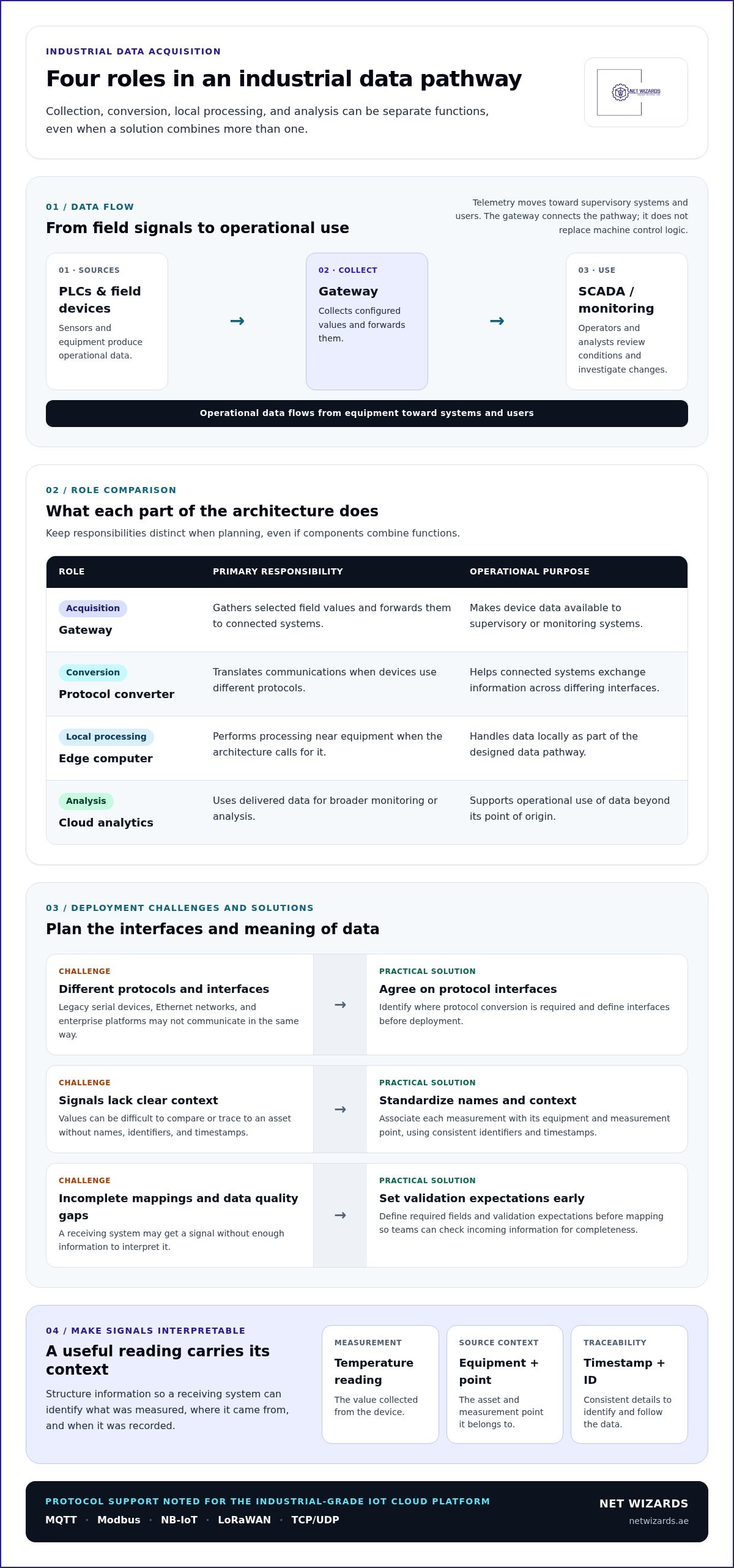
Data acquisition systems capture measurements and signals for use beyond the point where they originate. In an operational technology (OT) architecture, a gateway might collect sensor readings or PLC status information and make them available to a SCADA system or monitoring platform. Acquisition is distinct from control: a gateway can carry telemetry without replacing the PLC logic that controls a machine or process. The required interfaces and functions depend on the project architecture.
Where the gateway sits between field devices and supervisory systems
PLCs, Industrial IoT sensors, and other field equipment produce operational data. A gateway collects configured values and forwards them to connected systems. A supervisory layer can then display the information, giving operational teams a way to review conditions and investigate changes.
Typical telemetry path
PLCs and field devices → Industrial data acquisition gateway → SCADA or monitoring platform → Operators and analysts
Direction shown: operational data moves from equipment toward systems and users.
A data pathway can include several interfaces and destinations. Before selecting equipment, list the signals that matter, the systems that need them, and how users will interpret them. This helps reveal gaps between field connectivity and the supervisory system, instead of assuming the gateway will resolve every integration requirement on its own.
How gateways differ from protocol converters and edge computers
These components can work together, but they have distinct responsibilities. A gateway collects and forwards data between connected systems. A protocol converter translates communications so devices using different protocols can exchange information. An edge computer performs local processing near the equipment when the architecture calls for it. Cloud analytics use delivered data for broader monitoring or analysis.
Some architectures combine multiple roles in one device or solution; others keep them separate. Don’t assume every gateway performs protocol conversion, edge processing, or cloud analytics. NET WIZARDS provides Industrial IoT sensors, gateways, and protocol converters alongside Industrial Computing, edge computing, and an Industrial-grade IoT Cloud Platform. The project architecture defines how each component fits into the data pathway.
- Acquisition: gather selected field values.
- Conversion: translate communications where interfaces differ.
- Processing: handle data locally when the design requires it.
- Delivery and analysis: route data to supervisory or cloud systems for operational use.
How Gateway Architecture Handles Data Collection, Conversion, and Delivery
A useful architecture defines more than the connection between a device and a platform. It specifies what data enters the system, how teams interpret it, how it moves across the network, and which applications receive it. A practical industrial data acquisition gateway design treats collection, conversion, transport, and destination requirements as distinct questions, even if one component handles several of them.
Typical data pathway
OT sources → Gateway collection → Data handling and protocol conversion, where required → Communications → SCADA, monitoring platform, or cloud layer → Operational users
Each stage needs an agreed interface and a clear data purpose. The functions shown can be distributed across components according to the project architecture.
- Source connectivity: identify the field devices and signals the system needs to collect.
- Data handling: define how values, timestamps, device identifiers, and context are represented.
- Transport: determine how information passes between OT equipment and receiving systems.
- Destination: specify whether data goes to SCADA, a monitoring platform, or a cloud layer.
From raw device signals to structured operational data
A value becomes more useful when users can identify its source and meaning. For example, associate a temperature reading with the relevant equipment and measurement point, then use a timestamp and consistent identifier to make it traceable. Without that context, a monitoring screen may show values that are difficult to compare or link to a specific asset.
Incomplete mappings create a practical problem: a system may receive a signal but lack the naming or context needed to interpret it. Set naming conventions, required fields, and validation expectations before mapping data. This gives controls and analytics teams a shared basis for checking whether incoming information is complete and meaningful. Data acquisition in Industry 4.0 provides wider context for the role of acquisition in connected industrial architectures.
Where edge computing and the industrial cloud platform fit
Gateway-level collection brings data from connected sources into the defined pathway. Edge computing is a separate architectural role for workloads performed near the data source. Whether a project needs local processing depends on its operational requirements. Don’t assume every gateway includes an edge computer or processing functions.
The Industrial-grade IoT Cloud Platform can provide a monitoring and integration layer beyond field collection. Its confirmed protocol support includes MQTT, Modbus, NB-IoT, LoRaWAN, and TCP/UDP. This describes platform support, not the specifications of an individual gateway model. NET WIZARDS L.L.C brings together Industrial IoT sensors, gateways, protocol converters, edge computing, and cloud integration to support defined data pathways. Review your industrial integration requirements.
How to Compare Industrial Data Acquisition Gateway Approaches
Choose an architecture based on the work the data pathway must perform. A straightforward telemetry project may need collection and delivery only. Mixed equipment may require protocol conversion, while local processing needs may justify adding edge computing. The right industrial data acquisition gateway approach fits the sources, destinations, and operational responsibilities of the project, not simply the approach with the longest protocol list.
Architecture comparison
Standalone collection
Suitable need: Gather defined signals and forward them to a compatible supervisory or monitoring system.
Benefit: Keeps the architecture focused when data transformation needs are limited.
Trade-off: It may not resolve incompatible source and destination protocols.
Collection with protocol conversion
Suitable need: Connect sources and receiving systems that communicate differently.
Benefit: A protocol converter can translate communications within the data pathway.
Trade-off: Mapping and testing are still needed to ensure the receiving system interprets values correctly.
Gateway plus edge computing
Suitable need: Include local processing as part of the architecture.
Benefit: Places selected computing workloads near the data source.
Trade-off: Adds processing and support responsibilities that must be defined for the project.
Which gateway approach fits your data acquisition requirement?
Start with the intended operational outcome. For limited transformation, use a collection-focused design. If a PLC or field device communicates differently from the supervisory platform, include protocol conversion and document how each signal maps across the interface. Add edge computing when local workloads are required. A long protocol list does not establish compatibility on its own: the specific devices, data mappings, and destination systems must fit the intended pathway.
Evaluation criteria for an industrial gateway shortlist
Document the connected devices, communication requirements, data destinations, and team responsible for day-to-day operation. Assess how each proposed architecture fits existing PLCs, SCADA, and cloud or monitoring systems. Define required data fields and mappings, then identify where protocol conversion or local processing belongs. This makes integration gaps visible before deployment.
Review cybersecurity, remote management, and lifecycle needs against the project’s operating requirements. Decide who owns configuration, updates, troubleshooting, and ongoing support, and how the design fits the wider OT environment. A broader protocol count is useful only when it matches interfaces actually in scope. NET WIZARDS provides Industrial IoT sensors, gateways, and protocol converters that can form part of an integration design, with components selected to suit the required data pathway.
- Source fit: Are the required devices and communications accounted for?
- Destination fit: Can the intended supervisory or monitoring systems receive usable data?
- Function fit: Are conversion and edge processing included only where needed?
- Operational fit: Are security, management, and lifecycle responsibilities defined?
Industrial Gateway Challenges and Practical Integration Solutions
Integration risks often appear at system boundaries. A legacy device may use a protocol that the monitoring platform does not accept, a platform may receive values without useful context, or teams may not know who owns configuration and fault response. Address these issues in the industrial data acquisition gateway plan before expanding the connection scope. Early decisions help limit rework and establish a clearer operational data pathway.
Challenge-to-solution guide
- Fragmented protocols → Inventory devices and interfaces, document mappings, and use protocol converters where translation is required.
- Inconsistent or incomplete data → Set naming, timestamp, context, and validation requirements with the receiving-system team.
- Network interruptions → Define how the system should handle missing or delayed data, including whether buffering is required and how recovery is verified.
- Unclear system ownership → Assign responsibility for OT equipment, gateway configuration, communications monitoring, and platform operations.
- Cybersecurity concerns → Document approved connections, access responsibilities, and the controls required at each network boundary.
Resolving protocol and legacy-system integration issues
Start by listing connected devices, their communication protocols, required data points, and intended destinations. For example, a legacy field instrument may communicate differently from a modern monitoring platform. If the architecture requires translation, place a protocol converter in the defined pathway and document how source values map to destination fields. Test representative data paths before widening the integration. This helps surface mismatches while the scope is manageable.
Improving data quality, resilience, and operational ownership
Agree on naming conventions, timestamps, validation rules, and exception handling with the teams responsible for the source equipment and receiving systems. Decide how operators will recognize missing, delayed, or invalid readings, and who investigates communications issues. If an interruption could affect data availability, define expected system behavior and test recovery during integration. Don’t assume buffering or recovery functions are present unless they are included in the project requirements.
Security and ownership also need clear boundaries. Document which team maintains OT devices, gateway configuration, network connections, and platform operations. This prevents faults from falling between teams and supports a controlled response when data stops arriving. NET WIZARDS’ Industrial IoT sensors, gateways, and protocol converters can support an end-to-end data acquisition design, with the integration approach aligned to project requirements.
Discuss your industrial data integration requirements
Building an End-to-End Data Acquisition Solution with NET WIZARDS
An effective data acquisition solution starts with operational requirements, not a predetermined hardware configuration. Identify which equipment must provide data, where that information needs to go, and which operational decisions it should support. This keeps the design tied to the actual integration scope and helps teams separate essential functions from unnecessary complexity.
Requirements-led data pathway
Operational needs → Industrial IoT sensors and connected equipment → Gateways and protocol converters, as required → Industrial networking and edge computing → Industrial-grade IoT Cloud Platform → Monitoring and operational decisions
The components and connections depend on the project architecture.
A solution scope built around operational requirements
NET WIZARDS L.L.C provides Industrial IoT sensors, gateways, and protocol converters alongside Industrial Computing, edge computing, industrial networking, and cloud integration. These capabilities serve distinct roles in a system: sensors provide field measurements, gateways collect and move data, and protocol converters support communication between systems where translation is required. Edge computing and the Industrial-grade IoT Cloud Platform can extend the architecture according to defined processing and integration needs.
The platform supports MQTT, Modbus, NB-IoT, LoRaWAN, TCP/UDP, and other protocols. This is platform-level support, not a specification for every gateway or device. Define the required interfaces and data destinations before assigning components. NET WIZARDS L.L.C also provides in-house R&D for custom hardware and software development, with solution delivery spanning sensor design, cloud integration, and analytics.
A well-scoped pathway can make operational data more accessible for monitoring and analysis. Depending on the application and how teams use the resulting information, this can contribute to operational efficiency, predictive maintenance, energy optimization, and enhanced safety. These benefits depend on matching collected data and integration functions to operational needs.
Define the next steps for a gateway integration project
Prepare a practical project brief before detailed design begins. Include the equipment and protocols in scope, required data points, intended destinations, and decisions that monitoring should support. Then record integration constraints, data-quality needs, cybersecurity requirements, and ownership across OT equipment, gateway configuration, networking, and platform operations.
- Inventory: list devices, interfaces, protocols, and relevant data points.
- Map destinations: identify SCADA, monitoring, or cloud systems that need the data.
- Set data requirements: document naming, context, timestamps, and validation expectations.
- Assign ownership: clarify who manages configuration, communications, and platform operations.
NET WIZARDS L.L.C has 20 years in business supporting industrial technology and integration. A requirements-led scope helps align components with the intended data pathway and operational use.
Turn Gateway Planning into an Operational Data Pathway
An industrial data acquisition gateway delivers value when the full pathway works: field data is collected, translated where required, given useful context, and delivered to systems that support operational decisions. Choose an architecture based on connected equipment, destinations, processing needs, security requirements, and clear ownership, rather than protocol count alone.
Plan data mappings and validation before deployment, then test representative connections to expose integration gaps early. A requirements-led design can help teams build a stronger foundation for monitoring, operational efficiency, predictive maintenance, energy optimization, and enhanced safety.
NET WIZARDS brings 20 years in business, in-house R&D for custom hardware and software development, and end-to-end delivery spanning sensor design, cloud integration, and analytics. Define your requirements and align the architecture with the decisions your operation needs to make.
A well-planned data pathway gives teams a clearer foundation for turning operational signals into useful insight.
Frequently Asked Questions
What is an industrial data acquisition gateway?
An industrial data acquisition gateway collects operational data from connected field devices and transfers it to other systems for monitoring or analysis. Depending on the architecture, it may work alongside protocol converters, edge computing, supervisory systems, or an industrial cloud platform. Define its role by the required data sources, destinations, and handling requirements. The gateway label alone doesn’t establish which interfaces or functions a project needs.
How does an industrial data acquisition gateway work?
An industrial data acquisition gateway receives data from connected equipment, handles it according to the configured integration, and passes it to a designated system. The pathway may include protocol conversion or connect with edge computing and cloud services. Its exact sequence depends on the equipment, interfaces, and destinations. Clear device mapping and meaningful data context help operational teams identify where readings originate and interpret them consistently.
What is the difference between a data acquisition gateway and a protocol converter?
A data acquisition gateway supports the broader task of collecting and delivering operational data, while a protocol converter focuses on translating communications between systems that use different protocols. These functions can work together within one architecture, but don’t assume they are interchangeable. First identify the data sources and destinations. Then determine whether the project requires collection, protocol translation, or both, and define how translated data should map to the receiving system.
Can an industrial data acquisition gateway connect legacy equipment to modern monitoring systems?
Yes. It can support an architecture that connects existing equipment with newer monitoring systems when the required interfaces and data handling are addressed. Start by listing device protocols and data points, then document what the destination system expects. A protocol converter may be required if communication methods differ. Validate representative data paths during design to identify legacy-system constraints early and ensure readings reach the monitoring system with useful context.
How do I choose an industrial data acquisition gateway?
Compare gateway approaches against device and protocol compatibility, intended destinations, data quality, security, manageability, and lifecycle ownership. Establish whether the project needs collection alone, protocol conversion, edge processing, or a combination. Don’t use protocol count as the sole selection measure. A documented inventory of devices, interfaces, and required data flows gives the team a clearer basis for judging architectural fit and identifying integration gaps before deployment.
What problems can an industrial data acquisition gateway solve?
A gateway can bring data from industrial equipment into a defined monitoring or analytics pathway. It can support integration between devices and destination systems, particularly when the architecture includes protocol conversion or edge computing. Hardware alone won’t resolve inconsistent data, unclear system ownership, or security requirements. Address those challenges through explicit data mapping, validation rules, defined responsibilities, and security planning alongside the gateway design.