The newer device isn’t automatically the better architecture. An industrial edge controller can process data or run application logic close to equipment, while an RTU is typically used for remote telemetry and control. The right choice depends on what each layer must do, not the label on the hardware.
It’s reasonable to ask whether adding an edge device will complicate established PLC, SCADA, or field-device integrations. Product names often overlap, and control, protocol conversion, local processing, and remote communications may sit in different parts of the same system.
This comparison explains where industrial edge controllers and RTUs differ, where their responsibilities overlap, and when a hybrid architecture may make sense. You’ll learn how to assign control and telemetry tasks, address integration challenges, and assess gateways and protocol converters for connecting existing equipment to monitoring platforms. The goal is a practical architecture decision that supports operational efficiency and future integration without assuming one device must replace another.
Key Takeaways
- Choose an industrial edge controller when local data processing or application logic is central to the operational task.
- Use an RTU when remote telemetry and control are the primary requirements, especially for distributed assets.
- Map PLCs, SCADA, RTUs, sensors, actuators, and data flows before assigning functions to a new device layer.
- Address legacy protocol incompatibility by mapping interfaces and using suitable gateway or protocol-converter integration.
- Consider a combined architecture when local processing, remote telemetry, and integration with existing equipment all matter.
Table of Contents
- What Is an Industrial Edge Controller, and Where Does It Fit?
- Industrial Edge Controller vs. RTU: Compare Their Operational Roles
- How to Evaluate an Industrial Edge Controller for an Existing OT System
- Industrial Edge Deployment Challenges and Practical Solutions
- Building an Industrial Edge Architecture Around the Right Controller Role
What Is an Industrial Edge Controller, and Where Does It Fit?
An industrial edge controller sits between field equipment and higher-level monitoring systems. It processes selected data near the source, runs assigned application logic, or organizes information for connected systems. Its role is not automatically to replace a PLC, RTU, or SCADA platform. It can add local processing or integration where the operational design calls for it.
Keep the responsibilities distinct. Sensors and actuators provide or receive field signals. Data acquisition gathers readings, protocol conversion translates between interfaces or networks, and remote monitoring communicates asset status. Cloud analytics evaluates information across broader operations. An edge device may support part of this chain, but assign each task deliberately. Local processing is useful when a process needs information handled near equipment or when data should be filtered and organized before it travels upstream.
Diagram: Typical industrial data flow
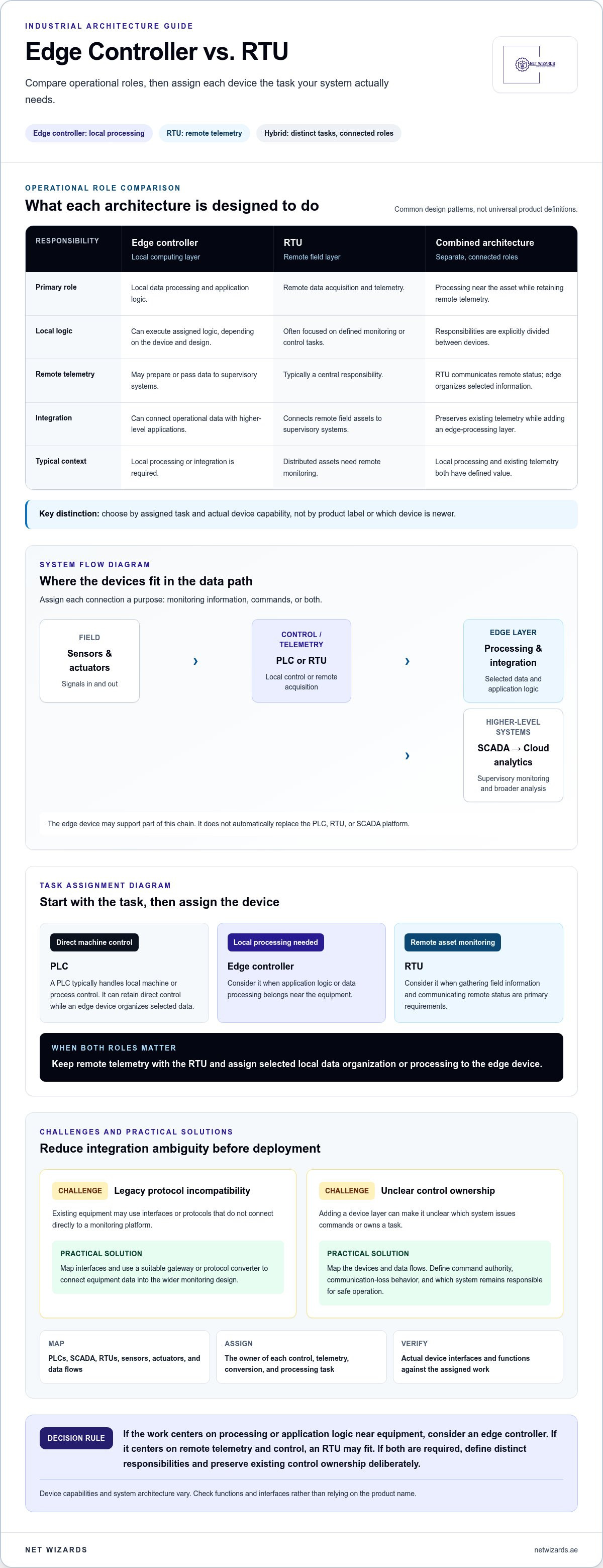
Field devices (sensors and actuators) → PLC or RTU → Edge processing and integration → SCADA supervisory monitoring → Cloud analytics
For each arrow, identify what data moves, which device owns it, and whether the connection carries monitoring information, commands, or both. Some functions may be combined in one device, while others remain distributed across the architecture.
How Does an Industrial Edge Controller Differ from a Gateway?
A controller is defined primarily by what it does locally: it executes application logic, processes data, or coordinates an operational task. A gateway focuses on connecting devices, protocols, or networks so information can move between them. A gateway or protocol converter can help bring existing equipment data into a wider monitoring design. Some products combine these roles, so assess supported interfaces, processing functions, and the task each device will own rather than relying on its label.
Where Do RTUs, PLCs, SCADA, and Edge Devices Fit?
A PLC typically handles local machine or process control. An RTU gathers field information and supports remote telemetry and control, often for distributed assets. The Remote Terminal Unit (RTU) is commonly associated with communication between remote equipment and SCADA systems. SCADA provides supervisory monitoring across processes; it is not interchangeable with the field controller. An edge device adds local computing or integration between operational equipment and higher-level systems.
Map these roles before changing an established system. For example, a PLC can retain direct machine control while an edge device organizes selected data for supervisory or cloud use. That separation supports structured integration without shifting control ownership unintentionally. For a broader view of Industry 4.0 solutions architecture, consider how connected assets, edge processing, and monitoring work together across the system.
Industrial Edge Controller vs. RTU: Compare Their Operational Roles
The practical distinction is the task the architecture assigns to each device. An RTU typically prioritizes collecting information from remote assets and communicating it to a supervisory system. An industrial edge controller is suited to local data processing or application logic where the operation requires it. These are common design patterns, not universal technical definitions: device capabilities and system architecture vary.
Visual 2: Operational role comparison
Responsibility | Edge controller | RTU | Combined architecture
Primary role | Local processing and application logic | Remote data acquisition and telemetry | Processing near the asset, with remote telemetry retained
Local logic | Can execute assigned local logic, depending on device and design | Often focused on defined monitoring or control tasks | Explicitly divided between devices
Remote telemetry | May prepare or pass data for supervisory systems | Typically a central responsibility | RTU communicates remote status; edge device organizes selected information
Integration | Can connect operational data with higher-level applications | Connects remote field assets to supervisory systems | Preserves existing telemetry while adding an edge-processing layer
Typical context | Local processing or integration is required | Assets are distributed and need remote monitoring | Both existing telemetry and local processing have defined value
These roles describe architectural intent, not guaranteed product features. Check the device’s actual interfaces and functions against the tasks it must perform.
Which Device Fits Local Control and Which Fits Remote Telemetry?
Start with where a decision must occur. If field equipment needs application logic close to the process, an edge controller may support that role, while a PLC can retain direct machine control where designed to do so. If the primary requirement is to gather readings from a remote pump station or another distributed asset and transmit status to a supervisory system, an RTU may remain suitable. Don’t move control simply because a newer device can process data.
Define control authority and fail-state behavior before implementation. Specify which device can issue commands, what happens if communication is interrupted, and which system remains responsible for safe operation. These decisions reduce ambiguity during integration and fault handling.
Can an Industrial Edge Controller and an RTU Work Together?
Yes. A layered design can retain an RTU’s established telemetry role while an edge controller processes or organizes selected information for supervisory use. This adds a local-processing layer without requiring an unnecessary replacement of existing remote monitoring. The benefit depends on clear data ownership, compatible interfaces, and an agreed boundary between monitoring and control.
For an existing system, document the signal path and responsibility for each command before adding the edge layer. NET WIZARDS L.L.C supplies industrial networking equipment, gateways, and edge computing solutions for architectures connecting field devices, edge processing, and cloud monitoring. Discuss an industrial integration requirement in the context of your operational architecture.
How to Evaluate an Industrial Edge Controller for an Existing OT System
Begin with the operational requirement, not a device specification sheet. Identify what the system must do, where a response must occur, which assets provide or receive signals, and which system owns each data point. An industrial edge controller should address a defined need, such as processing selected information near equipment or preparing data for supervisory applications, without creating ambiguity about existing control responsibilities.
Before assigning functions to the edge, map the current installation: PLCs, SCADA, RTUs, sensors, actuators, gateways, and communication paths. Record which device reads each value, which system issues commands, and where operators currently view status. This baseline exposes dependencies that a product label alone won’t reveal.
Which Interfaces and Protocols Should the Design Account For?
Inventory the interfaces and protocols in use, then compare them with the proposed device and application requirements. Modbus may carry field or equipment data, while MQTT or OPC UA may be used in higher-level data flows where the installation supports them. Treat each as an interface requirement to validate, not an assumption about what every device supports.
Separate translation from processing. If two systems use incompatible protocols or communication interfaces, a suitable gateway or protocol converter can bridge the gap. Local application logic is a separate design function. Keeping the distinction clear helps prevent a protocol-conversion task from expanding into an unintended control change.
Visual 3: OT data-flow map
Sensors and actuators → PLCs and RTUs → Gateways or protocol converters, where required → Edge processing → SCADA and supervisory systems → Industrial cloud platform
At each step, record the source, destination, protocol, and responsible system. Not every architecture uses every layer.
How Should Data Processing and Cloud Connectivity Be Divided?
Classify information by its operational destination. Data needed for a local decision may require handling at the edge; information used for operator oversight may flow to SCADA; selected records may also support cloud monitoring or broader analysis. This division can make data flows more structured and support operational efficiency, energy optimization, or predictive maintenance objectives.
Connectivity interruptions are a design challenge, especially when remote systems depend on updates. Specify which local functions must continue during an interruption, what data should be retained or forwarded later, and which actions require supervisory communication. Don’t assume cloud availability or define behavior without regard to process requirements. For additional context, see SCADA edge node architecture and industrial IoT cloud architecture when reviewing how edge processing connects with monitoring and cloud destinations.
Industrial Edge Deployment Challenges and Practical Solutions
Edge deployment risk often comes from unclear interfaces and responsibilities, not from the device alone. Use a defined sequence before introducing an industrial edge controller or changing existing OT workflows:
- Define the operational need: State what the system must accomplish and where processing or response must occur.
- Map interfaces: Record connected assets, protocols, data paths, and current system dependencies.
- Allocate functions: Document which device handles control, telemetry, protocol conversion, processing, and supervision.
- Validate data flow: Test representative paths from field source to intended destination.
- Plan monitoring: Specify how operators will see device status, communication issues, and data quality.
Legacy protocol incompatibility can block integration. Map existing interfaces first, then use a suitable gateway or protocol converter where translation is required. This gives existing equipment data a defined path without confusing conversion with application logic. Unclear control ownership creates a separate risk: define the boundaries among PLCs, RTUs, edge devices, and supervisory systems before commissioning changes.
How Can Teams Reduce Integration and Data-Flow Risk?
Document each data source, destination, transformation, and responsible system. For example, identify which device reads a sensor value, whether a gateway changes its protocol, where edge processing occurs, and which system receives the result. Test representative device and protocol paths before expanding the design. This can expose interface mismatches and incorrect assumptions while the scope remains manageable.
Monitoring needs equal attention. Define how operators will identify an unavailable device, a broken communication path, or missing or inconsistent readings. Assign ownership for investigating each issue, and make data status visible in the operational systems used to manage the process. Clear traceability supports troubleshooting and shows where information was lost or altered.
How Should Cybersecurity and Operational Continuity Shape the Design?
Include network segmentation, access control, and software update ownership in the design discussion. Decide which connections are necessary, who administers access, and who coordinates updates across connected devices. These are project-specific engineering decisions; a general design statement cannot guarantee security for every installation.
Connectivity loss also needs an explicit response. Define which local functions must continue if supervisory or cloud connections become unavailable, what data should be retained locally, and how operators will recognize the interruption. Align these requirements with the process and device roles. This reduces reliance on assumptions about external connectivity and helps preserve operational continuity where the system design requires it.
Building an Industrial Edge Architecture Around the Right Controller Role
Choose the architecture by assigning each operational responsibility to the layer best suited to own it. Keep local control with the established controller when the process depends on its defined logic. Retain an RTU when remote telemetry is the primary requirement for distributed assets. Use a gateway or protocol converter when equipment interfaces need to communicate across systems. Combine these layers when operations require remote visibility and additional local processing.
This role-based approach supports structured integration: teams can preserve existing control and telemetry paths while adding data processing where it serves a clear purpose. Better-organized operational data can inform predictive maintenance and energy optimization initiatives, although outcomes depend on data quality, system design, and operational use.
What Benefits Can an Integrated Edge and Gateway Solution Provide?
Aligning field devices, protocols, processing, and data destinations gives each connection a defined purpose. Gateways and protocol converters can connect existing equipment with wider monitoring architectures, while edge computing processes or organizes selected information before it moves to supervisory or cloud systems. The benefit is a clearer integration path, with less ambiguity about where information originates and which system consumes it. For hardware-selection considerations, consult industrial AI edge computing hardware.
How Can NET WIZARDS Support the Solution Architecture?
NET WIZARDS L.L.C supplies industrial networking equipment and Industrial IoT sensors, gateways, and protocol converters for architectures spanning field devices to cloud monitoring. Its Industrial-grade IoT Cloud Platform supports MQTT, Modbus, NB-IoT, LoRaWAN, and TCP/UDP, providing a multi-protocol option for connected monitoring architectures. The company has 20 years in business.
For project teams, the practical next step is to document the operational task, existing interfaces, control ownership, and required data destinations. Use that baseline to define which responsibilities remain with PLCs or RTUs and where edge processing or protocol integration adds value. A clearly scoped architecture can support operational efficiency and provide a structured basis for monitoring and future integration.
Set a Clear Direction for Your Industrial Edge Architecture
The right architecture starts with operational responsibility, not the device label. Use an industrial edge controller where local processing or application logic serves a defined need. Keep an RTU in its telemetry role when remote monitoring remains the priority, and consider a combined design when both functions matter. Mapping interfaces, data ownership, control authority, and connectivity requirements before deployment helps protect existing integrations and makes system responsibilities easier to manage.
NET WIZARDS L.L.C brings 20 years in business and supplies industrial networking equipment, edge computing, gateways, protocol converters, and an Industrial-grade IoT Cloud Platform. These capabilities support integration from field devices to cloud monitoring and can provide a structured foundation for operational efficiency, predictive maintenance, and energy optimization.
A clearly defined architecture gives teams a practical basis for integrating existing OT systems and planning future capabilities with confidence.
Frequently Asked Questions
What is an industrial edge controller?
An industrial edge controller is a device layer that processes data or runs assigned application logic close to industrial equipment. It can also help integrate operational data with supervisory or cloud systems, depending on its capabilities and the architecture. It doesn’t automatically replace a PLC, RTU, gateway, or SCADA platform. Define its specific task, interfaces, and control authority within the system before assigning it an operational role.
What is the difference between an industrial edge controller and an RTU?
An industrial edge controller generally focuses on local data processing and application logic, while an RTU commonly focuses on collecting information from remote assets and communicating telemetry to supervisory systems. Their functions can overlap, and product labels aren’t universal technical standards. Compare actual device capabilities with system requirements. An RTU may remain appropriate for remote monitoring, while edge processing can address a need to handle or organize information near equipment.
Can an industrial edge controller replace an RTU?
It can replace an RTU only if the proposed device and design can assume the RTU’s required telemetry and control responsibilities. Compare interfaces, communication paths, behavior during connection loss, and data destinations before making that change. Replacement isn’t necessary when the RTU already provides suitable remote telemetry. A combined design may retain its established role while adding edge processing, avoiding unnecessary changes to working system boundaries.
Can an industrial edge controller work with legacy equipment?
Yes, an industrial edge controller can be integrated with legacy equipment when the required interfaces, protocols, and data paths are addressed. Start by mapping existing PLCs, RTUs, sensors, and supervisory systems. If devices use different communication interfaces or protocols, a suitable gateway or protocol converter may bridge them. Validate representative data paths before deployment, and keep protocol translation separate from control logic to avoid unintended changes to existing operations.
Does an industrial edge controller need a cloud connection?
No. A cloud connection isn’t inherent to the controller’s local processing role. Some architectures use edge devices to prepare information for supervisory monitoring or an Industrial-grade IoT Cloud Platform, while local functions remain defined at the site. Specify what must continue during a connectivity interruption, which information should be retained or forwarded, and which actions depend on remote systems. Set these requirements according to the process, rather than assuming constant connectivity.
Which protocols should an industrial edge controller support?
Choose protocols based on the equipment and systems the controller must connect, not a generic checklist. Inventory existing interfaces first. Modbus may be relevant to field equipment, while MQTT, NB-IoT, LoRaWAN, and TCP/UDP can apply to different data and connectivity paths. OPC UA may also be relevant where the architecture uses it. Confirm that device support matches the required role, since protocol support varies by product and implementation.
How do I choose between an industrial edge controller and a PLC?
Choose according to the task and control responsibility. A PLC typically manages direct machine or process control; an edge controller is generally used for local processing, application logic, or integration with higher-level systems. These functions can coexist. Identify where decisions must occur, which device issues commands, and what behavior is required if communications fail. Keep direct control with the system designed to own it unless the architecture explicitly assigns that role elsewhere.
What challenges should be addressed before deploying an industrial edge controller?
Address legacy interface incompatibility, unclear control ownership, cybersecurity, connectivity interruptions, and ongoing device monitoring. Map data sources, destinations, transformations, and command authority across PLCs, RTUs, gateways, edge devices, and supervisory systems. Test representative connections, define network segmentation and access responsibilities, and plan how operators will identify missing or inconsistent data. Document which local functions continue without external connectivity. These project-specific decisions reduce integration uncertainty and clarify operational accountability.