A sensor reading has little value if it arrives too late, lacks operational context or triggers no clear response. Unplanned stoppages disrupt production and maintenance plans, so industrial iot condition monitoring must do more than collect asset data. It must help teams recognise meaningful changes and decide what to do next.
That requires trustworthy signals, reliable connections and a defined path from alert to maintenance action. Integration with legacy equipment, inconsistent data and unclear project objectives can weaken a deployment. Start with the assets and decisions that matter most, then build the monitoring architecture around them.
This guide explains how to move from asset signals to actionable condition insights, address common deployment challenges and evaluate connectivity, edge computing and cloud components. It also examines how Industrial IoT sensors, gateways and protocol converters can connect equipment data with an Industrial-grade IoT Cloud Platform. NET WIZARDS L.L.C brings 20 years in business and end-to-end capability from sensor design through cloud integration and analytics. The focus is practical: identify changes early, put alerts in context and give teams a clear basis for maintenance decisions that may help reduce downtime.
Key Takeaways
- Use asset criticality and observable condition changes to decide where monitoring can support earlier investigation.
- Trace how equipment data moves through gateways, communications, edge or cloud processing, and into insights teams can act on.
- Compare monitoring approaches by data requirements, integration effort, response workflow and operational fit, rather than assuming one method suits every asset.
- Address data gaps, protocol mismatches, connectivity constraints and unclear alert ownership through disciplined scoping, validation and operational handover.
- Assess industrial iot condition monitoring solutions for relevant data acquisition, integration, analytics and clearly assigned maintenance responses.
Table of Contents
- Industrial IoT Condition Monitoring: Connect Downtime Causes to Observable Signals
- How Industrial IoT Condition Monitoring Turns Asset Data into Maintenance Insight
- Industrial IoT Condition Monitoring Approaches: Match Monitoring to the Operational Need
- How to Implement Industrial IoT Condition Monitoring in a Manufacturing Operation
- Build a Condition Monitoring Solution Around Industrial Integration and Action
Industrial IoT Condition Monitoring: Connect Downtime Causes to Observable Signals
Equipment rarely stops without an operational reason, but the first sign may be subtle, intermittent or hidden in data teams don’t routinely review. Industrial IoT condition monitoring collects and interprets asset data so teams can investigate changes, assess operating risk and make informed maintenance decisions. It may bring an emerging issue to attention earlier, but it cannot guarantee that every failure will be detected or avoided.
Definition
Condition monitoring is the process of collecting and interpreting information about an asset’s condition over time to support operational and maintenance decisions.
This practical definition aligns with the foundational overview of Condition monitoring. The value comes from connecting a meaningful signal to the equipment’s operating context and an agreed response, not simply generating more readings.
Which manufacturing downtime causes can condition monitoring help investigate?
Monitoring can support investigations into wear, abnormal operating conditions and process interruptions. It does not diagnose these causes by itself. For example, a change in vibration, temperature, pressure or electrical current may justify checking an asset. Which variable matters depends on the machine, process and available instrumentation. Confirm sensor suitability and data availability for each use case.
- Wear or mechanical change: Review relevant vibration or temperature trends where measurement is appropriate to the asset.
- Abnormal operating conditions: Compare available pressure, temperature or current data with operating context and process records.
- Process interruption: Examine equipment status or process data alongside event timing to help identify where investigation should begin.
Treat a changing reading as an early warning, not a confirmed fault or root-cause finding. Inspection and engineering assessment are still necessary to establish what happened and what action is appropriate.
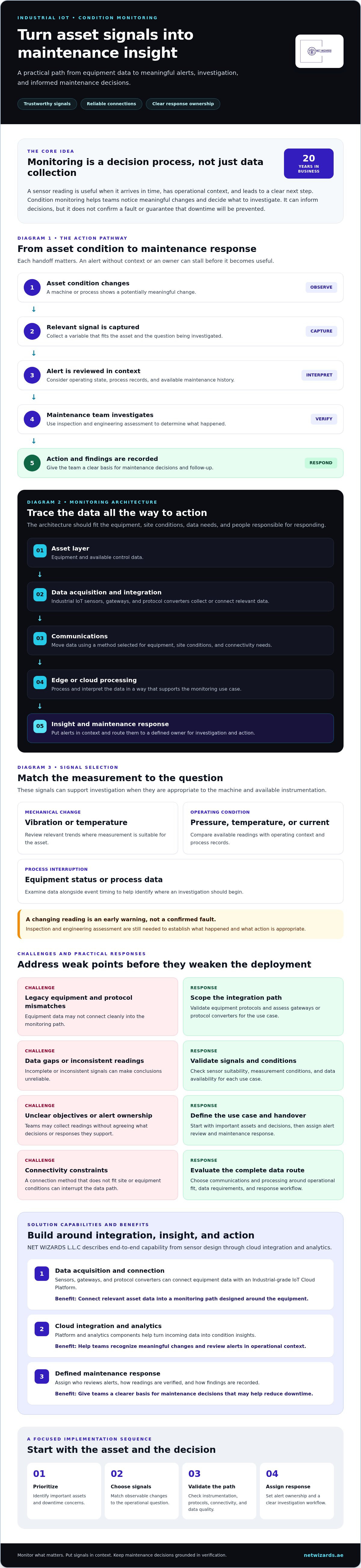
Infographic: From asset condition to maintenance response
Asset condition changes → Relevant signal is captured → Alert is reviewed in operating context → Maintenance team investigates → Action and findings are recorded
What condition monitoring can and cannot establish
Condition data can help teams prioritise investigation and inform maintenance planning. It doesn’t replace physical inspection, equipment knowledge or engineering judgement. Conclusions may be unreliable when readings are incomplete, inconsistent or separated from context such as operating state or maintenance history. Define who reviews each alert and how the team verifies it before taking action.
For a useful deployment, start by identifying the downtime concern, then confirm which observable variables could provide relevant evidence. During project scoping, validate sensor type, measurement conditions, equipment protocols and data availability. This keeps the design tied to the asset and helps teams distinguish a meaningful change from a data-quality issue.
How Industrial IoT Condition Monitoring Turns Asset Data into Maintenance Insight
A useful monitoring architecture carries relevant asset data to the people responsible for acting on it. The path may include sensors, integration hardware, communications, local or cloud processing, and a user-facing view. Give each layer a defined role. If equipment data cannot be interpreted or alerts have no assigned owner, adding connectivity alone won’t improve maintenance decisions.
Architecture diagram: From equipment to maintenance action
Asset layer: Equipment and available control data
↓
Gateway layer: Industrial IoT sensors, gateways, and protocol converters collect or connect relevant data
↓
Communications layer: Transfer data using a method selected for the equipment, site conditions and connectivity needs
↓
Edge and platform layers: Process and interpret data locally, in the cloud, or across both, according to operational requirements
↓
Maintenance-user layer: Dashboards and alerts support review, investigation and an assigned response
Where sensors, gateways and protocol converters fit
Industrial IoT sensors provide measurements relevant to a defined monitoring objective. Gateways act as integration points between supported field data and upstream monitoring systems. Protocol converters can help connect equipment data when protocols differ. Modbus is among the supported protocols, but confirm compatibility with the specific equipment, configuration and control environment before selecting an integration approach.
Choose sensors and protocols based on the asset and the data it can reliably provide. During project scoping, confirm measurable variables, existing instrumentation, data access and integration requirements. This reduces the risk of collecting signals that cannot answer the operational question or connect cleanly with existing systems.
Choosing edge and cloud roles for condition monitoring
Edge computing can process data close to its source, while a cloud platform can support broader analytics and remote monitoring. The right arrangement depends on connectivity, data handling and operating requirements. NET WIZARDS’ Industrial-grade IoT Cloud Platform provides an option for analytics and remote monitoring. Define which processing and review tasks belong at each layer.
Configure dashboards and alerts around operating context, such as asset state and limits that matter to the maintenance team. A change should prompt a proportionate review, not be treated automatically as a confirmed fault. Teams need a clear route to validate the alert, record findings and decide on maintenance action. Practical industrial IoT best practices also emphasize connecting data collection to usable insight.
For industrial iot condition monitoring, a clear data path makes it easier to trace an alert to its source and determine who should respond. NET WIZARDS’ contact page provides a way to discuss how gateways, protocol converters and cloud components may fit your requirements.
Industrial IoT Condition Monitoring Approaches: Match Monitoring to the Operational Need
Adding sensors doesn’t automatically reduce downtime or create predictive maintenance. Results depend on whether the data is relevant, integration is workable and someone can review and act on the findings. Select an approach based on asset criticality, available data and the maintenance team’s capacity to respond, not the complexity of the technology.
Condition-based alerts versus analytics-led monitoring
Threshold alerts apply rules to measured values when teams can define and validate a meaningful limit. Analytics-led monitoring looks for patterns across available data to support investigation and maintenance decisions. Neither approach is inherently better for every asset. Before relying on analytics to guide action, confirm that it suits the application and assess its outputs against evidence from that use case.
| Approach | Data needs | Integration effort | Response workflow | Potential fit |
|---|---|---|---|---|
| Condition-based monitoring | Relevant asset-condition readings and operating context | Depends on sensor availability and access to equipment data | Review a condition change and determine whether inspection or maintenance is warranted | Assets where condition information can inform maintenance timing |
| Threshold alerts | A measured variable and a validated rule or limit | Requires access to the relevant signal and a way to route alerts | Check the alert, confirm operating context and assign follow-up | Situations with interpretable values and clear alert ownership |
| Analytics-led monitoring | Usable data with sufficient context to assess patterns | Depends on data quality, system integration and application validation | Review an indicated pattern, investigate and document the decision | Use cases where pattern analysis may add insight beyond simple rules |
Use a proportionate design. For a critical asset with accessible measurements and a team prepared to investigate alerts, a validated threshold may be a practical starting point. Where teams need to interpret patterns across operating conditions, analytics may warrant evaluation. In both cases, weak or inconsistent data can undermine conclusions, and alerts without an owner can go unactioned.
Edge processing versus cloud-based monitoring
Edge processing handles some data near operational sources, while cloud-based monitoring places processing and review within a platform environment. The choice depends on connectivity, operational context, data-handling requirements and integration needs. A combined design may also be appropriate, but define the role of each layer and how teams respond if data or connectivity is unavailable. Validate the proposed system rather than assuming its architecture will deliver particular latency, uptime or savings.
Selection guide: Asset criticality + accessible, reliable data + maintenance response capacity → monitoring approach suited to the operational need.
Selection principle: Choose the monitoring method and processing location that match the asset’s condition data, site requirements and the team’s ability to interpret and act on the resulting insight.
How to Implement Industrial IoT Condition Monitoring in a Manufacturing Operation
Start with the maintenance decision, not a hardware list. A disciplined rollout connects an operational concern to suitable signals, verified integration and a response with a named owner. For industrial iot condition monitoring, this sequence helps reveal data and workflow gaps before teams depend on alerts.
- 1. Prioritise assets and define the question. Select equipment based on its operational importance and specify what the team needs to investigate, such as a recurring stoppage or a suspected change in asset condition. Challenge: An overly broad scope can make requirements unclear. Response: Begin with a defined group of assets and a specific maintenance question.
- 2. Review the baseline and available data. Document current instrumentation, existing equipment data, operating context, systems and maintenance records. Identify who will review alerts and decide what action follows. Challenge: Data gaps can make condition changes difficult to interpret. Response: Record what is available and have engineering verify whether additional sensors or measurements are appropriate.
- 3. Validate the site and integration path. Check sensor suitability, deployment conditions, equipment protocols, data access and communications coverage. Assess whether gateways or protocol converters could connect required signals with monitoring systems. Challenge: Protocol mismatches or site connectivity constraints can interrupt the data path. Response: Confirm compatibility and site conditions before selecting equipment or a communications method.
- 4. Test data and alerts in operation. Verify that incoming readings are consistent and alerts reflect meaningful conditions in the asset’s operating context. Ask relevant maintenance and operations staff to review sample alerts. Challenge: Poorly defined thresholds or unclear alerts can cause confusion. Response: Validate alert logic with the teams expected to investigate it.
- 5. Complete operational handover and review. Assign alert ownership, escalation steps and a method for recording inspection findings and maintenance actions. Establish a review process to refine thresholds and dashboards using operational feedback. Challenge: An alert without an accountable recipient may not lead to action. Response: Define responsibility and workflow before relying on the monitoring output.
Implementation infographic: Phases, gates and accountable roles
Scope: Asset and maintenance teams define the question → Gate: Is the asset and decision in scope?
↓
Assess: Engineering reviews signals, protocols and site conditions → Gate: Can the required data be collected and integrated?
↓
Validate: Operations and maintenance review data and alerts → Gate: Are readings usable and alerts understood?
↓
Handover: Named owners follow response and maintenance-record workflows → Review: Refine the setup with operational feedback.
Keep each decision gate explicit. If the data is unsuitable, integration is unverified or no team owns the response, resolve that gap before expanding the deployment. This gives operations and maintenance a defined basis for assessing whether the monitoring arrangement is fit for purpose.
For an initial discussion, outline the assets, available data and integration questions that need assessment. Discuss condition monitoring requirements
Build a Condition Monitoring Solution Around Industrial Integration and Action
A fit-for-purpose condition monitoring solution connects relevant asset data to a maintenance decision. Evaluate the complete path: what the system measures, how it integrates with existing equipment, where data is processed, how teams interpret insights and who owns the response. A clear architecture can reduce disconnected components and make monitoring outputs more useful to operations.
What to assess in an industrial condition monitoring partner
Ask prospective suppliers to explain how their proposed architecture will connect the equipment in scope and handle its protocols. Confirm sensor suitability, available data and integration requirements with engineering rather than assuming compatibility. Then assess how dashboards, analytics and alerts will reflect operating context, and how maintenance teams will record and act on findings.
- Data acquisition: Which asset signals are available, and what needs engineering validation?
- Protocol integration: How will gateways or protocol converters connect equipment data to monitoring systems?
- Architecture: What role will edge computing and cloud components play, based on connectivity and data-handling requirements?
- Operational ownership: Who validates the data, reviews alerts and makes maintenance decisions?
- Delivery responsibilities: Which party owns integration, testing, technical decisions and handover?
These questions help expose deployment challenges early. Data gaps call for a review of instrumentation and access. Protocol mismatches require compatibility checks. Connectivity constraints need site assessment. Unassigned alerts need a defined workflow and accountable owner. Ask for clarity on responsibilities and validation steps, not unsupported guarantees.
How NET WIZARDS L.L.C capabilities can support the architecture
NET WIZARDS L.L.C supplies Industrial IoT sensors, gateways, and protocol converters for data acquisition and integration, alongside edge computing and an Industrial-grade IoT Cloud Platform. The platform’s stated capabilities include analytics, remote monitoring and maintenance, and custom dashboards and reports. Select components according to the asset signals, protocols and operating requirements confirmed during scoping.
With 20 years in business, NET WIZARDS L.L.C provides end-to-end capability from sensor design through cloud integration and analytics. Define the required scope and ownership of technical decisions during scoping, then validate that the proposed components fit the equipment and operational requirements.
Before requesting solution scoping, document the assets under consideration, the data and systems currently available, known protocol requirements, connectivity conditions and the maintenance questions the deployment should inform. This gives technical discussions a clear operational basis and helps identify what still needs verification. NET WIZARDS’ contact page is available for discussing those requirements.
Turn Condition Data into a Clear Maintenance Decision
Industrial iot condition monitoring can support earlier investigation when relevant asset signals are interpreted in context and connected to a defined response workflow. Sensor and protocol choices must suit the equipment, while edge and cloud roles should reflect connectivity and data-handling requirements. Assign clear ownership for reviewing alerts and recording maintenance decisions.
Start with a practical scope: identify priority assets, available data, existing systems and the operational questions monitoring should help answer. Validate integration and data quality before relying on alerts. This gives teams a sound basis for assessing condition changes without treating them as confirmed faults or assuming every stoppage can be prevented.
NET WIZARDS L.L.C has 20 years in business and provides end-to-end capability from sensor design through cloud integration and analytics. Bring asset and integration requirements into the initial discussion to help define a suitable architecture and identify what needs validation.
Use the NET WIZARDS contact page to discuss your industrial condition monitoring requirements. A clear scope is a strong starting point for making condition insights more actionable and maintenance planning more informed.
Frequently Asked Questions
What is industrial IoT condition monitoring?
Industrial IoT condition monitoring collects and interprets data from connected equipment to inform operational and maintenance decisions. Sensors or existing instrumentation provide readings, while gateways and software can make those readings available for review. A deviation or pattern is an indication to investigate, not proof of a fault. Confirming a fault or its root cause still requires appropriate inspection, operating context and engineering judgement.
Can industrial IoT condition monitoring reduce manufacturing downtime?
It can help teams identify condition changes and investigate them before they become an operational interruption, but it can’t guarantee less downtime or prevent every failure. The benefit depends on relevant data, reliable integration and a response workflow that assigns alerts to the right people. Assess whether monitoring helps the team make timely maintenance decisions, then review its value against actual operating experience.
How does condition monitoring identify potential equipment problems?
It tracks relevant asset signals and highlights changes that may warrant investigation. Depending on the equipment and available instrumentation, these could include vibration, temperature, pressure or electrical readings. Teams interpret changes alongside operating state, process conditions and maintenance history. A signal can point to an area to examine, but it doesn’t independently establish a fault or root cause. Inspection and engineering assessment remain essential.
What data is needed for industrial condition monitoring?
The required data depends on the asset, the maintenance question and the information already available. A rotating machine might call for suitable vibration or temperature readings, while another process may require different variables or equipment status data. First document the signals, operating context and records needed to investigate the target issue. Then verify sensor suitability, data access, quality and equipment integration before finalising the design.
What happens if industrial equipment uses different communication protocols?
Different protocols may require an integration approach that can collect and translate equipment data for the monitoring system. Gateways or protocol converters may be relevant, but don’t assume they support every device or configuration. Document equipment interfaces and protocol requirements, then confirm compatibility through technical assessment. Modbus is one supported protocol in NET WIZARDS L.L.C’s technology stack, but compatibility with project-specific equipment still needs verification.
Should condition monitoring data be processed at the edge or in the cloud?
Neither option is universally best. Edge processing handles data near operational sources, while cloud processing can support broader platform-based analytics and remote monitoring. Selection depends on connectivity, operating context, data-handling requirements and integration with existing systems. Some architectures may use both. Define what each layer must do and validate the design against site conditions and operational needs before implementation.
How do you implement industrial IoT condition monitoring in a manufacturing plant?
Begin by prioritising assets and defining the maintenance question. Review available signals, systems, protocols and site conditions, then assess suitable sensors, gateways and communications. Integrate the data and validate its quality and meaning before relying on alerts. Finally, assign alert owners, escalation steps and maintenance-record responsibilities. Review operational feedback to refine dashboards and alert rules, and resolve data or integration gaps before expanding deployment.