What if the gateway that looks best on a feature sheet creates the most work at integration? For an industrial iot gateway middle east deployment, the decisive question is whether field data can move reliably from existing equipment through edge systems into operational platforms and the cloud. Protocol mismatches, unclear processing responsibilities and poor fit with existing OT and IT architecture can turn a hardware choice into a system-wide constraint.
Industrial teams know that gateways connect devices and networks. The challenge is to define what each layer must do before procurement: which protocols need conversion, where data should be processed, and how the design should respond if connectivity is interrupted. A clear architecture makes those decisions explicit and helps limit integration complexity.
This article provides a practical framework for assessing gateway architectures against operational and integration requirements. It examines protocol fit, edge-versus-cloud responsibilities and deployment trade-offs, then maps a solution path from field devices through gateways and edge computing to an Industrial-grade IoT Cloud Platform. NET WIZARDS L.L.C brings together Industrial IoT sensors, gateways, and protocol converters with end-to-end integration capabilities.
Key Takeaways
- Choose an industrial IoT gateway middle east deployment around the data path it must support, not a feature checklist alone.
- Map field equipment, protocols, gateway functions and platform interfaces to identify integration dependencies before procurement.
- Compare protocol conversion, cellular or LoRaWAN connectivity, and edge computing according to their role in the deployment and the trade-offs they introduce.
- Build practical selection outputs, including an equipment register, protocol matrix and data-flow diagram, to clarify requirements across teams.
- Assess how Industrial IoT Gateways, Edge Computing Devices, protocol converters and the Industrial-grade IoT Cloud Platform can work together, then validate compatibility for each device and interface.
Table of Contents
- What an Industrial IoT Gateway Does in an Operational Data Path
- How Industrial IoT Gateway Protocols and Edge Data Flows Work
- Compare Industrial IoT Gateway Architectures Against Deployment Needs
- Plan Industrial IoT Gateway Selection and Integration Step by Step
- Integrate Industrial IoT Gateways with NET WIZARDS Engineering and Platforms
What an Industrial IoT Gateway Does in an Operational Data Path
An industrial IoT gateway is an integration point between field equipment, communications networks and higher-level applications. It receives data from connected devices, then may convert protocols, process selected data locally or transport information onward, depending on its hardware and the deployment design. The gateway’s role is defined by the required data path, not by its name alone. A general IoT gateway reference describes this bridging function between devices and cloud services.
Keep the functions distinct during design. Data acquisition gathers readings or messages from sensors and controllers. Protocol conversion translates data between supported protocols so systems that communicate differently can exchange information. Edge processing handles selected data near the equipment, while onward transport sends data to operational applications or cloud services. A gateway may perform one or several of these functions. Not every device performs them all.
Diagram 1. Example operational data path
Sensors and controllers → Industrial IoT gateway → Edge services, where required → Cloud or operational platform → Operator applications
Data flows toward applications for monitoring and analysis. Control instructions may follow a return path only where the system is designed to support them.
The practical challenge is fitting this path around existing assets. Legacy equipment may use protocols that a target platform does not accept directly, while operational teams may need some information locally and other data in a cloud platform. Define the equipment, interfaces and data destinations first. Then assign acquisition, conversion, processing and transport responsibilities to the appropriate components. This reduces ambiguity at integration boundaries and clarifies requirements before procurement.
Gateway, router and protocol converter: where the roles differ
A gateway connects systems as an integration point. A router directs network traffic between networks, while a protocol converter translates data between supported industrial and network protocols. These functions can overlap in a deployment, but they are not interchangeable by default. Product functions depend on the selected hardware and architecture. NET WIZARDS supplies Industrial IoT sensors, gateways, and protocol converters for sensor-to-cloud solution design, with integration tailored to project requirements.
Which industrial applications use gateway architectures?
Factory automation can use gateways to bring equipment data into monitoring systems. Utilities can collect telemetry from distributed assets, while remote monitoring and facility management can centralize information from devices across a site or network. These data flows can support operational efficiency, predictive maintenance, energy optimization and enhanced safety when the application and data are designed for those objectives. For wider network design context, see Industrial Networking Equipment Architecture Guide.
For an industrial iot gateway middle east deployment, start with the operational objective and installed equipment. That gives engineering teams a sound basis for choosing the gateway’s role and defining how field data reaches operator applications.
How Industrial IoT Gateway Protocols and Edge Data Flows Work
Protocol selection determines how field data moves between equipment, gateway software and monitoring or control platforms. A sensor may publish readings in a format that a controller, gateway or cloud application does not accept directly. The integration design must identify where translation happens and what format each destination expects. Industrial IoT sensors, gateways, and protocol converters can form the data path, with their roles determined by the equipment and interfaces in the project.
Modbus and M-Bus are relevant examples in automation and metering integrations. MQTT, NB-IoT, LoRaWAN, TCP/UDP and OPC UA are examples of protocols or connectivity options used across platform integrations. These names do not mean that a single gateway supports every protocol or that devices using the same protocol will automatically interoperate. Confirm the required protocol, data structure and interface at each connection point, then map those requirements to gateway software and platform capabilities.
Map protocol requirements to connected equipment
Start with an equipment register. Record each sensor, meter, controller or application, the protocol it uses, and the data it needs to send or receive. Identify conversion points and destination interfaces. This protocol matrix helps expose gaps before deployment, such as a field device that communicates over Modbus while the target application expects data through MQTT. The design may call for a protocol converter, gateway configuration or another defined integration layer.
Diagram 2. Example data-flow sequence
Field device data → Protocol acquisition → Gateway or protocol conversion → Edge handling, if required → Cloud or monitoring platform → Operator application
Assign a function to each stage. The diagram is a planning model, not a claim that every gateway acquires, converts and processes data.
Decide what belongs at the edge and what belongs in the cloud
Edge computing handles selected data close to the equipment, while cloud services can support broader monitoring, storage or analytics. The division depends on operational priorities. Data needed for timely local action may warrant edge-side handling; data intended for analysis across sites may be sent to a cloud platform. Connectivity conditions and data volumes also influence the design, but no single allocation fits every system.
For an industrial iot gateway middle east deployment, define what must continue locally if the connection to remote services is interrupted, what data should be transmitted, and which systems own monitoring or control decisions. Clear boundaries can reduce unnecessary data movement and prevent responsibility from being split ambiguously between edge and cloud. For a focused discussion of local processing, see Edge Computing Nodes for SCADA Telemetry Pipelines.
NET WIZARDS’ Industrial-grade IoT Cloud Platform provides multi-protocol support, while Industrial IoT Gateways and Edge Computing Devices can be considered within an end-to-end sensor-to-cloud architecture. Map interfaces to the project’s actual requirements. Discuss your gateway integration requirements.
Compare Industrial IoT Gateway Architectures Against Deployment Needs
Compare gateway architectures by the job each component must perform in the data path. Protocol conversion addresses differences between equipment and application interfaces. Cellular or LoRaWAN connectivity provides a way to transmit data across a network. Edge computing handles selected data near its source. These are architecture dimensions, not mutually exclusive product categories. One deployment may combine them, while another may need only one or two.
Compatibility is the central constraint. A protocol name alone does not prove that specific equipment, gateway software and platform interfaces can exchange the required data. Base selection on documented interfaces and the intended system architecture, then define the integration boundary for each component.
Architecture comparison
Protocol conversion: Purpose: translate data between supported protocols. Data path: field equipment through a gateway or protocol converter to an application interface. Dependencies: source and destination protocols, data mapping and platform requirements. Trade-off: adds an integration layer that must match the equipment and application.
Cellular or LoRaWAN connectivity: Purpose: carry data across a network. Data path: connected equipment or gateway to a network and onward platform. Dependencies: the chosen connectivity method, network design and receiving interface. Trade-off: connectivity transports data, but does not by itself resolve protocol mismatches or define processing responsibilities.
Edge computing: Purpose: handle selected data close to equipment. Data path: field data to edge devices or gateway functions, then to local or cloud applications as designed. Dependencies: the processing task, platform workflow and operational ownership. Trade-off: teams must define which functions run locally and how they relate to cloud services.
Protocol gateway versus connectivity gateway
A protocol gateway addresses communication between systems that use different supported protocols. A connectivity gateway addresses how data travels across a network. If a meter uses one protocol and the monitoring platform expects another, conversion may be needed alongside network transmission. Treat these as separate requirements in the design, even when selected hardware combines functions. Do not assume a particular interface or performance characteristic without documented specifications.
Edge gateway versus cloud-dependent data handling
Edge processing can keep selected handling near the equipment, while cloud services can support centralized monitoring and analytics. Decide which functions depend on connectivity, what the operational team must manage locally, and where data should be available. These are system-design decisions, not automatic product features. For platform-level context, see Industrial Cloud Platform Architecture for Smart Assets.
For an industrial iot gateway middle east deployment, compare options against the actual assets, interfaces and operating objectives. NET WIZARDS’ Industrial IoT Gateways, Edge Computing Devices, protocol converters and Industrial-grade IoT Cloud Platform can work as parts of an end-to-end architecture, with integration shaped around project requirements.
Plan Industrial IoT Gateway Selection and Integration Step by Step
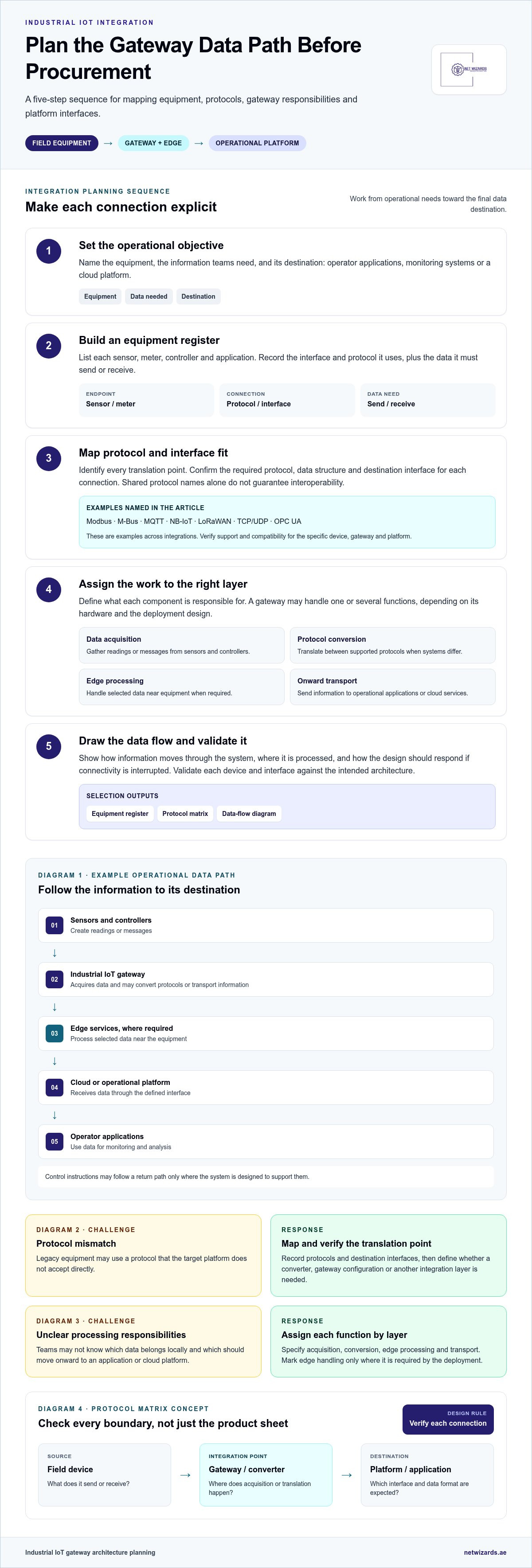
Gateway selection is more reliable when teams work from installed equipment toward the required applications. This sequence exposes legacy protocol gaps, fragmented data paths and unclear edge-versus-cloud responsibilities before they become deployment problems. For an industrial iot gateway middle east project, record each decision and its evidence so engineering, operations and IT teams share the same requirements.
- Inventory equipment. Record sensors, meters, controllers and existing systems, including their roles and available documentation. Output: an equipment register.
- Map protocols and interfaces. Document how each device communicates and where translation may be required. Separate verified information from assumptions that need engineering validation. Output: a protocol matrix.
- Define data needs. Specify what information each application needs, whether the system monitors data or also supports control, and how quickly teams need to act on it. Output: a data-requirements record.
- Design responsibilities. Assign acquisition, conversion, edge handling and onward transport to the relevant components. Identify which data goes to SCADA, cloud, metering or facility-management systems. Output: a data-flow diagram.
- Validate integration. Test representative equipment and interfaces against the intended workflow before wider deployment. Document gaps and resolve them in the design. Output: an integration test record.
Build a gateway requirements matrix
Bring the equipment register and protocol matrix into one view. For each device, capture its protocol, required data, destination, monitoring or control role, and the component expected to handle it. Mark confirmed system requirements separately from assumptions. Include cybersecurity and operational requirements as design inputs, such as access ownership, data handling and maintenance responsibilities. These considerations do not establish any particular product capability or certification.
Infographic 3. Requirements-to-architecture workflow
Legacy protocols → Map device interfaces → Define conversion requirements
Fragmented data paths → Identify destinations and owners → Draw end-to-end data flow
Unclear edge and cloud roles → Assign processing responsibilities → Validate the operating design
Validate interfaces and integration before deployment
Trace every planned connection to its receiving system. A gateway may connect equipment to SCADA, a cloud platform, a metering system or facility-management software, but the design must account for the specific interfaces and data expected at each boundary. Define who owns the data, how exceptions are handled and who maintains the integration. Project-specific testing can reveal mapping or workflow gaps before wider rollout.
For broader OT architecture considerations, consult the mission-critical industrial networking pillar. NET WIZARDS’ end-to-end sensor-to-cloud integration capabilities bring Industrial IoT sensors, gateways, and protocol converters into the same planning context.
Integrate Industrial IoT Gateways with NET WIZARDS Engineering and Platforms
A gateway delivers value as part of a defined system, not as an isolated device. NET WIZARDS L.L.C brings Industrial IoT Gateways, Edge Computing Devices and protocol converters into an end-to-end architecture that can connect field equipment with monitoring and analytics. The Industrial-grade IoT Cloud Platform provides multi-protocol support, including MQTT, Modbus, NB-IoT, LoRaWAN and TCP/UDP. This does not mean every device or gateway supports every protocol combination. Integration depends on the project’s equipment, interfaces and data requirements.
NET WIZARDS L.L.C has 20 years in business. Its engineering capabilities include custom hardware and software development and OEM/ODM services through in-house R&D centres in the United Arab Emirates, China and Taiwan. Keeping sensor design, gateway integration and cloud systems within an end-to-end engineering approach can help clarify ownership across interfaces and align data collection with the operational use of that data.
Connect gateway engineering with industrial cloud integration
Start with the field data and its purpose. Industrial IoT sensors collect information; gateways and protocol converters support communication across the defined architecture; cloud monitoring and analytics make selected information available to operational teams. Aligning these layers can support more coherent monitoring and help teams use telemetry for operational efficiency, predictive maintenance, energy optimization and enhanced safety. The value depends on how the solution is configured and used, not on the gateway alone.
Apply the architecture to remote and distributed assets
Remote monitoring illustrates why the end-to-end path matters. Distributed assets may use different communication methods, so teams need to align device protocols, gateway functions, connectivity and platform interfaces. NET WIZARDS L.L.C’s LoRaWAN network is being deployed through a joint venture with InfraX by DEWA, backed by an investment of AED 6 million. LoRaWAN connectivity reaches up to 10 km from gateways, with multi-year battery life for remote sensors. Suitability depends on the deployment design and connected devices.
For an industrial iot gateway middle east project, define the assets, protocols, destinations and operational objectives before specifying the architecture. NET WIZARDS L.L.C can bring gateway requirements into the wider sensor-to-cloud design, including the role of edge devices and cloud integration. Discuss your project requirements and the data path your systems need to support.
Specify the Data Path Before You Select the Gateway
A sound gateway decision starts with the operational data path, not a feature list. Map the installed equipment and protocols, identify destination systems, and assign clear responsibilities for acquisition, conversion, edge handling and cloud services. Then validate interfaces and integration assumptions before deployment. This process helps address legacy-device differences, fragmented data flows and uncertainty about where processing belongs.
For an industrial iot gateway middle east deployment, the right architecture depends on existing assets and operational objectives. NET WIZARDS brings 20 years in business, in-house engineering and end-to-end solution delivery from sensor design through cloud integration and analytics. Its Industrial IoT Gateways, protocol converters, Edge Computing Devices and Industrial-grade IoT Cloud Platform can be considered as connected parts of a project-specific design.
Define the interfaces, data responsibilities and integration boundaries with care, and your gateway specification can provide a firmer foundation for a connected industrial operation.
Frequently Asked Questions
What is an industrial IoT gateway, and what does it do?
An industrial IoT gateway connects field equipment with networks and higher-level applications. Depending on the design, it can acquire device data, convert supported protocols, handle selected processing at the edge, and transport information to monitoring or cloud platforms. Its specific role depends on the hardware and integration architecture. Define the required data path first, including the equipment, interfaces and destination systems the deployment must connect.
How does an industrial IoT gateway differ from a protocol converter?
An industrial IoT gateway is an integration point within a wider data path, while a protocol converter focuses on translating data between supported protocols. A gateway may include conversion as one of its functions, but the terms are not interchangeable by default. For example, a converter may help bridge equipment using Modbus to a system expecting another supported protocol. Confirm the actual interfaces and data mapping required for the project.
Which protocols should an industrial IoT gateway support?
Choose protocols according to the equipment and platform interfaces in the deployment, rather than selecting the longest list. Modbus and M-Bus may be relevant to automation and metering; MQTT, NB-IoT, LoRaWAN, TCP/UDP and OPC UA are examples used in industrial connectivity and platform integration. Support varies by gateway and configuration. Document each device’s protocol, data requirements and destination, then match them to the proposed architecture.
Can one industrial IoT gateway connect legacy equipment to a cloud platform?
Yes, if the gateway and system architecture support the equipment’s interfaces and the cloud platform’s expected data format. The integration may require protocol conversion, data mapping and a defined network path. A gateway does not make every legacy device automatically compatible. Build an equipment and protocol register, identify conversion points, and validate data exchange with the target platform before expanding the deployment.
How do I choose between an edge gateway and a cloud-based architecture?
Choose based on operational responsibilities, connectivity conditions, data volumes and how quickly teams need to use information. Edge computing handles selected data close to equipment, while cloud services can support centralized monitoring and analytics. A deployment may use both. Define which functions must operate locally, what data should be sent onward, and which systems and teams own monitoring, processing and response.
What challenges should a gateway integration plan address?
Address legacy protocols, fragmented data paths, incompatible interfaces and unclear responsibility between edge and cloud systems. Also define data destinations, ownership, monitoring or control needs, exception handling and ongoing maintenance responsibilities. Separate verified requirements from assumptions that need engineering validation. A protocol matrix and data-flow diagram make dependencies visible, while project-specific integration testing can identify gaps before a broader rollout.
How do industrial IoT gateways support predictive maintenance?
Gateways can help bring equipment telemetry into monitoring and analytics workflows. When sensors provide relevant operational data and the wider system is configured to analyze it, teams can use those insights to support predictive maintenance. The gateway itself does not predict failures. Results depend on the data collected, its quality, the analytics applied and how operational teams use the findings to plan maintenance activity.
How can NET WIZARDS support an industrial gateway integration project?
NET WIZARDS supplies Industrial IoT sensors, gateways, and protocol converters, Edge Computing Devices, and an Industrial-grade IoT Cloud Platform. Its end-to-end capabilities span sensor design through cloud integration and analytics, supporting architecture planning across the data path. With 20 years in business, NET WIZARDS can align gateway and platform requirements with project-specific equipment, protocols and operational objectives as part of an industrial iot gateway middle east deployment.