
The fastest route to industrial IoT can be a carefully engineered solution, not an off-the-shelf purchase. In the UAE, equipment must suit actual site conditions, while legacy Modbus or M-Bus systems can complicate integration. The key question is whether bespoke development can deliver a defensible return on investment. Industrial IoT R&D services UAE give operators a way to assess that decision against operating conditions, protocol requirements and long-term costs.
Custom engineering is not automatically the right answer. It needs a clear business case, defined technical requirements and a realistic view of lifecycle costs. This framework explains how to evaluate those factors, identify when standard equipment is sufficient and build an ROI calculation for bespoke automation investments.
You’ll also find practical guidance on hardware selection and legacy-system integration, alongside a decision framework for moving from concept to deployment. NET WIZARDS has 20 years in business and provides bespoke R&D engineering services for complex industrial automation needs.
Key Takeaways
Use a decision framework to determine when bespoke industrial IoT R&D services UAE are justified over standard equipment.
Assess environmental conditions and legacy Modbus or M-Bus requirements before selecting sensors, gateways or protocol converters.
Build an ROI case around measurable operational factors, including sub-metering workload, energy use and maintenance needs.
Evaluate an R&D provider’s services against your integration and deployment requirements, and consider NET WIZARDS’ 20 years in business as context when assessing the company.
Table of Contents
Evaluating Industrial IoT R&D Services UAE for Infrastructure
Industrial IoT R&D applies sensors, gateways, connectivity and cloud architecture to an operation’s specific assets and requirements. Unlike a standard device purchase, it begins with the operating environment, existing equipment and the data an organization needs to act on. The broader Industrial Internet of Things (IIoT) connects industrial systems with capabilities such as edge computing and data analysis. The engineering challenge is applying those capabilities without disrupting established operations.
Off-the-shelf equipment can be a sound choice when its environmental specifications, interfaces and supported protocols match the site. Gaps can emerge when devices must operate in demanding heat or humidity, or connect to legacy equipment using protocols such as Modbus or M-Bus. A mismatch may lead to unreliable readings, integration workarounds or additional maintenance. Industrial IoT R&D services UAE help organizations assess whether adaptation or custom engineering is the better fit.
Defining the Scope of Industrial R&D
Scope may include custom hardware development, gateway and protocol-converter design, or architecture for telemetry and AI edge computing. OEM and ODM engineering may also suit projects that require product development around defined requirements. Treat proprietary communications as a design decision, not an automatic requirement. First assess interoperability, security needs and compatibility with existing systems. A clear scope limits unnecessary customization and keeps engineering focused on an operational need.
Challenges and Solutions: Environmental Resilience
Challenge: Equipment selected without reference to actual site conditions may not suit heat, humidity, dust or enclosure constraints. Solution: Define the installation environment, review component and enclosure suitability, and test prototypes against relevant operating conditions. Thermal management and material selection may also need consideration. Benefit: This evidence-led process can reduce avoidable replacement and maintenance risk. It cannot guarantee uptime, so validate performance against the project’s acceptance criteria.
When engineering must address specific operating requirements, look for a provider with relevant product development services. NET WIZARDS has 20 years in business and provides bespoke R&D engineering services. That experience can be one factor in evaluating design trade-offs. Before committing, confirm testing methods, documentation, ownership and support arrangements. Better-fit telemetry can support operational efficiency and predictive maintenance when sensor data is reliable and teams have defined how they will use it.
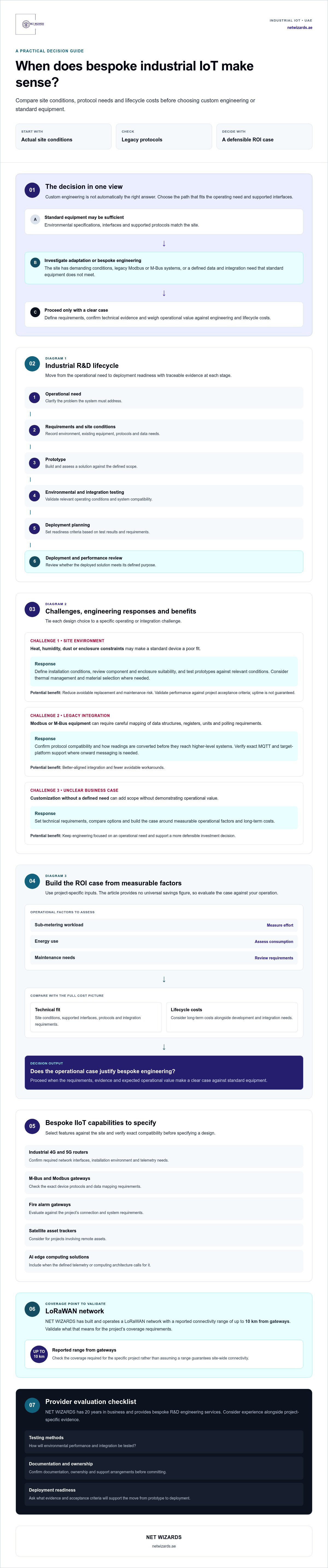
Infographic 1: Industrial R&D lifecycle
Operational need → Requirements and site conditions → Prototype → Environmental and integration testing → Deployment planning → Deployment and performance review
At each stage, record the technical evidence and decision criteria before moving forward. This creates a traceable path from prototype results to deployment readiness.
Key Features of Bespoke IIoT Hardware and Gateways
A bespoke gateway should solve a defined connection problem, not add another isolated device to the network. In an industrial environment, that may mean connecting legacy meters to a cloud platform, transmitting sensor data over LoRaWAN or routing information from remote assets. NET WIZARDS supplies industrial 4G and 5G routers, M-Bus / Modbus gateways, fire alarm gateways, satellite asset trackers and AI edge computing solutions. Select features against site requirements, and verify exact protocol compatibility before specifying a design.
Protocol support needs particular scrutiny. Modbus and M-Bus devices may expose different data structures, registers, units and polling requirements. A converter must map those details correctly before passing readings to higher-level systems. MQTT may be required for onward messaging, but confirm the target platform’s exact support rather than assuming compatibility. The Smart Manufacturing Initiative provides context for the UAE’s broader focus on digital capabilities and industrial modernization.
Hardware Features to Specify
Start with operating conditions and data needs. For industrial 4G or 5G routers, confirm the required network interfaces, installation environment and telemetry requirements against the actual device specification. A satellite asset tracker may suit equipment operating beyond cellular coverage, subject to coverage and deployment assessment. Where LoRaWAN is appropriate, NET WIZARDS reports a connectivity range of up to 10 km from gateways through a network delivered as part of LoRaWAN public network in Dubai
AI edge computing can process selected data near its source, potentially supporting local analysis without sending every raw reading upstream. Define which signals the application needs, how it handles communications loss and what information must reach the cloud. For existing Ethernet or PoE infrastructure, document switch and power requirements as integration criteria rather than assumed product capabilities.
Challenges and Solutions: Protocol Fragmentation
Challenge: Legacy Modbus or M-Bus equipment and fire alarm panels may not communicate directly with modern platforms. Solution: Specify a suitable gateway or protocol-converter design, then test representative devices and data mappings before deployment. Confirm which alarms, readings and status changes must pass through. Benefit: A validated interface can reduce manual data handling and support a more consistent flow between operational equipment and monitoring systems. It does not, by itself, guarantee uninterrupted service.
Diagram 2: Functional block diagram of a custom industrial gateway architecture
Modbus / M-Bus meters and equipment → Protocol conversion and data mapping → Gateway with defined connectivity → Edge processing, if required → Industrial cloud platform or monitoring system
For each connection, document the protocol, data fields, transmission path and failure behavior. Treat each item as a requirement to validate, not a universal feature.
For a project involving legacy protocols, define the device list and target data flow before selecting hardware. Assess NET WIZARDS’ industrial IoT R&D services UAE against those requirements. Review industrial gateway requirements with the team.
ROI Calculation and Decision Template for Automation
A credible automation business case starts with a measured baseline, not a projected saving. For industrial IoT R&D services UAE, compare the full cost of engineering and deployment with the operational value the system can reasonably deliver. Use site records for labor, energy, maintenance, communications and replacement costs. Separate verified savings from estimates, and identify who will measure each benefit after deployment.
The ROI Decision Framework
Compare custom R&D CAPEX with the lifecycle cost of standard equipment, including integration, ongoing operation, maintenance and replacement. Custom development may address limitations in standard products, but it also creates responsibilities for documentation, updates and future support. NET WIZARDS has 20 years in business. Treat that history as one factor in assessing delivery risk, not as a guarantee of project outcomes.
For AI edge computing, estimate whether local processing can reduce data sent to the cloud, then compare expected bandwidth use with actual tariffs and system costs. For sub-metering, estimate labor impact using the hours spent collecting and reconciling readings before and after automation. For predictive maintenance, base potential value on documented maintenance events and downtime. Validate assumptions in a pilot before counting them as realized savings.
Challenges and Solutions: Hidden Implementation Costs
Challenge: Field conditions, device compatibility and site-specific integration can add work not captured in an initial estimate. Solution: Include requirements definition, site assessment, prototype testing, integration effort and pilot evaluation in the project plan. Confirm which activities the R&D partner will deliver and which remain with the operator. Benefit: Explicit scope and staged validation make budget assumptions more transparent and reduce the risk of late project changes.
Evaluate LoRaWAN coverage against the asset map, obstructions and project requirements. NET WIZARDS’ LoRaWAN public network in Dubai, has a reported connectivity range of up to 10 km from gateways. Treat that as a stated range, not a guarantee of coverage at every site. Compare the proposed network design with alternatives, including the assets it can reliably serve after testing.
Infographic 3: Industrial automation ROI calculator template for 2026
Baseline: Record current labor hours, energy use, maintenance events, downtime and communications costs.
Investment: Add R&D, hardware, integration, testing, deployment and ongoing operating costs.
Annual net benefit: Verified labor, energy and maintenance savings, minus added operating costs.
ROI: (Cumulative net benefit minus initial investment) ÷ initial investment × 100.
Decision: Test assumptions, record uncertainty and compare results with the organization’s investment threshold.
Use the same measurement definitions before and after deployment. A defensible ROI case shows its inputs, distinguishes expected from confirmed benefits, and makes clear what evidence would change the investment decision.
Navigating Technical Challenges in IoT Product Development
Industrial IoT product development requires coordination between hardware design, software integration and operating requirements. When assessing an R&D provider, examine relevant engineering experience, prototyping processes, technical documentation and testing methods. NET WIZARDS has 20 years in business and provides bespoke R&D engineering services. For a project in the UAE, confirm how the engineering team will work with stakeholders, document decisions and validate the design against intended site conditions.
Control over industrial communications starts with understanding interfaces, data formats and dependencies. Check that the proposed architecture can communicate with the required utility and operational systems. For AMI sub-metering, use the project’s applicable utility specifications to define standards and integration requirements rather than assuming one configuration fits every deployment.
Technical Standards, Security and Field Constraints
For metering projects, confirm whether DLMS or M-Bus is required and test data exchange using the actual meters and receiving platform. A fire alarm gateway may connect panel data with a building management system, but verify the panel interface, required signals and integration responsibilities for the project. Protocol labels alone do not establish compatibility.
At the edge, define which data must be processed locally, who can access it and how the system will protect it. Remote sensor battery performance depends on reporting frequency, radio conditions, sensing workload and environmental exposure. Record these assumptions and validate them in representative field conditions before relying on a multi-year service-life estimate.
Challenges and Solutions: Connectivity Gaps
Challenge: Remote industrial sites and pipeline corridors may include areas with weak or unavailable cellular connectivity. Solution: Map asset locations and communications needs, then assess suitable options such as satellite asset trackers or LoRaWAN gateways. Validate coverage under actual deployment conditions and confirm reporting expectations for each asset. Benefit: A connectivity plan matched to asset location can extend monitoring to equipment that would otherwise be difficult to reach. Confirm coverage and transmission behavior before defining monitoring as continuous or real time.
For industrial IoT R&D services UAE, turn these considerations into project acceptance criteria: required protocols, utility integration, edge security, field-test evidence, battery assumptions and verified connectivity. Clear criteria give engineering teams and operators a common basis for assessing readiness.
Review IoT product development requirements
Planning Deployment with NET WIZARDS R&D Services
Deployment readiness depends on more than a viable prototype. Engineering decisions must carry through to integration, operating documentation and future modification. For buyers evaluating industrial IoT R&D services UAE, assess how the proposed work addresses the project scope and operating requirements. Confirm responsibilities, design ownership and prototype validation methods before work begins.
NET WIZARDS reports an AED 6 million investment in a LoRaWAN network delivered through a joint venture with a third-party license holder. This is relevant when evaluating the company’s network infrastructure offering, but it should not replace a project-specific assessment of coverage, device compatibility and deployment needs. Ask how a proposed solution will be tested against the assets and operating conditions it must support.
Comprehensive Solution Benefits
Match each platform or device to a defined operational outcome. An Industrial-grade IoT Cloud Platform can provide a place to consolidate and review operational data, subject to confirmed integration requirements. An AMI sub-metering platform can support visibility into meter data, while Smart Parking & Parking Guidance Systems address a distinct site-management need. Fire alarm gateways can provide an interface for fire alarm system data, but teams should confirm panel compatibility and building-system requirements before specifying integration. Benefits depend on accurate data, suitable configuration and clear operating procedures.
In-house R&D can support product development and adaptation, but treat prototyping capability as something to verify during procurement. Request a development plan with prototype milestones, acceptance criteria and documentation deliverables. This makes it easier to judge whether a design is ready for field evaluation and what remains before wider deployment.
Challenges and Solutions: Vendor Independence
Challenge: Dependence on a single international vendor may constrain hardware choices or make future changes reliant on that vendor’s product roadmap and support model. Solution: Define interface requirements, data access, documentation, ownership and change responsibilities at the outset. Then assess whether R&D services can adapt the design to the operation’s needs. Benefit: Clear technical control can improve flexibility and support long-term infrastructure planning. It does not remove the need to maintain, test and govern the resulting system.
Diagram 4: NET WIZARDS R&D project coordination
Operating requirements → Engineering coordination and product development → Prototype validation → Deployment planning → Deployment review
Confirm the role, deliverables and handover responsibilities for each project workstream. The diagram represents a planning model, not a claim that every project follows the same workflow.
Turn Your Industrial IoT Strategy into a Measurable Investment
A strong investment decision depends on more than selecting the right device. Assign clear ownership for technical validation, operational adoption and post-deployment measurement. These steps help ensure the system is engineered to specification and used effectively by the teams responsible for it.
NET WIZARDS provides industrial IoT R&D services UAE organizations can evaluate against their project scope, integration requirements and long-term operating plans. Before proceeding, agree on deliverables, acceptance criteria and how the project will be reviewed after deployment.
With accountable decision-making and a practical implementation plan, your organization can move from technical evaluation toward an informed deployment.
Discuss your industrial IoT R&D requirements with NET WIZARDS
Frequently Asked Questions
What are the primary benefits of custom industrial IoT R&D services?
Custom industrial IoT R&D can address requirements that standard devices do not meet, including specific operating conditions, legacy interfaces or proprietary automation needs. It can also support tailored gateway and cloud integration, helping teams connect equipment and use operational data more effectively. The value depends on project fit. Define the technical problem, compare custom development with available standard solutions and measure expected benefits against actual operating costs.
How does the 10 km LoRaWAN range impact project ROI?
NET WIZARDS reports a connectivity range of up to 10 km from gateways for its LoRaWAN network, which is part of a joint venture with a third-party license holder backed by an AED 6 million investment. The range can inform the assessment of distributed assets, but it does not confirm coverage across every site. To assess ROI, map assets, validate coverage in the field and compare the proposed network design with other connectivity requirements and costs.
Why is extreme heat a major challenge for industrial networking equipment?
Heat can push electronic components beyond their specified operating conditions and increase thermal stress, while humidity and enclosure conditions may add further risks. This can affect reliability and increase maintenance needs if equipment is not suited to its installation environment. Check manufacturer operating limits, enclosure suitability and heat-management requirements. Validate the chosen device under representative site conditions rather than assuming a standard commercial product will perform reliably in an industrial setting.
Can custom R&D help integrate legacy Modbus and M-Bus devices?
Yes. Custom R&D can help connect legacy equipment through a suitable M-Bus / Modbus gateway or protocol converter. The engineering work should account for the specific device interfaces, register or data mapping, polling needs and receiving platform. Test representative meters and equipment before deployment, and verify that the required readings transfer accurately. NET WIZARDS supplies M-Bus / Modbus gateways and provides R&D services, but project compatibility should be confirmed against the actual system configuration.
What is the typical lifespan of a custom-engineered industrial sensor?
There is no single reliable lifespan for every custom industrial sensor. Service life depends on its components, operating environment, measurement workload, power source and maintenance conditions. NET WIZARDS’ product information describes multi-year battery life for remote sensors, but does not specify a universal sensor lifespan or a precise battery duration. Request product-specific operating limits and lifecycle assumptions, then validate them through testing in conditions representative of the intended installation.
How do R&D services support product development?
NET WIZARDS provides bespoke R&D engineering services for complex industrial automation needs. When evaluating a provider, clarify which workstreams it will handle, how teams will document decisions, and who will own prototypes, technical files and future design changes. Confirm the proposed validation process and deliverables before work begins.
What role does AI edge computing play in industrial automation ROI?
AI edge computing processes selected data near its source, which can support local analysis and reduce the amount of information sent to a cloud platform. Any bandwidth cost benefit depends on data volume, connectivity charges and processing requirements. For ROI, compare current data transmission and operating costs with a tested edge design. Also define which alerts or decisions require local processing and measure whether they improve maintenance or operational workflows.
How can organizations justify the cost of bespoke IoT hardware?
Justify bespoke hardware with a documented business case, not an assumed saving. Establish current labor, energy, maintenance and communications baselines, then include development, testing, integration, deployment and ongoing operating costs. Estimate benefits using site data, distinguish projections from verified results, and test key assumptions in a pilot. Industrial IoT R&D services UAE are most defensible when custom development solves a defined constraint that standard equipment cannot address effectively.