A connected dashboard cannot solve a fragmented operation if equipment, protocols, and existing systems still cannot exchange useful data. For UAE operators, choosing an industrial IoT solutions provider UAE means assessing more than devices or software. The real test is whether a partner can explain how sensors, gateways, connectivity, edge computing, platforms, and integration will work together with your existing operations.
Provider proposals can be difficult to compare when they leave hardware ownership, protocol compatibility, or integration responsibilities unclear. Start with your operational requirements, then check how each proposed component addresses them.
This guide provides a practical framework for assessing integration capability, operational fit, platform architecture, and delivery responsibilities. It explains what to verify across Industrial IoT sensors, gateways, protocol converters, and cloud platforms, including support for protocols such as MQTT and Modbus. Use these criteria to clarify solution boundaries, surface technical questions early, and prepare a focused discussion with your engineering team.
Key Takeaways
- Compare providers by how clearly they define equipment, connectivity, platform, integration, and delivery responsibilities.
- Map existing assets and protocols before evaluating solutions to identify where sensors, gateways, or protocol converters may fit.
- Assess an industrial IoT solutions provider UAE against your operational use case, not just its product list or platform demonstration.
- Connect each deployment challenge, such as disconnected equipment or fragmented utility data, to a defined technical approach and operational purpose.
- Prepare for engineering discussions by documenting required data, current systems, interfaces, and the decisions monitoring needs to support.
Table of Contents
- What Should an Industrial IoT Solutions Provider in the UAE Deliver?
- How Industrial IoT Sensors, Gateways, Edge, and Cloud Work Together
- How to Compare Industrial IoT Solutions Providers in the UAE
- What Challenges Can an Industrial IoT Deployment Solve, and How?
- From Provider Shortlisting to a Defined UAE IoT Project
What Should an Industrial IoT Solutions Provider UAE Deliver?
An industrial IoT solutions provider UAE should connect operational assets, communications, data platforms, and the decisions teams need to make. Supplying devices is only one part of the scope. Establish who designs the architecture, integrates equipment and protocols, commissions the system, and manages platform responsibilities after deployment.
Definition: An industrial IoT provider aligns industrial devices, connectivity, data processing, and monitoring with operational requirements. Unlike a general IT vendor or consumer automation provider, it must account for industrial equipment, existing protocols, and the implications of changing how operational data is collected or used.
Which operational problems should the provider address?
Start with a specific operational gap, not a technology list. Disconnected equipment can make it difficult to compare asset status. Limited metering can make utility use harder to review. Incomplete asset visibility can slow investigation of equipment conditions. For each gap, identify the data required, the asset or system it comes from, and the decision that information should support.
This distinction keeps industrial requirements separate from consumer smart-home applications. Industrial automation, facilities, utilities, transportation, and critical infrastructure may involve existing equipment and protocols that a proposed solution must accommodate. A well-defined scope can support operational efficiency, predictive maintenance, energy optimization, or enhanced safety. Set expected outcomes against your own process measures rather than assuming a particular result.
What belongs in an end-to-end industrial IoT scope?
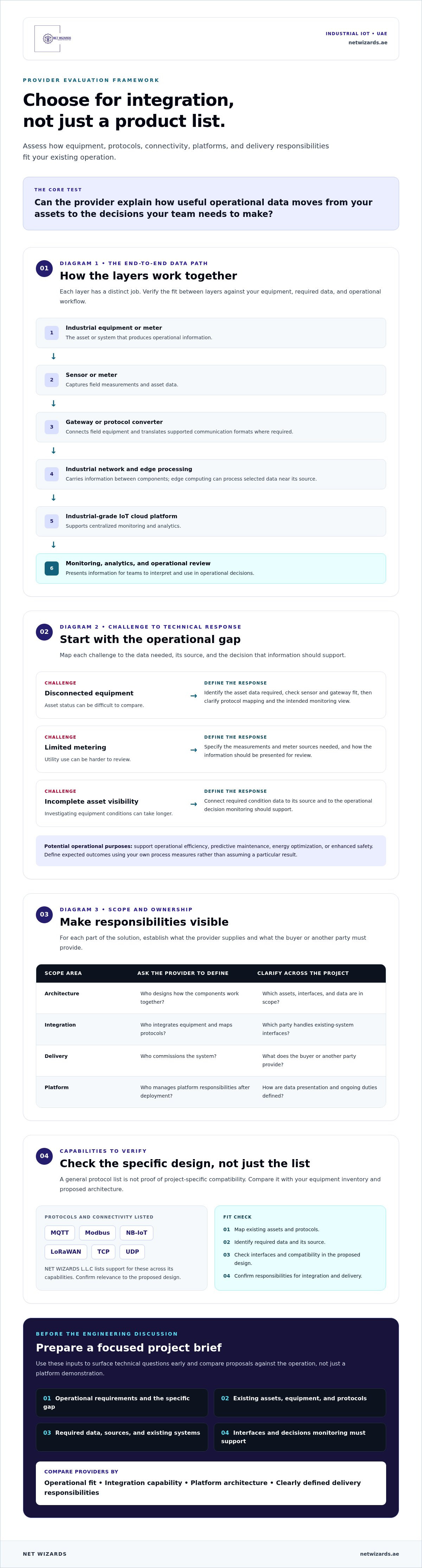
Assess the complete data path. Industrial IoT sensors capture field information. Gateways and protocol converters connect devices and translate data where required. Industrial networking carries information onward, while edge computing can process selected data before it reaches an Industrial-grade IoT Cloud Platform. Monitoring interfaces and reports then present information for review. The Industrial Internet of Things (IIoT) overview provides broader context on the technologies behind this architecture.
Data path diagram
Industrial asset → Sensor or meter → Gateway or protocol converter → Industrial network and edge processing → Cloud platform → Monitoring interface and operational decision
For every step, document what the provider supplies and what the buyer or another party must provide. Confirm who handles existing-system interfaces, protocol mapping, data presentation, commissioning, and ongoing platform responsibilities. NET WIZARDS L.L.C lists support for MQTT, Modbus, NB-IoT, LoRaWAN, TCP, and UDP across its capabilities. Check those details against your equipment inventory and the proposed design, rather than treating a general protocol list as proof of project-specific compatibility.
How Industrial IoT Sensors, Gateways, Edge, and Cloud Work Together
An industrial IoT architecture moves operational data from equipment to a point where teams can interpret it and act. Each layer has a distinct role: sensors capture field measurements, gateways collect device data and connect field equipment to wider networks, protocol converters translate between supported communication formats, industrial networking carries information between system components, edge computing processes selected data near its source, and a cloud platform supports centralized analytics and monitoring.
This connected architecture is central to the Industrial Internet of Things, where operational technology and digital systems work together. For buyers evaluating an industrial IoT solutions provider UAE, check how each layer fits the actual equipment, required data, and operational workflow. A list of supported technologies alone does not establish end-to-end compatibility.
System architecture diagram
Industrial equipment or meter → Industrial IoT sensor → Gateway or protocol converter → Industrial network → Edge processing → Industrial-grade IoT Cloud Platform → Remote monitoring, analytics, and operational review
What do gateways and protocol converters contribute?
Gateways provide a connection point between field equipment and upstream monitoring systems. Protocol converters can translate data between supported formats, which may help connect equipment that communicates differently. Conversion does not automatically make every device or interface compatible. Confirm the equipment, data points, protocol versions, and system interfaces the proposed design will support, and ask who will validate them.
NET WIZARDS L.L.C lists support across MQTT, Modbus, NB-IoT, LoRaWAN, TCP, and UDP. Ask the provider to specify where each protocol applies in your proposed design. Confirmed protocol support is a starting point; project-specific interface validation is still necessary.
When should processing happen at the edge or in the cloud?
Edge processing places selected computation closer to equipment, while cloud-based services centralize information for broader monitoring and analysis. The right division depends on what must be processed locally, what teams need to review across systems, and how existing infrastructure connects. NET WIZARDS L.L.C offers AI edge computing and an Industrial-grade IoT Cloud Platform with analytics capabilities. Clarify which functions sit at each layer and what users will see in the platform.
A defined design can help teams organize operational information for equipment review, energy analysis, or maintenance decisions. Before selecting a configuration, map a representative asset and its interfaces with your engineering team. You can discuss an industrial IoT architecture against those requirements.
How to Compare Industrial IoT Solutions Providers in the UAE
A broad product catalogue does not prove project fit. An industrial IoT solutions provider UAE should show how its proposed hardware, connectivity, platform, and integration responsibilities address your stated operational challenge. Compare documented capabilities and scope, not unverified performance promises or credentials.
Which technical questions should buyers ask providers?
Give each provider the same asset inventory and use case, then ask for a response that identifies the proposed components and interfaces. Confirm which existing devices, systems, and protocols require integration, and how compatibility will be checked. Require a clear division of responsibility for hardware, connectivity, platform configuration, and third-party interfaces. Specify which dashboards, reports, or monitoring workflows the proposal includes.
| Comparison area | What to verify | Evidence to request |
|---|---|---|
| Use-case fit | Does the proposal address the stated monitoring, metering, tracking, or facility need? | A solution outline linked to the operational requirement |
| Protocols | Are the required protocols and interfaces identified? | A compatibility assessment for the listed equipment and systems |
| Hardware | Are sensors, gateways, or other devices specified for their intended role? | A defined component list and responsibility split |
| Platform scope | Are monitoring, analytics, and reporting functions described? | Documented platform functions and workflow examples |
| Integration ownership | Who handles existing systems and third-party interfaces? | A written scope showing inclusions, exclusions, and owners |
How can the solution be matched to the operational use case?
Start with the decision teams need to make, then check whether the proposed components can provide relevant information. For energy monitoring or sub-metering, examine the fit of an AMI Sub-Metering Platform and the required metering interfaces. For asset visibility, consider whether a Satellite Asset Tracker suits the use case. Facility monitoring may call for an Industrial Cloud Platform, relevant sensors, or a Weather Monitoring Station, depending on the data required. Treat each as a candidate capability, not a complete design, until interfaces and scope are confirmed.
Challenge-to-evaluation infographic
- Fragmented utility data: assess metering and platform functions. Ask which meters and data points are included.
- Limited asset visibility: assess tracking requirements. Ask how assets, connectivity, and monitoring fit the deployment.
- Equipment integration gaps: assess gateways and protocol support. Ask how interfaces will be validated and who owns integration.
Compare deployment constraints, data ownership requirements, and how operational teams will use monitoring outputs. A coherent proposal connects the challenge to the solution layers, identifies unresolved dependencies, and makes responsibilities explicit. This gives procurement and engineering teams a consistent basis for evaluating fit before committing.
What Challenges Can an Industrial IoT Deployment Solve, and How?
Industrial IoT is most useful when it addresses a defined operational gap. Disconnected assets can leave teams without a consolidated view. Limited monitoring can make changing equipment conditions harder to review. Fragmented utility data can complicate resource decisions. The solution should connect the required information to a practical workflow, not promise savings, uninterrupted operation, or a particular maintenance outcome.
Challenge-to-solution infographic
- Operational problem: Disconnected equipment. Proposed component: Gateways and protocol converters, where interfaces are compatible. Decision support: A more consolidated view of available equipment data.
- Operational problem: Limited visibility of asset or process conditions. Proposed component: Relevant Industrial IoT sensors, connectivity, and platform monitoring. Decision support: Review of monitored conditions to inform operational follow-up.
- Operational problem: Fragmented utility data. Proposed component: Metering interfaces and an AMI Sub-Metering Platform, subject to project requirements. Decision support: A clearer basis for reviewing consumption information.
How can fragmented equipment data become actionable?
Gateways can connect compatible field equipment to monitoring systems, while protocol converters can help translate supported data formats. Together, these components may bring information from separate sources into a shared monitoring workflow. An Industrial-grade IoT Cloud Platform can support monitoring, analytics, and reporting, giving teams a place to review data gathered across monitored assets.
Compatibility is project-specific. Before selecting components, document equipment models, interfaces, required data points, and any existing operational systems involved. Ask the provider to confirm how each interface will be technically validated and which party owns that work. Confirmed protocol support alone does not establish that every device or system will integrate as required.
How can monitoring support maintenance and resource decisions?
Remote monitoring can give teams visibility of reported asset or process conditions, which can inform investigation and follow-up. For example, energy monitoring and sub-metering can organize utility data for review. Remote tank or cold storage monitoring may also be relevant where those conditions matter, but the required sensors, interfaces, connectivity, and reporting scope need to be established for the project.
The benefit is better-informed decisions, not a guaranteed reduction in consumption or a prediction that equipment will fail. A defined monitoring scope can help teams see which assets are covered, what information is available, and how it relates to maintenance, resource use, or safety workflows. When assessing an industrial IoT solutions provider UAE, require the proposal to connect each operational need to specified components, validated interfaces, and useful decision support.
From Provider Shortlisting to a Defined UAE IoT Project
A disciplined shortlist begins with the operational requirement, not a preferred device or platform. Document what teams need to observe, which systems already hold relevant information, and what decisions the data should support. This gives each provider a consistent basis for proposing an architecture and stating what its scope includes.
What should an industrial IoT requirements brief include?
Record the operational challenge, assets to monitor, current systems, known protocols and interfaces, and required reports or control workflows. Mark uncertain compatibility for engineering review rather than assuming it. Identify stakeholders across operations, engineering, facilities, IT, and procurement so technical requirements and ownership questions are surfaced early.
- Define the use case. State the operational problem and the decision or process the solution should support.
- Inventory assets. List equipment, meters, or other assets in scope and note the data each needs to provide.
- Map interfaces. Document current systems, known protocols, and connections between them. Flag unknowns for validation.
- Set the project boundary. Specify expected hardware, connectivity, platform functions, reporting, and integration responsibilities.
- Assess proposals consistently. Compare each provider’s response against the same requirements, dependencies, exclusions, and evidence.
This sequence helps expose gaps before a proposal becomes a commitment. It also makes it easier to distinguish a defined integration plan from a catalogue of potentially relevant products.
What should buyers expect from an initial provider discussion?
Use the discussion to test the proposed scope against your brief. Ask which assets and interfaces the design addresses, what needs technical validation, where edge processing or platform functions fit, and who owns connections to existing or third-party systems. Clarify the expected monitoring or reporting workflow, as well as what is outside the proposed scope. The objective is a clear account of dependencies and responsibilities, not an unsupported promise of operational results.
NET WIZARDS L.L.C has been in business for 20 years and supplies industrial networking equipment, gateways, AI edge computing, and an Industrial-grade IoT Cloud Platform. Assess these capabilities against your asset inventory and project requirements. A relevant capability is a fit only when its interfaces, role, and delivery boundary align with the intended use case.
With a requirements brief prepared, you can discuss your industrial IoT requirements and assess technical fit and project scope with NET WIZARDS L.L.C.
Turn Your IoT Requirements into a Defined Project
Selecting an industrial IoT solutions provider UAE starts with operational fit. Define the challenge, identify the assets and systems involved, and document the data and workflows your teams need. Then compare proposals by architecture, protocol compatibility, integration ownership, and clearly stated scope. A broad product range matters only when its components address your requirements.
NET WIZARDS L.L.C brings 20 years in business and capabilities spanning Industrial IoT sensors, gateways, cloud integration, and analytics. Its industrial networking and cloud capabilities support multiple protocols, including MQTT, Modbus, NB-IoT, LoRaWAN, TCP, and UDP. These provide a starting point for a technical discussion, while project-specific interfaces and responsibilities still need to be assessed against your systems.
Bring your asset inventory, known interfaces, operational priorities, and open engineering questions to the next discussion. A clearly defined scope gives your team a stronger basis for evaluating technical fit and planning a supportable solution.
Prepare your requirements and contact NET WIZARDS L.L.C to discuss the technical fit and scope of your industrial IoT project.
Frequently Asked Questions
What does an industrial IoT solutions provider do?
An industrial IoT provider connects operational assets, communications, data platforms, and monitoring workflows. Its scope may include Industrial IoT sensors, gateways, protocol converters, industrial networking, edge computing, and cloud-based monitoring. NET WIZARDS supplies these types of industrial capabilities, including an Industrial-grade IoT Cloud Platform and AI edge computing. Before selecting a provider, confirm which components are included, who owns integration, and how the proposed architecture supports your operational requirements.
How do I choose an industrial IoT solutions provider in the UAE?
Start by documenting the operational challenge, existing assets, protocols, systems, and monitoring or reporting needs. Then compare each industrial IoT solutions provider UAE against the same criteria: relevant hardware, platform functions, integration ownership, and the method for validating compatibility. Ask providers to distinguish confirmed capabilities from items that require project-specific review. A broad product catalogue alone does not show that a provider’s proposed solution fits your equipment or workflows.
Can industrial IoT systems work with existing equipment?
They may work with existing equipment when the necessary interfaces and protocols are supported and validated for the project. Gateways and protocol converters can help connect compatible equipment with monitoring systems, but their presence does not guarantee integration. Prepare an asset and interface inventory, including known protocols and systems, then ask the provider to identify dependencies and explain how compatibility will be checked. Mark unknowns clearly for engineering review before finalizing scope.
What is the difference between an industrial IoT gateway and an IoT cloud platform?
A gateway connects field devices or protocols with other parts of an IoT system. A cloud platform provides centralized functions such as monitoring, analytics, and dashboards. Edge computing can process information closer to operational equipment before selected data is used elsewhere. These components can work together, but the right architecture depends on your assets, interfaces, data needs, and workflows. Confirm what each component does in the proposed design and who is responsible for integration.
What should an industrial IoT solution include?
An industrial IoT solution should include the components required for its defined use case, rather than a standard bundle of technologies. Depending on the project, this may involve sensors, gateways, protocol converters, industrial networking, edge computing, and an Industrial-grade IoT Cloud Platform. Define the required monitoring or reporting, integration responsibilities, and compatibility checks with engineering stakeholders. NET WIZARDS supplies industrial networking equipment, gateways, AI edge computing, and cloud platform capabilities.
How can industrial IoT support predictive maintenance and energy optimization?
Monitoring can make asset conditions or energy data more visible to operational teams, helping inform maintenance and resource decisions. For example, sub-metering can organize utility data for review, while asset monitoring can help teams observe reported equipment conditions. Predictive maintenance and energy optimization are operational objectives, not guaranteed outcomes. Results depend on the assets monitored, data quality, integration, and how teams use the information in their established processes.
What information should I prepare before contacting an industrial IoT provider?
Prepare the operational use case, challenge, asset list, known protocols, existing systems, and the reports or workflows your teams need. Note uncertain interfaces for technical review rather than assuming compatibility. Identify stakeholders from operations, engineering, facilities, IT, and procurement so they can clarify requirements and responsibilities. This preparation helps an industrial IoT solutions provider UAE assess technical fit, discuss architecture dependencies, and define which components and integration tasks belong in the proposed scope.