What if a machine is connected to your network, yet the data reaching the control system still carries the wrong meaning? A physical link can establish communication, but it cannot resolve differences in protocols, data structures, or control behavior. An industrial protocol converter helps bridge those differences, but reliable integration depends on more than getting devices to exchange messages.
Legacy and newer equipment often need to work together without replacing functioning machinery. The challenge is choosing the right function for the job: protocol translation, a gateway role, or a change to the transmission medium. Each addresses a different part of the architecture.
This article explains how an industrial protocol converter enables incompatible systems to exchange usable data, where it fits within an automation architecture, and how it differs from a media converter. You’ll also learn how to plan around operational requirements and validate that signals retain their intended meaning, not just that communication is active. The result is a practical framework for integrating equipment and connecting device data to monitoring or cloud systems.
Key Takeaways
- An industrial protocol converter helps incompatible equipment exchange data, but the integration must preserve what each value means.
- Trace how signals are received, interpreted, mapped, translated, and presented to the destination system.
- Distinguish protocol translation from gateway functions and media conversion before defining the system architecture.
- Plan integration with a documented interface and point inventory, clear data mapping, and validation against operational requirements.
- NET WIZARDS supplies Industrial IoT sensors, gateways, and protocol converters, along with industrial networking and cloud solutions.
Table of Contents
- What Is an Industrial Protocol Converter, and What Problem Does It Solve?
- How Industrial Protocol Conversion Preserves Data Meaning
- Protocol Converter vs Gateway vs Media Converter: Which Role Fits?
- How to Plan an Industrial Protocol Converter Integration
- How NET WIZARDS Supports Industrial Protocol Integration
What Is an Industrial Protocol Converter, and What Problem Does It Solve?
An industrial protocol converter translates communications between different industrial protocols so equipment can exchange data in a form the receiving system can use. It is useful when devices are physically connected but follow different communication rules. A controller may send data successfully, yet another device may not understand its format, addressing, or supported functions.
That is a protocol mismatch, not necessarily a wiring fault or unavailable network. A broken cable or inactive network prevents communication from reaching its destination. Protocol incompatibility means a message may reach the other device, but that device cannot interpret it as intended. An industrial protocol converter addresses the translation layer. It does not, by itself, correct physical faults or ensure that connected systems will operate together correctly.
Diagram 1: Protocol translation between incompatible devices
Device A
Protocol and data format A
↓ Send data
Protocol converter
Receive → map → translate
↓ Present translated data
Device B
Protocol and data format B
The devices exchange mapped data through the converter. The exact protocols and functions depend on the equipment and its configuration.
What Does a Protocol Converter Translate?
A converter receives data using one protocol, interprets the relevant information, and presents it using another. This can involve translating message structure or mapping data points so the destination system can identify values, statuses, or commands. The practical scope varies by device: supported protocols, available functions, and configuration determine what it can translate.
Modbus and M-Bus are familiar examples in industrial and building systems. A Modbus device and an M-Bus system may need a suitable conversion path to share selected information. The protocol names alone do not establish compatibility. The converter must support the required interfaces and functions, and the data points must be configured appropriately. The List of automation protocols illustrates the range of communication methods used across automation.
Why Do Industrial Systems Need Protocol Conversion?
Facilities often combine equipment from different generations and vendors. Existing instruments or controllers may continue to perform their original roles while newer systems collect data for supervision, reporting, or coordinated operation. Without a translation path, useful information can remain isolated in the equipment that produced it.
Conversion can make selected data available across that boundary without requiring every machine to be replaced. The benefit depends on accurate mapping and integration. An incorrect point definition can deliver a value that appears valid but has the wrong meaning, while unsupported control functions may remain unavailable.
Protocol conversion is protocol-level translation between communications, not a guarantee that connected systems are fully integrated. Treat it as one defined part of an integration design. Identify what information must cross the boundary, how the destination will interpret it, and how the required behavior will be validated.
How Industrial Protocol Conversion Preserves Data Meaning
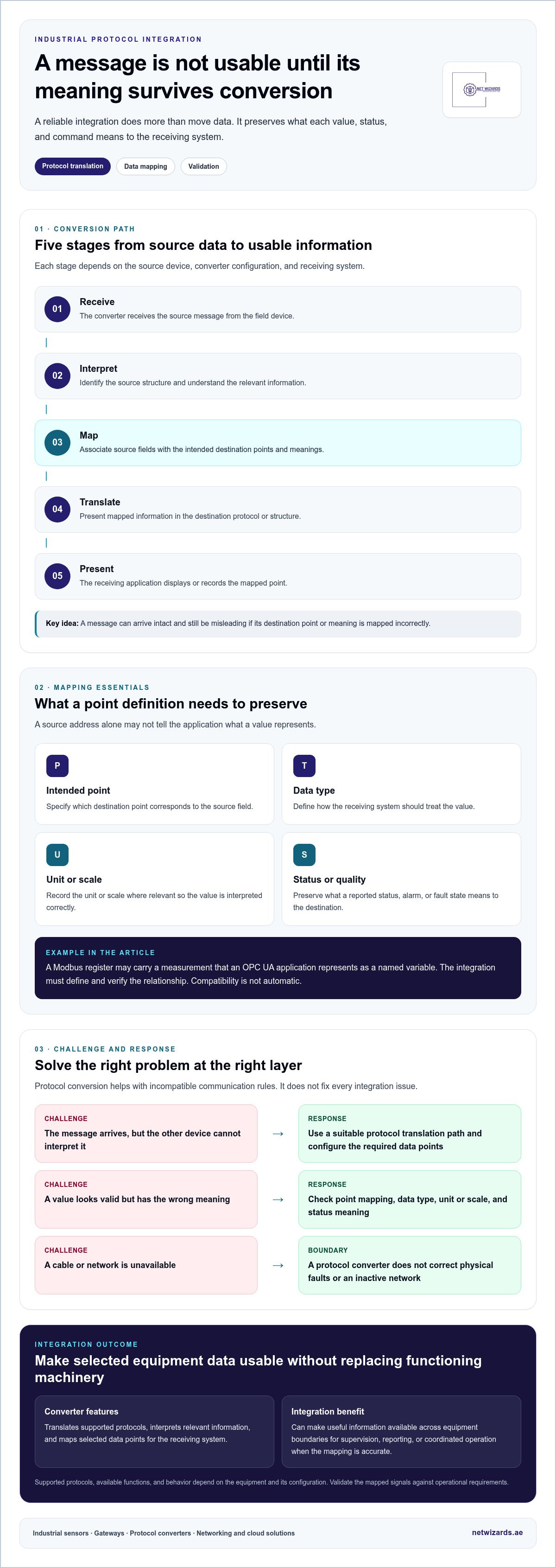
Translating a message format is only one part of conversion. The receiving application also needs to know what each value represents, how to locate it, and how to interpret its state. A number can arrive intact and still be misleading if the mapping assigns it to the wrong point, leaves out its unit, or treats a status value as a measurement.
A disciplined conversion path moves through five stages: receive the source data, interpret its structure, map relevant fields to destination points, translate them into the destination format, and present them to the application. Each stage depends on the source device, converter configuration, and receiving system. Not every protocol exposes the same information, so a translation may preserve only the data and functions defined for the integration.
Diagram 2: From field signal to supervisory application
Field device reports a process value and status
↓
Converter receives the source message
↓
Source field is identified and interpreted
↓
Mapping associates it with the intended destination point, unit, and status meaning
↓
Value is translated into the destination structure
↓
Supervisory application displays or records the mapped point
Example path only. Available values and behavior depend on the devices, protocols, and configuration.
From Protocol Frames to Usable Industrial Data
Source data may appear as registers, objects, or named points, while the destination application expects its own structure and identifiers. For example, a Modbus register might carry a measurement that an OPC UA application represents as a named variable. This example does not imply automatic compatibility. The integration must define which source data corresponds to which destination variable and confirm that the required functions are supported.
Mapping needs to capture more than an address. Record the intended point, data type, unit or scale where relevant, and how status or quality should appear to the destination. If a value represents a temperature, the application must treat it as that measurement rather than an unlabeled number. If a source reports an alarm or fault state, the mapping must preserve the distinction between normal and abnormal states. Document assumptions so interpretation does not depend on whoever configures the next system.
Correct mapping matters more than simple connectivity because a connected value is useful only when the destination interprets it as the intended measurement, state, or command.
What Must Be Validated After Translation?
Validate representative points against the operating requirements before relying on them for monitoring or control. During controlled commissioning tests, compare what the source device reports with what the destination application displays. Check that the mapped point, units, status changes, and command behavior match the agreed design. Test commands only within an approved, controlled process, since translating a command does not establish that its operational effect is correct.
- Values: Compare source and destination observations for selected points.
- Units and scaling: Confirm the displayed measurement has the intended interpretation.
- Status: Check that normal, alarm, and fault indications are represented correctly where available.
- Commands: Verify intended behavior under controlled conditions, if commands are in scope.
Keep the point list, mappings, assumptions, and test results together as an auditable reference. This makes later fault investigation more direct and helps teams distinguish a source-device issue from a translation or application-mapping issue. For project-specific integration planning, NET WIZARDS can discuss your system requirements.
Protocol Converter vs Gateway vs Media Converter: Which Role Fits?
These terms describe related but distinct integration roles, and product labels alone can obscure what a device actually does. Start with the engineering task: must the system translate data between protocols, connect or manage communication across systems, or change the physical medium carrying the signal? Some devices combine functions, so assess the required behavior and system boundary rather than relying on a category name.
| Device role | Primary function | System boundary | Problem addressed |
|---|---|---|---|
| Protocol converter | Translates communications between different protocol representations. | Between devices or applications that use different protocols. | Endpoints cannot exchange required data in a mutually understood format. |
| Gateway | Connects or manages communication across systems, depending on its design and functions. | Between networks, systems, or communication domains. | Systems need a defined connection point to exchange or manage information. |
| Media converter | Changes the transmission medium, such as copper Ethernet to fibre, without necessarily translating the protocol. | Along the physical communication path. | The network needs a different physical medium while retaining the communication protocol. |
Diagram 3: Identify the integration task
Different protocol representations → Protocol conversion → Translate communications
Separate networks or systems → Gateway function → Connect or manage communication
Different transmission media → Media conversion → Change the physical path
These functions may coexist in an architecture, but they solve different problems.
When Is a Protocol Converter the Relevant Choice?
Consider an industrial protocol converter when two endpoints need to exchange information but require different protocol representations. First identify the exact source and destination protocols. Then define the data points, direction of communication, and required read, status, or command behavior. A protocol match on a device label is not enough if the necessary functions or application behavior differ.
For example, a system may need selected field-device values available to another controller using a different protocol. Suitability depends on the converter’s supported functions and how the application uses those values. A clear requirements list helps distinguish protocol translation from other network tasks and prevents selection based on terminology alone.
When Is the Requirement a Gateway or Media Converter?
A gateway may be the relevant role when communication must cross a system or network boundary, or when the device manages that exchange. Its exact function varies by design. A media converter addresses a physical-layer requirement, such as carrying an Ethernet connection over a different medium. It does not necessarily change how the endpoints communicate.
Misclassification creates avoidable integration gaps: changing the media will not resolve incompatible protocols, and protocol translation alone may not provide the network connection or management a system requires. Document the required function, interfaces, and boundaries before selecting a device. NET WIZARDS supplies industrial networking equipment, gateways, and protocol converters for industrial integration. Review your integration requirements with NET WIZARDS.
How to Plan an Industrial Protocol Converter Integration
Plan the integration around the devices and exchanges the operation requires, not a product label. An industrial protocol converter can translate supported communications, but successful implementation also depends on interface details, point definitions, configuration, and agreed acceptance criteria. A staged workflow helps expose gaps before they become commissioning problems.
Define Endpoints, Protocols, and Required Data
Start with an interface inventory. Record each source device and destination system, their protocols and physical interfaces, and the operational purpose of the connection. Separate required measurements, status points, and control exchanges so teams can see which information must flow in each direction. Assign responsibility for source documentation, destination configuration, and acceptance criteria.
- 1. Inventory interfaces: Identify endpoints, protocol versions where relevant, and connection points. If a device’s interface is unclear, resolve it from available device documentation before selecting a converter.
- 2. Define exchanges: List required data points and their direction. If requests are vague, create a documented point list that names each value, status, or command and its intended use.
- 3. Set requirements: Define the required behavior and acceptance criteria with the teams responsible for the source and destination. This prevents a basic data connection from being mistaken for a complete operational requirement.
Configure, Test, and Document the Integration
Use the inventory and point list to select and configure equipment for the actual endpoints. Check supported protocols and functions against the required exchanges. Labels such as “gateway” or “converter” are not substitutes for verifying the interfaces and behavior the integration needs.
- 4. Map and configure: Associate source points with destination points, then review addressing, data types, units, and status representation. If values appear incorrect, compare the mapping and configuration with the source documentation before changing unrelated settings.
- 5. Test and record: Exercise representative exchanges under planned operating conditions. Compare source and destination observations, confirm expected status changes, and test control behavior only where it is in scope and safe to do so. Record results, assumptions, configuration, and any unresolved limitations.
Integration boundary diagram
Source device and protocol
↓ Required measurements, status, or commands
Converter boundary: protocol support, point mapping, configuration
↓ Translated exchanges
Destination system and application
Document each interface, data direction, dependency, and validation responsibility at the relevant boundary.
This record gives operations and engineering teams a shared reference for commissioning and later troubleshooting. It also helps isolate whether a mismatch originates at the source, in the mapping, or in the destination configuration. For broader design context, apply a mission-critical industrial networking architecture alongside this device-level workflow.
How NET WIZARDS Supports Industrial Protocol Integration
Protocol conversion sits within a wider integration design. NET WIZARDS supplies Industrial IoT sensors, gateways, and protocol converters, alongside industrial networking equipment and cloud solutions. These components can connect field data to supervisory or cloud applications, with each project’s architecture shaped by its endpoints, required exchanges, and operational objectives.
From Protocol Conversion to End-to-End Integration
A deployment may combine sensors that collect field data, gateways or converters that handle communication between devices and systems, and an application layer for monitoring or analysis. Not every project needs every layer. Where cloud integration is required, the Industrial‑grade IoT Cloud Platform supports MQTT, Modbus, NB-IoT, LoRaWAN, and TCP/UDP. Protocol support provides integration options, while the actual data path and functions depend on system requirements and configuration.
When suitable data reaches monitoring and analytics tools, teams can use it to identify operating patterns and investigate issues. Depending on the data collected and the solution design, this can support activities such as predictive maintenance, energy optimization, or safety monitoring. These are potential operational benefits, not automatic results of adding a converter or connecting a cloud platform. Data quality, suitable analysis, and the intended operating process remain essential.
For example, a facility seeking to monitor selected equipment readings may need a sensor or existing field device, a compatible communication path, and a destination application that presents the readings in context. A separate objective, such as analyzing energy use, may require additional data points and analytics. Define the intended outcome first, then include only the architecture layers needed to support it.
Engineering Support for Project-Specific Requirements
Industrial sites can have equipment and interface requirements that call for more than a standard connection path. NET WIZARDS brings 20 years of experience to industrial integration and provides industrial networking, cloud, and bespoke R&D engineering services. This work can align an implementation with defined endpoints, data exchanges, and application requirements.
Start with a clear statement of the integration challenge: which systems need to exchange information, what data or commands must pass between them, and where the data will be used. That gives engineering work a defined basis and helps determine whether sensors, gateways, protocol converters, networking, or cloud integration are needed.
For project-specific integration planning, identify the required interfaces, data flows, and operational objectives. NET WIZARDS can help shape the solution around those requirements.
Set the Next Stage of Your Integration Roadmap
Use the next project review to turn connectivity objectives into an operational roadmap. Identify which information must become available to operators, what decisions that information should support, and how the integration will be maintained as equipment or requirements change. This keeps an industrial protocol converter within a larger plan instead of treating device communication as the final outcome.
Prioritize the exchanges that matter most to current operations, then define how the solution will be assessed before expanding its scope. A measured approach directs engineering effort toward useful data access and gives teams a clear basis for future integration decisions.
NET WIZARDS can help shape the next step around your system requirements and intended outcomes.
With a clear objective and a disciplined path forward, your systems can become a stronger foundation for informed operations.
Frequently Asked Questions
What is an industrial protocol converter?
An industrial protocol converter translates communications so devices using different industrial protocols can exchange specified information. For example, a plant may need a machine’s operating state available to a separate monitoring application. The converter handles communication translation, while the integration design defines which states are exposed and how the application uses them. It is not a substitute for confirming the complete system behavior.
Can an industrial protocol converter connect equipment from different manufacturers?
Yes. It can support communication across manufacturers when the required protocols and functions are supported. Two products that use the same protocol may still differ in the functions or data structures they expose. Before integration, compare the required exchanges with each endpoint’s documentation, including whether the application needs read-only monitoring or control. This establishes a practical compatibility basis beyond manufacturer names or protocol labels.
Does a protocol converter change the meaning of data?
A converter can present data in a destination format, but configuration determines whether the destination interprets it correctly. For example, a numeric value may require a defined scale, signedness, or byte order before an application can display it accurately. Confirm these details against the source device and destination software, then compare selected readings with a known reference before using them for operational decisions.
Is a protocol converter the same as an industrial gateway?
Not necessarily. A protocol converter’s central role is translation between communications, while a gateway may provide a connection point between systems or networks. A gateway can also include protocol translation, depending on its design, so the terms can overlap. If a system needs both network connectivity and translation, document both functions separately and verify that the architecture addresses each one.
Can protocol conversion support legacy industrial equipment?
Yes. Conversion can provide a path for legacy equipment to share selected information with newer systems when its available interface and communication functions meet the integration need. A practical first stage may expose non-control data, such as equipment status, to a monitoring application while existing machine operation remains unchanged. This lets teams assess the value of the data before defining broader exchanges or control requirements.
What information is needed to plan a protocol converter integration?
Prepare device manuals, interface details, protocol information, and a clear description of the intended data exchange. Include sample point names or addresses, expected data types, and whether communication must be one-way or two-way. Also identify who can approve test results and what the destination application must show. This preparation helps engineering teams resolve missing information early and establish a useful commissioning reference.