
A single dropped data packet across an operational technology backbone isn't an isolated IT inconvenience; it's an immediate catalyst for catastrophic process shutdowns and complete telemetry blackouts. Building resilient mission critical industrial networking requires moving beyond standard enterprise equipment that degrades rapidly under extreme ambient heat, heavy vibration, and severe electromagnetic interference.
You already know the operational friction: bridging legacy Modbus and M-Bus field devices into modern IP platforms frequently introduces latency jitter, disrupting real-time SCADA systems when determinism matters most. This guide delivers the architectural blueprints required to solve those vulnerabilities definitively. You'll master the engineering principles, verified hardware topologies, and multi-bearer failover architectures needed to eliminate single points of operational failure.
From selecting ruggedized field equipment to establishing secure, automated protocol conversion pipelines into industrial cloud platforms, here's how to engineer an OT infrastructure that delivers uncompromised continuity under harsh industrial conditions.
Key Takeaways
- Understand the core engineering foundations of mission critical industrial networking, contrasting non-deterministic commercial Ethernet with deterministic OT architectures.
- Discover how fanless passive convection cooling and port-level galvanic isolation prevent thermal throttling and transient surge damage in harsh operating environments.
- Implement redundant bearer diversity using industrial 4G and 5G routers alongside satellite telemetry to eliminate remote operational blackouts.
- Bridge legacy serial fieldbus infrastructure with modern cloud platforms through specialized M-Bus and Modbus gateways configured for secure protocol mediation.
- Establish rigorous procurement criteria evaluating MTBF, ingress protection, and lifecycle operating costs to replace fragile commercial gear with verified industrial hardware.
Table of Contents
- Defining Mission Critical Industrial Networking in Operational Technology
- Core Architectural Pillars of Ruggedized Industrial Networks
- Bearer Diversity: Cellular, Satellite, and Industrial Fieldbus Topologies
- Engineering Protocol Mediation: From Legacy Serial Fieldbus to AI Edge Nodes
- Procurement and Deployment: Selecting Enterprise-Grade Industrial Communication Hardware
Defining Mission Critical Industrial Networking in Operational Technology
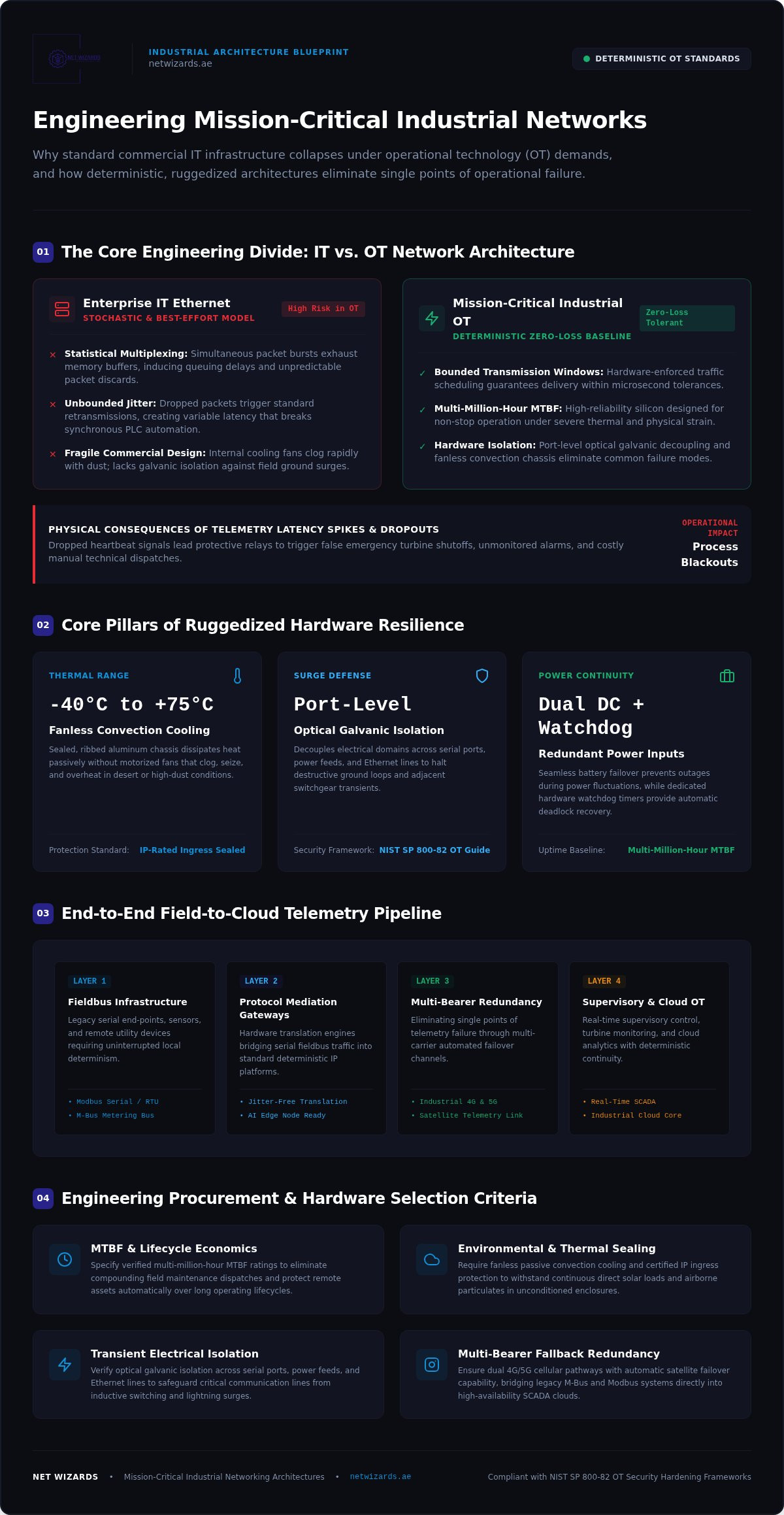
Mission-critical industrial networking provides deterministic, zero-loss telemetry across demanding operational environments. In enterprise IT, networks function on a best-effort delivery model where dropped packets prompt standard retransmissions. In Operational Technology (OT), that model fails. Industrial automation cannot tolerate variable latency. A dropped frame doesn't just buffer an application; it blinds supervisory control systems, halts high-speed lines, and introduces severe safety hazards. Deploying true mission critical industrial networking demands an uncompromising engineering baseline established on bounded latency, multi-million-hour mean time between failures (MTBF), and continuous survivability under extreme operational conditions.
Determinism versus Best-Effort Transmission
Commercial enterprise switches handle network traffic stochastically. When simultaneous packets converge on an egress port, statistical multiplexing introduces queuing delay, buffer bloat, and unpredictable packet discards. Industrial programmable logic controllers (PLCs) cannot function on statistical averages. They require strict determinism, operating within bounded transmission windows where critical control data arrives within microsecond tolerances. Without hardware-enforced traffic scheduling, high-frequency telemetry bursts exhaust commercial switch memory buffers, causing immediate packet loss that disrupts synchronous automation cycles.
Operational Consequences of Communication Dropouts
The downstream consequences of communication failures are physical and immediate. In power generation and utility distribution, millisecond-level telemetry latency spikes cause protective relays to misinterpret dropped heartbeats as severe field faults, triggering costly emergency turbine shutoffs. Undetected pressure or temperature alarms expose operators to compliance penalties, environmental hazards, and permanent asset damage. Across distributed utility installations, intermittent telemetry blackouts create compounding operational expenses, forcing emergency technical dispatches to inspect field assets that deterministic network infrastructure protects automatically.
Core Architectural Pillars of Ruggedized Industrial Networks
Commercial hardware buckles quickly in unconditioned field enclosures. Sustaining mission critical industrial networking requires physical, electrical, and deterministic resilience engineered into the silicon, chassis, and protocol stack. Plant communications must survive continuous exposure to direct solar load, intense mechanical vibration, and heavy inductive switching. Deploying purpose-built industrial networking equipment guarantees continuous uptime where commercial hardware fails prematurely.
Thermal and Environmental Hardening
Motorized fans represent the most common mechanical point of failure in remote electrical enclosures. In severe desert conditions, cooling fans rapidly clog with fine dust, overheat, and seize. Ruggedized network hardware uses fanless, ribbed aluminum chassis engineered for passive convection cooling. These systems dissipate thermal energy efficiently across ambient temperature ranges from -40°C to +75°C. Matched with IP-rated ingress protection against moisture and airborne particulates, sealed chassis eliminate thermal throttling without relying on external airflow.
Electrical Isolation and Surge Suppression
Ground potential differences across long-distance cable runs routinely produce destructive transient currents. Robust deployments integrate optical galvanic isolation across serial ports, power feeds, and Ethernet interfaces to decouple electrical domains. This isolation halts transient ground loops caused by adjacent switchgear or lightning strikes. Adhering to the physical hardening frameworks outlined in the NIST Guide to OT Security safeguards core communications against electromagnetic interference. Dual DC power inputs and hardware watchdog timers complete the physical baseline, providing seamless battery failover and automatic deadlock recovery.
Deterministic Redundancy Protocols
Standard enterprise recovery protocols like Spanning Tree Protocol (STP) take seconds to recalculate broken network paths. In high-speed industrial environments, that delay drops control packets and trips safety systems. Industrial architectures deploy hardware-accelerated redundancy topologies:
- Sub-Millisecond Ring Topologies: Reconverge alternate paths in under 20 milliseconds, keeping real-time supervisory control active.
- Parallel Redundancy Protocol (PRP): Transmits duplicate frames across two independent network paths simultaneously, guaranteeing zero switchover time if one fails.
- High-availability Seamless Redundancy (HSR): Implements ring-based duplicate packet handling for substation automation and continuous process control loops.
Bearer Diversity: Cellular, Satellite, and Industrial Fieldbus Topologies
No single transmission medium guarantees absolute operational availability across distributed assets. Relying solely on terrestrial fiber or private wireless creates distinct single points of failure. True mission critical industrial networking leverages bearer diversity, orchestrating cellular, non-terrestrial satellite, and physical fieldbus backbones into a unified telemetry architecture. When physical lines sever or regional telecommunications degrade, automated failover ensures mission-critical data pathways remain active without human intervention.
Industrial 4G and 5G Cellular Gateways
Modern industrial 4G and 5G routers serve as the primary communication bridge for remote telemetry units. In high-density utility networks, 5G network slicing guarantees deterministic bandwidth reservations for real-time SCADA polling. Dual-SIM hardware architectures eliminate carrier dependence. If the primary cellular carrier drops carrier signal, automated failover logic detects path degradation through continuous ICMP heartbeat tracking, switching traffic to the secondary SIM within seconds. Hardware-accelerated IPsec and OpenVPN tunnels establish encrypted links over public or private cellular infrastructure, preserving data integrity across wide-area deployments.
Satellite Integration for Isolated Field Infrastructure
Where terrestrial cellular signals cannot penetrate, satellite telemetry provides vital operational reach. Low-earth-orbit constellations and traditional geostationary links backhaul mission-critical status updates from offshore equipment and isolated desert pipeline valves. Continuous satellite polling requires disciplined bandwidth optimization. Field hardware employs binary protocol compaction, delta-only updates, and local threshold monitoring to curb transmission volumes. During regional grid failures or widespread terrestrial carrier outages, intelligent routers transition priority telemetry payloads directly to secondary satellite asset trackers, ensuring command visibility remains uninterrupted.
Physical Fieldbus and Industrial Ethernet Backbones
While wireless links provide wide-area reach, localized field automation depends on hardened physical connectivity. Industrial topologies balance serial simplicity with high-throughput Ethernet backbones across three primary media:
- RS-485 Serial Loops: Ideal for daisy-chaining legacy field instruments up to 1,200 meters, though throughput remains capped at low baud rates.
- Industrial Ethernet Fiber: Delivers gigabit throughput across dozens of kilometers with total immunity to high-voltage electromagnetic interference.
- Hybrid Aggregation Nodes: Concentrate localized RS-485 and Ethernet sensor loops directly into ruggedized cellular and satellite gateways for redundant wide-area transport.
Engineering Protocol Mediation: From Legacy Serial Fieldbus to AI Edge Nodes
Protocol mediation securely translates legacy serial fieldbus registers into structured, cloud-ready payloads. Demanding a total rip-and-replace of functional industrial instrumentation is economically impractical and operationally disruptive. Millions of mission-critical serial devices remain installed across utility facilities, sub-metering stations, and industrial plants. True mission critical industrial networking preserves these operational investments by establishing an end-to-end translation pipeline:
- Physical Signal Conversion: Intercept raw serial signals using specialized M-Bus and Modbus gateways equipped with galvanic isolation.
- Semantic Register Mapping: Ingest holding registers and decode binary tables into standardized JSON, MQTT, or OPC UA information models.
- Local Edge Processing: Analyze high-frequency telemetry via AI edge computing nodes directly adjacent to the machinery.
- Secure Cloud Routing: Encrypt and transmit aggregated payloads upstream to central industrial cloud platforms.
Bridging Modbus and M-Bus to Modern Networks
Bridging serial field networks requires careful timing management. Converting Modbus RTU serial links over RS-485 into Modbus TCP Ethernet requires deterministic gateway processing to prevent message frame timing errors. In sub-metering systems and energy management networks, specialized M-Bus gateways manage physical level-shifting for hundreds of slave meters. Optimizing polling intervals across multi-drop topologies prevents serial bus saturation, ensuring predictable response cycles across all addressed devices.
AI Edge Computing at the OT Boundary
Streaming high-frequency raw telemetry, like acoustic signatures or multi-axis vibration registers, over wide-area networks exhausts cellular bandwidth rapidly. Deploying AI edge computing hardware directly at the field boundary shifts analytical processing to the physical site. Local inference models detect bearing wear and thermal anomalies in real time, transmitting only anomalous deviations and summary metrics upstream. If wide-area connectivity severs completely, edge nodes execute deterministic automated failsafes locally without waiting for cloud instruction.
Specialized Integration: Fire Alarm and Safety Gateways
Integrating proprietary fire alarm control panels into supervisory building management systems (BMS) presents strict safety-compliance hurdles. Specialized fire alarm gateways isolate safety loops from enterprise networks using unidirectional hardware filters. This physical and logical barrier blocks building automation commands from reaching or interfering with life-safety panels. The gateway normalizes proprietary fire alarm events instantly, broadcasting verified status notifications to SCADA platforms without compromising system integrity.
To upgrade your legacy serial loops into high-speed, cloud-ready architectures without taking critical systems offline, deploy engineered M-Bus and Modbus gateway solutions tailored to demanding operational field conditions.
Procurement and Deployment: Selecting Enterprise-Grade Industrial Communication Hardware
Procurement decisions across operational technology govern plant floor stability for decades. Evaluating communication gear strictly on initial acquisition cost ignores the harsh realities of physical field deployment. Substituting commercial switches or unhardened routers into industrial cabinets generates compounding lifecycle liabilities, resulting in premature capacitor failure, unexpected firmware locks, and frequent emergency truck rolls. Engineering true mission critical industrial networking demands an uncompromising procurement framework focused on calculated total cost of ownership, sustained environmental endurance, and vendor-backed engineering sovereignty.
Hardware Evaluation Checklist for Critical Infrastructure
Procurement engineers must validate equipment against verified manufacturing standards before bench approval and field installation:
- Component-Level Thermal Validation: Demand verified test reports proving continuous operation above 70°C without active cooling, utilizing industrial-grade solid-state components rather than derated commercial chipsets.
- Cryptographic Hardware Security: Verify tamper-resistant cryptoprocessors supporting hardware root-of-trust, secure boot routines, encrypted onboard storage, and structured CVE vulnerability remediation.
- Mechanical and Electrical Resilience: Review independent certifications verifying high shock thresholds, sustained vibration tolerance, and multi-kilovolt surge suppression across all physical ports.
Integrating Turnkey Industrial Networking Systems
Deploying standardized hardware into complex legacy plants often reveals unexpected protocol translation hurdles. Resolving these proprietary telemetry barriers requires custom research and development capabilities to engineer bespoke firmware mediation and specialized physical interfaces. Prior to field commissioning, robust architectures undergo full-scale laboratory environmental stress screening, testing packet determinism under simulated thermal extremes and heavy electromagnetic noise.
Procuring sovereign industrial hardware backed by local engineering expertise establishes operational autonomy and protects high-stakes capital investments. Operating teams looking to modernize their infrastructure can deploy expert industrial networking architectures engineered to maintain continuous uptime across demanding national industrial environments.
Securing Long-Term Telemetry Continuity Across Operational Infrastructure
Zero-downtime reliability demands engineering depth across every layer of the physical plant. Delivering dependable mission critical industrial networking requires eliminating commercial hardware compromises in favor of passive convection cooling, deterministic sub-millisecond ring recovery, and seamless multi-bearer failover spanning cellular and satellite channels. When legacy serial meters and high-speed IP platforms converge through robust protocol mediation, operational visibility becomes continuous rather than conditional.
Backed by over two decades of engineering presence across severe operating environments, NET WIZARDS delivers comprehensive industrial communication architectures. The turnkey delivery portfolio spans ruggedized industrial cellular routers, specialized field gateways, and AI edge computing platforms, reinforced by in-house research and development for non-standard protocol engineering. Achieve true infrastructural sovereignty across your facilities today. Consult with the industrial communication engineering specialists at NET WIZARDS to deploy an unyielding operational technology backbone engineered for continuous uptime.
Frequently Asked Questions
What makes industrial networking equipment fundamentally different from commercial enterprise hardware?
Industrial networking equipment is physically and logically engineered for zero unplanned downtime under harsh physical constraints. Commercial enterprise gear relies on motorized fans, commercial-grade capacitors, and best-effort packet delivery designed for climate-controlled data closets. Industrial hardware features fanless extruded aluminum enclosures, galvanic isolation, redundant dual-DC power inputs, and deterministic sub-millisecond recovery protocols. This design protects mission critical industrial networking architectures against continuous vibration, extreme ambient temperatures, and severe electromagnetic noise across plant environments.
Why is deterministic communication mandatory for operational technology and industrial control networks?
Deterministic communication guarantees that control packets arrive within strict, bounded time windows without variable latency or jitter. In operational technology, programmable logic controllers and safety instrumentation systems execute synchronous control loops requiring exact timing. If an enterprise network experiences packet queuing delays or statistical buffer drops, protective relays can trip emergency shutoffs inadvertently. Determinism enforces strict traffic prioritization and dedicated transmission scheduling, ensuring real-time supervisory signals never compete with lower-priority diagnostic data across OT lines.
How do industrial 4G and 5G routers handle extreme operational heat inside unconditioned field cabinets?
Industrial 4G and 5G routers rely entirely on passive convection cooling rather than mechanical fans that fail from dust ingress. High-grade aluminum housings act as direct heatsinks, drawing thermal energy away from the internal silicon and dissipating it through external fins. Combined with wide-temperature solid-state components rated from -40°C to +75°C, these ruggedized routers maintain maximum processing throughput and reliable wide-area telemetry without thermal throttling, even inside unshaded outdoor enclosures exposed to intense direct heat.
What is the most secure method for connecting legacy serial Modbus devices to industrial cloud platforms?
Deploying dedicated M-Bus and Modbus gateways provides the most secure bridge between serial registers and modern networks. The gateway establishes a strict boundary, translating legacy RTU registers into encrypted payloads like MQTT or OPC UA over TLS. By isolating serial field loops from direct IP routability and utilizing secure boot alongside encrypted onboard storage, the architecture blocks unauthorized external write commands from reaching field instruments while streaming real-time status data directly to industrial cloud platforms.
How does multi-bearer cellular and satellite failover operate during a terrestrial backhaul outage?
Multi-bearer failover uses automated health-check algorithms, such as ICMP ping heartbeats and link-quality monitoring, to assess primary carrier integrity. When a terrestrial line cuts or cellular connectivity drops, the router switches routing tables immediately to a secondary SIM or connected satellite asset tracker. The system applies strict quality-of-service policies, compressing priority telemetry and shedding non-essential payloads to conserve bandwidth. Once terrestrial connectivity stabilizes, the network smoothly restores primary routing without dropping active supervisory sessions.
Can fire alarm control panels be safely integrated into building management and industrial SCADA platforms?
Yes, provided the connection uses a specialized fire alarm gateway engineered with physical and unidirectional protocol isolation. Regulatory life-safety standards strictly prohibit external systems from sending unverified commands back into certified fire panels. A dedicated fire alarm gateway reads proprietary panel loops, extracts real-time event registers, and broadcasts normalized status telemetry outward to central SCADA networks. This setup delivers unified facility visibility without introducing any risk of command injection or external loop interference.
What role does AI edge computing play in reducing mission-critical network bandwidth requirements?
AI edge computing processes high-frequency telemetry at the machine boundary rather than streaming raw sensor streams over wide-area links. In mission critical industrial networking, continuous acoustic or vibration monitoring produces massive data volumes that can congest cellular channels. Edge nodes execute local inferencing algorithms to filter noise, pinpoint predictive mechanical anomalies, and calculate operational summary metrics. Only actionable alerts and distilled trend data transmit upstream, slashing cellular data consumption while enabling instant, autonomous safety actions locally.