A sensor reading is not a maintenance decision. Predictive maintenance edge hardware must capture useful equipment signals, process them close to the asset, and deliver findings that maintenance teams can act on. Choosing sensors, gateways, and edge devices is only part of the task. The data must also fit existing operational systems and workflows.
Industrial operators need to plan for equipment access, signal quality, network conditions, and maintenance responsibilities. Edge computing can support timely alerts and reduce unnecessary data transfer, but only when it is designed around those operational needs. This guide explains how field data acquisition, edge processing, and cloud monitoring work together, and how to connect analytics outputs to practical maintenance decisions.
NET WIZARDS L.L.C delivers Industrial IoT sensors, gateways, and protocol converters, AI Edge systems, and an Industrial-grade IoT Cloud Platform. Its end-to-end solution delivery covers sensor design through cloud integration and analytics. The ADNOC Onshore Remote Well Monitoring project includes predictive maintenance and SCADA integration. The sections ahead cover useful condition signals, hardware roles, deployment prerequisites, common challenges, and the workflow that turns predictive insights into operational decisions.
Key Takeaways
- Choose equipment signals that are relevant, interpretable, and consistent enough to support maintenance decisions.
- Match sensors, gateways, protocol converters, and edge processing to the asset’s data sources, connectivity, and operating requirements.
- Plan predictive maintenance edge hardware as part of an architecture connecting field data acquisition with edge processing and cloud visibility.
- Address incomplete data, protocol integration, and alert overload through staged assessment, testing, and clear response workflows.
- NET WIZARDS L.L.C connects Industrial IoT sensors, gateways, and protocol converters with AI Edge systems and an Industrial-grade IoT Cloud Platform.
Table of Contents
- What Predictive Maintenance Edge Hardware Does in an Industrial Operation
- How Predictive Maintenance Edge Hardware Turns Signals into Useful Insights
- How to Evaluate Predictive Maintenance Edge Hardware and Architecture
- How to Deploy Predictive Maintenance Edge Hardware: Challenges and Responses
- How NET WIZARDS Connects Edge Hardware with Predictive Maintenance Solutions
What Predictive Maintenance Edge Hardware Does in an Industrial Operation
Maintenance decisions depend on timing and evidence. Predictive maintenance uses equipment condition information, such as vibration, temperature, or pressure readings, to help teams identify changes and plan intervention before a failure occurs. Predictive maintenance differs from scheduled maintenance because decisions respond to observed condition, not only a calendar. It informs maintenance decisions, but cannot guarantee equipment will not fail.
Predictive maintenance edge hardware provides the local infrastructure to acquire, connect, and process operational data near equipment. It can prepare information for local review or route it to upstream systems. Its value comes from connecting a useful signal to a maintenance response, not from adding hardware in isolation.
How Predictive Maintenance Differs from Preventive and Reactive Maintenance
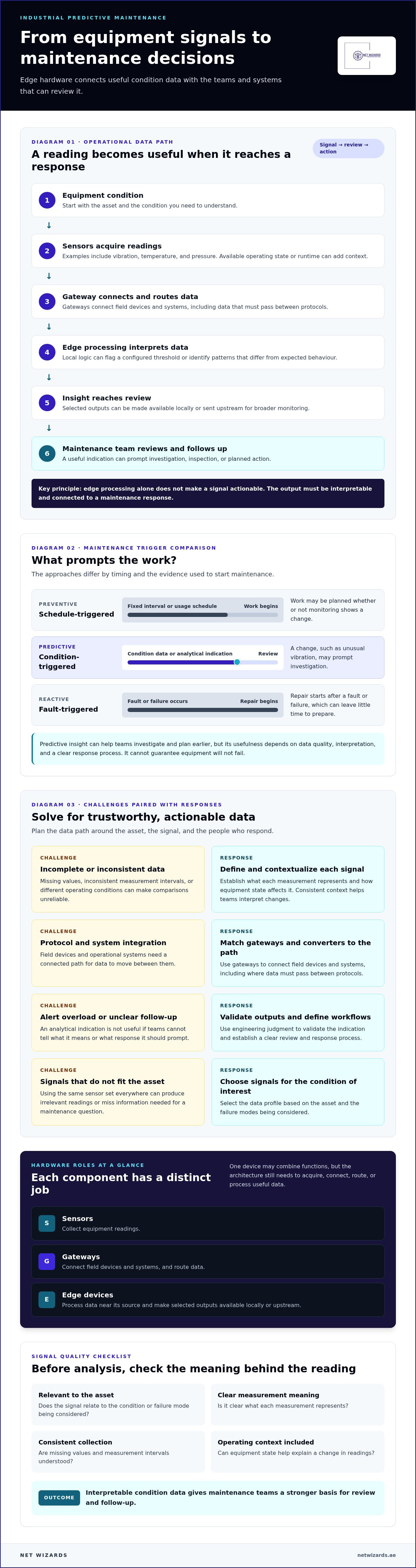
These approaches differ in when work is triggered and what evidence informs it. Scheduled work can suit routine servicing, while condition-based insight can help teams prioritize work as equipment condition changes.
Preventive maintenance: Work follows a fixed interval or usage schedule. For example, a team replaces a component during a planned service window, whether or not monitoring shows a change.
Predictive maintenance: Work is considered in response to equipment condition data or an analytical indication. For example, a change in vibration may prompt inspection of a rotating asset.
Reactive maintenance: Work begins after a fault or failure occurs. For example, a team repairs a motor after it stops operating.
Scheduled work offers planning structure but may happen before a component needs attention. Reactive repair can leave little time to prepare. Predictive insight may help teams investigate and plan earlier, but its usefulness depends on data quality, interpretation, and a clear response process.
What Edge Hardware Contributes to the Maintenance Process
Hardware roles are distinct, although one device may combine functions. Sensors collect signals from equipment. Gateways connect field devices and systems, including when data must pass between protocols. Edge devices process data near its source, then make selected outputs available locally or send them upstream for broader monitoring.
In an industrial predictive maintenance architecture, edge hardware acquires, connects, routes, or processes operational data between field assets and maintenance or monitoring systems. It links measurement to review while allowing the architecture to fit the asset, available signals, and operating environment.
Signal path: Equipment condition → Sensors collect readings → Gateway connects and routes data → Edge device processes data → Maintenance team reviews insight → Inspection or planned action
This sequence makes the operational purpose clear: the output must reach the people and systems responsible for maintenance. If a signal cannot be interpreted or linked to a response, adding edge processing alone will not make it actionable.
How Predictive Maintenance Edge Hardware Turns Signals into Useful Insights
Equipment produces readings, not maintenance instructions. Useful condition insight depends on a complete path: select relevant signals, acquire them reliably, interpret changes in context, then present findings where operations teams can review them. Predictive maintenance edge hardware can support this path by processing data near the equipment and forwarding relevant results to an industrial platform or other upstream system.
From Equipment Signals to Condition Data
Start with the asset and the condition you need to understand. Vibration may help indicate a change in rotating equipment. Temperature, operating state, or runtime may add useful context when those signals are available. The right data profile depends on the asset and the failure modes being considered. Applying the same sensor set everywhere can produce irrelevant readings while missing the information needed to answer a specific maintenance question.
Data quality matters as much as sensor selection. Readings need consistent meaning and enough context to interpret changes. Missing values, inconsistent measurement intervals, or signals collected under different operating conditions can make comparisons unreliable. Before analysis, establish what each measurement represents and how equipment state affects it.
How Edge Processing Produces an Insight
Edge logic can apply deterministic rules, such as flagging a reading that crosses a configured threshold. This is clear and direct when the condition and response are understood. Anomaly detection and other model-based analysis can identify patterns that differ from expected behaviour. Neither approach removes the need for engineering judgment. Teams must validate that an output is meaningful for the asset and define the action it should prompt.
Data-flow infographic: Equipment signals → Sensor acquisition and context → Edge processing and decision → Platform visibility → Human review and maintenance follow-up
For example, an unusual vibration indication may appear alongside operating-state data for review. A maintenance planner can assess the evidence, compare it with equipment history, and decide whether to inspect, monitor, or schedule work. The system supports the decision. It should not turn every deviation into an automatic repair instruction.
Choosing Local Processing, Cloud Analysis, or a Combined Design
Local processing can support timely decisions and keep selected analysis close to the asset. A cloud platform can provide broader visibility across equipment and support longer-term review. A combined design uses each where it fits. The division depends on response-time needs, network connectivity, data governance, and how existing systems exchange information. An Industrial-grade IoT Cloud Platform can support the wider monitoring architecture, while edge devices handle defined local processing tasks.
Define the intended decision before configuring analytics. NET WIZARDS L.L.C connects field data acquisition, edge processing, and cloud monitoring through Industrial IoT sensors, gateways, protocol converters, AI Edge systems, and an Industrial-grade IoT Cloud Platform. To discuss an architecture for your equipment and data flow, connect with the NET WIZARDS L.L.C team.
How to Evaluate Predictive Maintenance Edge Hardware and Architecture
Evaluate the data path before selecting devices. The right design depends on which assets provide usable signals, where analysis must run, how equipment communicates, and who owns the resulting maintenance decisions. Start with the existing OT environment. Adding analytics before understanding collection points, protocols, and workflows can increase integration effort without improving decision quality.
Questions to Ask About Data, Protocols, and Existing OT Systems
Map information already available from machines, controllers, and monitoring systems. Record what each signal represents, where it is collected, and how operations teams use it. Then determine how new condition data will reach the systems responsible for review and maintenance planning.
- Data: Which equipment signals and formats are available, and are they suitable for the condition being assessed?
- Protocols: Where do Modbus, MQTT, or OPC UA fit in the connection and data-exchange design?
- Ownership: Where will processing and storage occur, who manages access, and which team reviews alerts?
Protocol converters can help connect equipment that communicates through different protocols. Gateways connect field devices with upstream systems. Define the required data path and responsibilities clearly, especially when existing OT systems already support monitoring or control functions.
Matching Edge Hardware to the Use Case
Match hardware to the signals, processing task, connectivity, and maintenance approach. Industrial IoT sensors collect equipment data. Gateways connect devices and systems. Protocol converters support communication across different interfaces, while edge devices can process data near its source. These roles may be combined in a system, but they are not interchangeable: a gateway that routes data does not necessarily run analytics.
Use this matrix to frame the architecture decision:
Data source: Existing machine signals → Use available collection points where suitable; add sensing only to address identified data gaps.
Processing location: Local edge device → Suited to defined processing near equipment; cloud platform → Supports broader visibility and analysis; combined design → Divides functions across both.
Connectivity: Existing OT protocols and networks → Map protocol conversion and data routing to actual system interfaces.
Operational ownership: Maintenance and OT teams → Assign responsibility for reviewing outputs and determining follow-up.
Keep the initial design aligned with the operational question. A focused deployment can expose data-quality or integration gaps before analytics expand across more assets. NET WIZARDS L.L.C brings together Industrial IoT sensors, gateways, protocol converters, AI Edge systems, and industrial networking solutions. For guidance on device selection, see the AI Edge Computing Hardware buyer guide.
How to Deploy Predictive Maintenance Edge Hardware: Challenges and Responses
A deployment is ready to progress when equipment data, the integration path, and the maintenance response have been considered together. Treat predictive maintenance edge hardware as part of an operational process, not as a standalone analytics installation. Begin with a defined asset group and a specific decision the system should support, such as whether a condition change warrants inspection or continued monitoring.
Common Deployment Challenges and Practical Solutions
Address data and integration risks before scaling. Missing signals can make analysis unreliable, while unfamiliar alerts can erode confidence. Pair each issue with a practical response:
- Inconsistent or missing signals: Assess available readings, their meaning, and gaps before modeling. Resolve data-quality issues or narrow the use case to what the asset data can support.
- Legacy-system integration: Map protocols, interfaces, and existing collection points during architecture design. Test how the required information moves between equipment, gateways, edge devices, and operational systems.
- Low-trust or excessive alerts: Review outputs with maintenance and operations teams. Validate alert context, refine response rules, and distinguish actionable indications from conditions that require observation only.
These steps reduce avoidable complexity and help teams focus on signals they can interpret. They also make ownership explicit. Before deployment, decide who reviews an insight, who prioritizes resulting work, and how an urgent condition is escalated. An alert without an assigned owner can be delivered technically yet ignored operationally.
From Pilot Learning to an Operational Maintenance Workflow
Use a bounded deployment to test the complete path from asset data to a maintenance decision. Select the target asset group, document the intended decision, assess data readiness, and design the connection to existing OT systems. Test outputs against equipment context and recorded maintenance observations. A mismatch is a reason to investigate the signal, rule, or operating context before expanding the deployment.
Once an output is useful, define the working process: operations records the condition, maintenance reviews and prioritizes it, and the designated owner escalates it when required. Feed inspection findings and completed maintenance observations back into the review process to assess whether alerts remain relevant. Scale only when the data path and response responsibilities are understood.
Implementation infographic: Select asset group (asset and maintenance teams) → Assess data (OT and engineering) → Design integration (OT and system owners) → Test outputs (operations and maintenance) → Operationalize response (assigned maintenance owner)
Decision checkpoints: Are signals usable? Can systems exchange the required data? Are outputs credible? Is every alert assigned a response?
To discuss a deployment approach with NET WIZARDS, get in touch about predictive maintenance edge hardware.
How NET WIZARDS Connects Edge Hardware with Predictive Maintenance Solutions
Predictive maintenance depends on more than an analytics layer. Equipment signals need a reliable path from the field through connectivity and edge processing to the systems where teams monitor conditions and plan maintenance. NET WIZARDS L.L.C brings together Industrial IoT sensors, gateways, protocol converters, AI Edge systems, and an Industrial-grade IoT Cloud Platform to support this integrated architecture.
Hardware, Connectivity, and Cloud as One Industrial Architecture
Each component has a defined role. Industrial IoT sensors acquire field data, while gateways and protocol converters connect assets and help route information through industrial networks. Edge computing processes selected data near its source. The Industrial-grade IoT Cloud Platform supports broader visibility and monitoring. Together, these components connect operational information and support timely maintenance review, from field acquisition through to higher-level systems.
Architecture path: Equipment signals → Industrial IoT sensors → Gateways and protocol converters → AI Edge systems → Industrial-grade IoT Cloud Platform → Operational review
The architecture should reflect the asset, available data, existing OT systems, and the maintenance decision teams need to make. A remote monitoring deployment, for example, may need to connect field data with SCADA visibility while making condition information available for maintenance assessment. These design considerations also apply to broader Industry 4.0 solutions and the use of edge computing nodes for SCADA.
Project-Specific Engineering and a Practical Next Step
NET WIZARDS L.L.C’s ADNOC Onshore Remote Well Monitoring project includes predictive maintenance and SCADA integration. It shows how these elements can come together in a remote monitoring context, without implying that every asset or deployment uses the same architecture.
Project requirements vary. Signal availability, communication protocols, processing needs, and operational responsibilities all influence how a solution should be configured. NET WIZARDS L.L.C provides end-to-end solution delivery from sensor design through cloud integration and analytics, helping align hardware, connectivity, edge processing, and cloud integration with project-specific operational requirements.
A well-integrated architecture can give teams clearer operational insight and a more direct basis for maintenance decisions. Start by defining the asset, the information required, and the action the insight should support.
For help shaping the next step, contact NET WIZARDS L.L.C about your predictive maintenance architecture.
Turn Equipment Data into Actionable Maintenance Decisions
Predictive maintenance delivers value when condition data leads to a clear operational response. The right predictive maintenance edge hardware architecture connects relevant signals with suitable local processing, existing OT systems, and cloud visibility. Teams also need to validate analytics, assign alert ownership, and define how findings shape inspection or maintenance planning.
NET WIZARDS brings 20 years in business and end-to-end solution delivery from sensor design through cloud integration and analytics. Its integrated capabilities support a practical path from field data acquisition to edge processing and platform visibility, aligned with the equipment and workflow requirements of each deployment.
Start with a defined asset and a specific maintenance decision. Build from usable data, test the integration, and give teams a clear process for acting on the insight. Contact NET WIZARDS to discuss your predictive maintenance requirements.
Frequently Asked Questions
What is predictive maintenance edge hardware?
Predictive maintenance edge hardware is the equipment used to collect, connect, route, or process machine condition data near its source so teams can make informed maintenance decisions. It may include Industrial IoT sensors, gateways, protocol converters, and edge devices. Sensors capture signals, gateways connect equipment with other systems, and edge devices can process data locally. The hardware supports condition-based analysis, but does not guarantee that equipment failure will be prevented.
How does edge computing support predictive maintenance?
Edge computing processes selected equipment data close to where it is generated. This can support timely local analysis and reduce the need to send every raw reading to a remote platform. For example, an edge device may apply a defined rule to a condition signal and pass an alert or summary upstream. Maintenance teams still need to review the output, consider equipment context, and decide what action is appropriate.
What data is needed for predictive maintenance?
The required data depends on the equipment and the condition or failure mode being assessed. Relevant inputs may include vibration, temperature, operating state, or runtime when those signals are available and useful for the asset. Teams should establish what each reading means, how it is collected, and whether it is consistent enough for analysis. Missing or poorly interpreted data can weaken an insight, so assess data quality before relying on analytics.
Can predictive maintenance edge hardware work with existing industrial systems?
Yes. It can be designed to connect with existing industrial systems when their interfaces, protocols, and data flows are understood. Start by mapping current collection points and how operational data reaches control, monitoring, or maintenance systems. Gateways and protocol converters can support connections between different systems, while integration design defines what information moves and where it is reviewed. Test the data path before expanding analytics or connecting additional assets.
What is the difference between an industrial IoT gateway and an edge computer?
An industrial IoT gateway primarily connects field devices and systems, routes data, or supports communication across interfaces. An edge computer processes data locally and may run rules or analytics near the equipment. The roles can overlap in some architectures, so distinguish them by the task each component must perform. Define whether the requirement is data connectivity, local processing, or both, then plan how outputs will reach operational systems.
What are the main challenges in deploying predictive maintenance at the edge?
Common challenges include incomplete or inconsistent signals, integration with legacy OT systems, and alerts that teams do not trust or cannot act on. Assess data quality before modeling, map protocols and interfaces during architecture design, and validate outputs with operations and maintenance teams. Define alert ownership and escalation steps before deployment. These measures help limit unnecessary complexity and give each insight a clear route to review and follow-up.
Does edge hardware replace a cloud platform for predictive maintenance?
No. Edge hardware and cloud platforms perform complementary roles in many industrial architectures. Edge devices can handle selected processing close to equipment, while an Industrial-grade IoT Cloud Platform can support broader monitoring, data review, and analysis across assets. The right division depends on response-time needs, connectivity, data governance, and system design. NET WIZARDS connects field data acquisition, edge processing, and cloud visibility as part of its industrial technology capabilities.