A telemetry system can collect field signals correctly and still fail at the point that matters: delivering usable data to SCADA or cloud applications. The phrase remote telemetry unit rtu gateway describes a role in the data path, not necessarily one interchangeable device.
It’s reasonable to ask where an RTU ends and an IoT gateway or protocol converter begins. These functions can overlap, but their responsibilities depend on the field equipment, communications link, and monitoring system. Defining the architecture keeps data usable and integration manageable.
This article explains how RTUs and gateways collect, process, and transmit field data, and how information travels from equipment to supervisory and cloud applications. It also covers protocol compatibility, legacy device integration, and the questions to resolve before deployment. NET WIZARDS supplies Industrial IoT Gateways, Edge Computing Devices, and an Industrial-grade IoT Cloud Platform that supports multi-protocol integration. Use this guide to define each component’s role and assess how the complete telemetry path should work.
Key Takeaways
- Distinguish the remote telemetry unit rtu gateway by its role in the data path, rather than assuming an RTU and a gateway are always separate devices.
- Trace how field signals are acquired, interpreted, transmitted, and delivered to the application that needs them.
- Address inconsistent protocols, incomplete data, and unclear system boundaries through interface mapping and defined data ownership.
- Assess assets, data points, protocols, communications, and consuming systems before deployment. Separate essential telemetry from future objectives.
- NET WIZARDS’ Industrial IoT Gateways, Edge Computing Devices, and Industrial-grade IoT Cloud Platform can support an integrated telemetry architecture.
Table of Contents
What Is a Remote Telemetry Unit RTU Gateway?
Remote telemetry collects information from equipment at a distance and delivers it to a system where operators can monitor or use it. An RTU acquires field data and may support remote monitoring and control. A gateway connects devices or systems across protocols and networks. A remote telemetry unit rtu gateway can therefore describe a combined role in an architecture, rather than one standard device type.
These functions support remote equipment monitoring, utility metering, and industrial automation. An RTU may collect measurements and status signals from field equipment; a gateway may then translate or forward that information so a supervisory application can use it. The functions may be performed by separate components or overlap, depending on the interfaces and responsibilities the system requires. The foundational Remote Terminal Unit (RTU) overview describes the unit’s role in monitoring and controlling remote equipment.
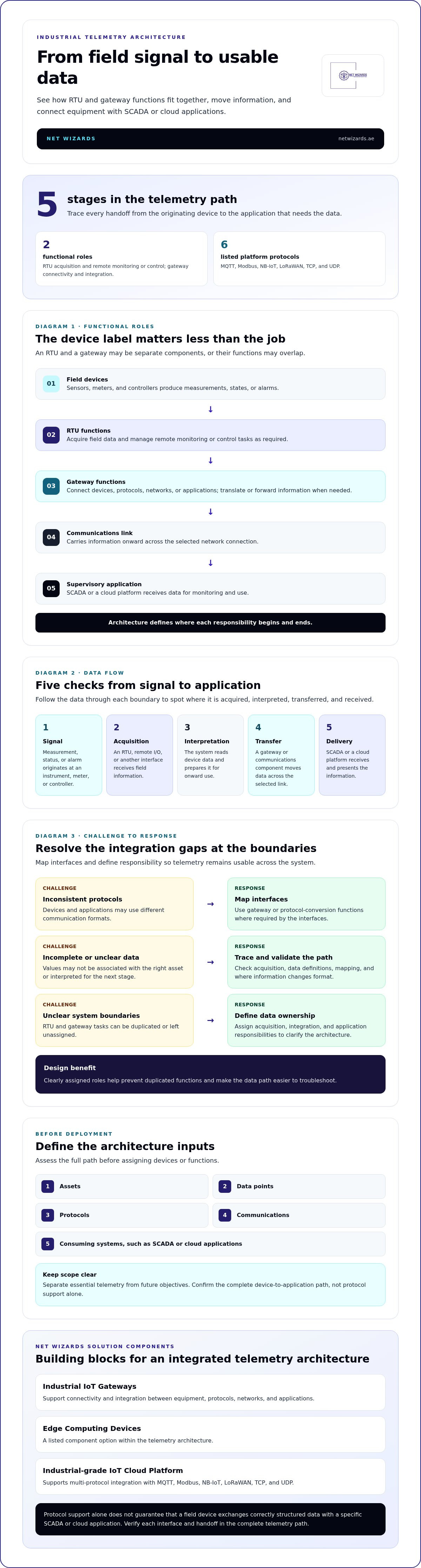
Infographic: Functional roles in a telemetry data path
Field devices → sensors, meters, or controllers produce measurements and status
RTU functions → acquire field data and manage remote monitoring or control tasks
Gateway functions → connect devices, protocols, networks, or applications
Supervisory applications → SCADA or cloud platforms receive data for monitoring and use
One device may perform more than one role. The architecture defines the boundary.
How Does an RTU Differ from an Industrial IoT Gateway?
An RTU is centred on the remote site: it gathers field information and can provide control functions as required by the application. An Industrial IoT Gateway is centred on connectivity and integration, linking equipment and protocols to networks or applications. These are functional descriptions, not a guarantee that every device has the same features. Before assigning either label, define the required acquisition, control, and communication responsibilities.
Where Does an RTU Gateway Fit in an Industrial System?
Field instruments and controllers sit upstream, producing measurements, states, or commands. The RTU or gateway handles the specified acquisition and integration tasks. Communications carry the information onward to supervisory systems or, where the architecture calls for it, a cloud platform.
Consider a remote pumping asset. Field instruments report operating conditions to a local telemetry component, which passes the required information over the site’s communications link to an operator’s monitoring application. If the field device and application use different protocols, gateway functions can bridge that interface. NET WIZARDS supplies Industrial IoT Gateways, Edge Computing Devices, and an Industrial-grade IoT Cloud Platform that supports multi-protocol integration. Clearly assigning roles helps prevent duplicated functions and makes the data path easier to troubleshoot.
How an RTU Gateway Moves Data from Field Equipment to Monitoring Systems
A reliable telemetry path has several handoffs. The remote telemetry unit rtu gateway may acquire information, interpret device communications, and forward data, but each task must suit the connected equipment and receiving application. Mapping these stages helps identify where a signal changes format, crosses a network boundary, or needs validation.
Data-flow infographic: Field to application
1. Field signal or device data → a measurement, status, or alarm originates at an instrument, meter, or controller.
2. Acquisition boundary → an RTU, remote I/O, or another interface receives the field information.
3. Interpretation and handling → the system reads the device data and prepares it for onward use.
4. Communications boundary → a gateway or communications component transfers the data across the selected link.
5. Application boundary → SCADA or a cloud platform receives and presents the information to users or services.
From Sensors, Meters, and Controllers to Usable Telemetry
Field devices provide readings, operating states, alarms, or other information. The acquisition layer must recognize each device’s interface and data structure. Remote I/O can bring field signals into a telemetry system, while a protocol converter can translate between supported formats where required. These components address different integration needs. Neither automatically resolves mismatched wiring, configuration, or data definitions.
For example, a utility meter may provide consumption readings and status information. Before those values become useful to an operator, the system must associate them with the correct asset and interpret them in a form the next stage can use. The interfaces, protocols, and control requirements depend on the selected equipment and architecture.
From Gateway Communications to SCADA or Cloud Platforms
Once the system has acquired and interpreted the data, gateway functions can route or present it to a supervisory application. NET WIZARDS’ Industrial-grade IoT Cloud Platform supports MQTT, Modbus, NB-IoT, LoRaWAN, TCP, and UDP. These protocols serve different communication roles, so stated protocol support alone does not establish that a particular field device can exchange correctly structured data with a specific SCADA or cloud application.
Verify the complete path: device interface, data mapping, gateway configuration, communications link, and receiving application. This matters for both monitoring and control. A monitoring deployment may send readings and alarms downstream only. If remote control is required, the architecture must also define how commands travel back to field equipment and which components handle them. Not every telemetry system needs a return control path.
NET WIZARDS’ Industrial IoT sensors, gateways, and protocol converters support integration planning across field and platform layers. NET WIZARDS telemetry architecture services can be considered when defining integration boundaries.
RTU Gateway Challenges and Design Responses
A remote telemetry unit rtu gateway can connect field equipment to supervisory systems, but the connection alone does not guarantee usable, complete data. Integration problems often arise at the boundaries: a device may use a different protocol, its data may be undocumented, or teams may disagree about which component owns a value. Address these issues through interface mapping and clear end-to-end requirements before deployment.
Infographic: Challenge, response, and architecture layer
Inconsistent protocols → map interfaces and define any required conversion → field and gateway layers
Incomplete or unclear data → document the source, format, meaning, and destination for each critical point → acquisition and data-handling layers
Unclear system boundaries → assign responsibility for collection, transformation, transmission, and use → gateway and supervisory layers
Connectivity interruption → specify how loss of communication is detected and how missing or delayed data is handled → communications and application layers
What Causes Gaps Between Field Data and Supervisory Systems?
Protocol mismatches can prevent connected components from exchanging information as expected. Even when a protocol is supported, device registers, signal meanings, units, status codes, or naming conventions may be undocumented or interpreted differently. Data may arrive yet remain incomplete or unusable if the application cannot identify what it represents.
Responsibility gaps also complicate fault-finding. If a reading is absent, the cause may be at the device interface, acquisition configuration, gateway mapping, communications link, or receiving platform. Document each critical data point with its source, format, destination, and operational meaning. This gives engineering and operations teams a shared reference for integration and troubleshooting.
How Can Integration Complexity Be Controlled?
Start with an inventory of existing equipment, interfaces, protocols, communications links, and supervisory applications. Then distinguish required monitoring from alarms and control. A monitoring-only requirement does not automatically include command handling. Defining these functions separately keeps architecture, testing, and ownership clear.
Connectivity interruptions need the same attention. Specify what the system should report when a link is unavailable, how operators will recognize missing or delayed information, and how the application should treat data after communication resumes. Do not assume a gateway provides uninterrupted service or a particular recovery mechanism unless it is specified.
NET WIZARDS’ Industrial IoT sensors, gateways, and protocol converters support integration planning across field and platform layers. Map existing interfaces first, then assign each required function to the appropriate component. This reduces ambiguity, clarifies responsibility, and gives teams a more controlled basis for deployment and future changes.
How to Assess an RTU Gateway Architecture Before Deployment
Assess the complete telemetry route before selecting or configuring components. A remote telemetry unit rtu gateway architecture should connect known field assets and required data to defined monitoring or control outcomes. Separate essential operational requirements from future cloud, analytics, or platform ambitions. This keeps the initial design focused while making later expansion easier to plan.
What Should the System Architecture Document Specify?
Build an inventory that records each asset, its source interface, the data required, the destination system, and the operational purpose of each data point. Identify existing protocols, any required conversion, and the SCADA, cloud, or monitoring applications that will consume the information. Also define alarm handling, control boundaries, and which layer validates data. A clear record gives engineering and operations teams a shared basis for implementation and fault investigation.
- Assets and interfaces: List field equipment and how each item connects to the telemetry system.
- Data and purpose: Record readings, alarms, status, or commands, along with their intended use.
- Integration: Map protocols, conversion points, communications links, and receiving applications.
- Ownership: Assign responsibility for acquisition, data validation, alarm handling, and control.
How Should Teams Validate Telemetry Requirements?
Trace representative data points from a source device to the target application. Check that values, units, status meanings, and alarm conditions remain consistent at each handoff. Test monitoring requirements separately from control requirements, since receiving telemetry does not by itself establish a validated command path.
Define how operating teams will identify missing, delayed, or inconsistent information. Specify where an issue should be visible, what context operators need to diagnose it, and which architecture layer owns the response. Reviewing Industrial IoT gateway data acquisition protocols can help frame protocol and platform considerations alongside the project’s device and application requirements.
Deployment-readiness infographic
Field inventory → identify assets, interfaces, and required data
Integration design → map protocols, data destinations, control boundaries, and ownership
Validation → trace representative readings, alarms, and status to the consuming application
Operations → define how teams detect and investigate missing, delayed, or inconsistent telemetry
NET WIZARDS’ Industrial IoT sensors, gateways, and protocol converters support architecture planning across field acquisition and platform integration. Clear requirements help align these components with the intended system and reduce ambiguity during deployment.
Integrating RTU Gateway Functions with NET WIZARDS Solutions
A remote telemetry unit rtu gateway architecture should match the field equipment, communication requirements, and monitoring outcomes of the deployment. NET WIZARDS supplies Industrial IoT sensors, gateways, and protocol converters, as well as Industrial IoT Gateways, Edge Computing Devices, and an Industrial-grade IoT Cloud Platform. Together, these capabilities can support an end-to-end design. The system architecture determines which components and functions each project needs.
How Do Gateway, Edge, and Cloud Functions Work Together?
Industrial IoT sensors provide field measurements and status data. Gateways connect devices and networks, while protocol converters can bridge interfaces that use different supported protocols. Edge computing and cloud monitoring address different stages: edge devices can form part of the local data path, while a cloud platform can receive information for monitoring and further use.
The Industrial-grade IoT Cloud Platform supports MQTT, Modbus, NB-IoT, LoRaWAN, TCP, and UDP. Protocol support is one part of integration, not proof that every device, gateway, and application will exchange data end to end. The design must also define data mapping, communications, and the receiving system’s requirements.
A well-mapped architecture can make operational information more accessible to teams, support analysis relevant to predictive maintenance and energy optimization, and help operators act on safety-related status or alarms. These benefits depend on the data collected, the application’s functions, and how teams use the information. Define the operational objective first, then assign each role to the appropriate system layer.
When Is Tailored Engineering Relevant to RTU Gateway Projects?
Tailored engineering is relevant when existing equipment, interfaces, or application requirements call for coordinated hardware and software decisions. NET WIZARDS provides industrial R&D engineering services for complex industrial automation needs, including custom product development and telemetry integration. Define the required interfaces and system responsibilities first so that engineering decisions align across the field, gateway, edge, and cloud layers.
NET WIZARDS brings 20 years in business to industrial connectivity and IoT projects. An architecture-led approach maps device data and protocols, defines how information moves between layers, and aligns selected capabilities with the intended monitoring or analytics workflow. The design is based on project requirements, rather than an assumption that one device fits every deployment.
Build a Telemetry Architecture Ready for Operations
A reliable remote telemetry unit rtu gateway deployment depends on clear responsibilities across field acquisition, protocol handling, communications, and the applications that use the data. Map assets and interfaces first, define which readings, alarms, or control functions matter, then validate representative data from source to destination. This approach exposes integration gaps before they become operational problems.
NET WIZARDS brings 20 years in business and provides industrial R&D engineering services for complex automation needs. Its Industrial-grade IoT Cloud Platform supports MQTT, Modbus, NB-IoT, LoRaWAN, TCP, and UDP. These capabilities can contribute to an integrated architecture, with component selection and configuration aligned to the deployment’s devices, interfaces, and monitoring requirements.
Set a clear operational objective, document the data path, and establish how teams will recognize missing or inconsistent information. A carefully defined design gives your team a stronger foundation for monitoring, integration, and future system development.
With clear requirements and architecture in place, your telemetry system can provide a clearer view of remote operations.
Frequently Asked Questions
Is an RTU the same as an industrial IoT gateway?
No, the terms are not automatically interchangeable. An RTU commonly handles remote telemetry and may support control, while an industrial IoT gateway connects devices, protocols, networks, or applications. A system can combine both functions, but the label alone does not define a device’s capabilities. Document the required field interfaces, data handling, communications, and destination systems before assigning responsibilities. This makes component roles clearer during integration and troubleshooting.
How does an RTU gateway send data to SCADA?
An RTU gateway sends data to SCADA by collecting information from field equipment, interpreting or converting it as required, and communicating it through an applicable interface and protocol. The exact path depends on the installed devices and system integration requirements. Trace representative readings, alarms, and status points from source to application. Confirm that SCADA receives the intended values and meanings, rather than assuming that a successful connection guarantees usable data.
Can an RTU gateway support multiple industrial protocols?
Some gateways and protocol converters support connections across different industrial protocols, but compatibility depends on the specific hardware, software, and integration design. NET WIZARDS’ Industrial-grade IoT Cloud Platform supports MQTT, Modbus, NB-IoT, LoRaWAN, TCP, and UDP. This platform support does not mean every protocol applies to every gateway or deployment. Map the field device’s interface and the receiving application’s requirements to establish the required end-to-end data path.
What challenges can affect remote telemetry integration?
Common challenges include protocol mismatches, incomplete device documentation, unclear data ownership, and poorly defined boundaries between field equipment and supervisory applications. A value may reach the platform but remain difficult to interpret if its format, unit, or operational meaning is unclear. Build an inventory of assets, interfaces, critical data points, destinations, and control responsibilities. This gives teams a consistent reference for diagnosing integration gaps and assigning corrective work.
How do I assess whether an RTU gateway architecture fits my project?
Start by listing remote assets, required readings, alarms, control functions, field interfaces, communications links, and destination applications. Then trace representative data points from source to target, checking protocol conversion and whether values retain their intended meaning. Separate essential monitoring and control needs from future analytics objectives. Define how operators will identify missing, delayed, or inconsistent telemetry as well. This assessment clarifies the architecture before deployment decisions are finalized.
What is the difference between an RTU gateway and a protocol converter?
A protocol converter primarily translates or bridges communications protocols. An RTU gateway architecture may also acquire remote data, connect field equipment, and deliver information to supervisory or cloud applications. The division of work varies by implementation, so do not rely on product labels alone. Document which component handles acquisition, conversion, communications, data validation, and control. Clear responsibilities help teams understand integration boundaries and locate faults across the telemetry path.