
What matters most when choosing a satellite asset tracker is not just the device’s feature list. It is whether the monitoring setup provides useful information to the people and systems responsible for your assets.
Remote equipment can be difficult to oversee, and unclear requirements can complicate procurement. A satellite asset tracker UAE enterprises consider should fit the assets’ operating conditions, connectivity needs, and monitoring workflows. NET WIZARDS supplies satellite asset trackers for continuous real-time monitoring of high-value mobile and remote equipment.
This guide explains how to assess tracker suitability, define reporting and integration requirements, and plan around common deployment challenges. With 20 years in business and end-to-end capabilities spanning sensor design, cloud integration, and analytics, NET WIZARDS approaches tracking as part of a wider operational monitoring architecture. Use the steps below to compare solution fit and build requirements around the assets you need to monitor.
Key Takeaways
- Start with an asset inventory covering operating conditions, movement patterns, and the decisions teams need to make.
- Assess satellite asset tracker UAE options by connectivity, data access, integration, and operational ownership. Mark each criterion as required, desirable, or project-specific.
- Map how tracking information should move from the device to platforms, dashboards, reports, and operational workflows before choosing an architecture.
- Address connectivity gaps, installation conditions, integration requirements, and ownership during requirements gathering and system design.
- Plan a staged rollout so tracker selection fits asset needs and existing monitoring systems before deployment expands.
Table of Contents
- What a satellite asset tracker must deliver for UAE-wide operations
- Satellite asset tracker connectivity and architecture: what buyers should assess
- Satellite asset tracker buying criteria: compare operational fit and integration
- Satellite asset tracking deployment challenges and practical responses
- Selecting a satellite asset tracker solution for operational rollout
What a satellite asset tracker must deliver for UAE-wide operations
Satellite asset tracking uses a tracker associated with equipment to communicate monitoring information to a platform, where operators can review the asset’s visibility. It is relevant when high-value mobile equipment or remote infrastructure operates beyond dependable terrestrial connectivity. The tracker is one part of the monitoring process, not a complete operating procedure on its own.
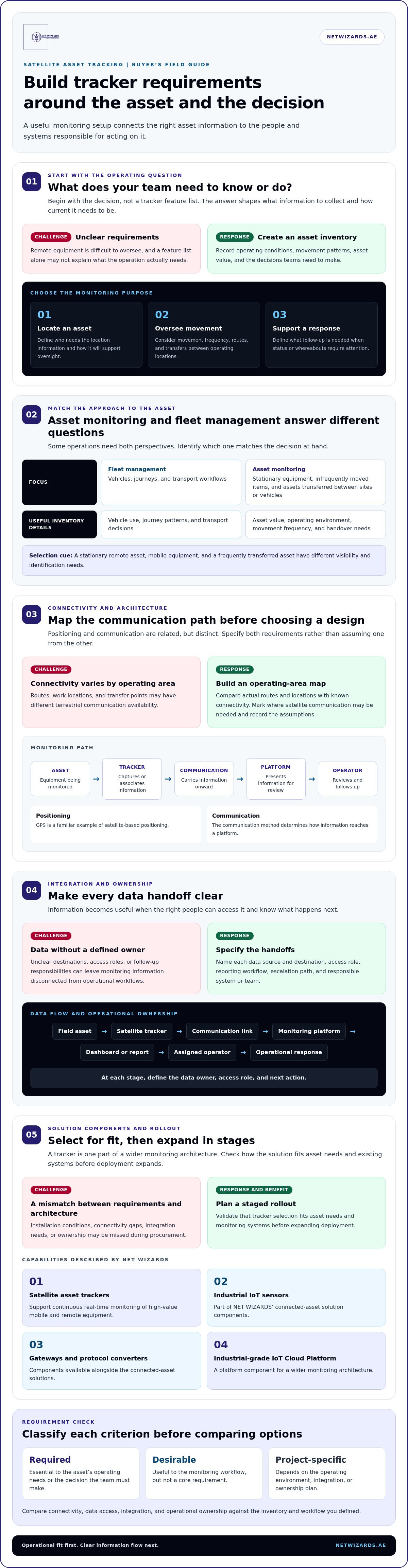
Asset monitoring and vehicle fleet management can overlap, but they address different operational questions. Fleet management often focuses on vehicles, journeys, and transport workflows. Asset monitoring can also cover stationary equipment, items moved infrequently, or assets transferred between sites and vehicles. Begin with the decision your team needs to make: locate an asset, oversee its movement, or support a defined response when its status or whereabouts require attention.
Operating context determines what “fit for purpose” means. A stationary remote asset has different movement patterns from mobile equipment. Equipment transferred regularly may need consistent identification and a clear handover process. Consider asset value, operating environment, movement frequency, and how quickly operators need to act on available information. These criteria help define reporting needs and prevent a feature list from becoming the only basis for selection.
Monitoring path
Asset → Tracker → Satellite communication → Platform → Operator
The tracker captures or associates information with an asset, communication carries it onward, and the platform presents it for review. Positioning and communication are related but distinct functions. The Global Positioning System (GPS) is a familiar example of satellite-based positioning. A tracker’s communication method determines how information reaches a platform. Specify both requirements separately rather than assuming a positioning method or reporting interval from the product category.
Which remote assets may benefit from satellite monitoring?
Remote infrastructure, mobile industrial equipment, and high-value equipment transferred between operating locations can all be difficult to oversee. Stationary assets may need location records and routine visibility. Mobile equipment may need monitoring as its location changes, while frequently transferred assets may require clear identification at each handover. For each asset type, decide who will use the information and how it will support operational oversight. That keeps tracking connected to a practical purpose instead of collecting data without a defined use.
What does continuous real-time monitoring mean operationally?
NET WIZARDS’ satellite asset trackers support continuous real-time monitoring of high-value mobile and remote equipment. To put that capability to work, define what information operators need and what action it should inform. Specify the reporting expectations that matter for each workflow, such as how current information must be to support a location check or operational follow-up. This makes monitoring requirements concrete and gives the project team a clear basis for system design.
Satellite asset tracker connectivity and architecture: what buyers should assess
Connectivity design starts with the asset’s operating profile, not an assumption that one network will serve every location. For each asset, record where it operates, whether it stays in one place or moves, and what communications are available along its expected routes. Note known gaps in existing connectivity and the consequences those gaps could have for operations. This gives the project team a practical basis for deciding where satellite communication belongs in the monitoring design.
How should buyers assess connectivity across operating environments?
Build an operating-area map from actual asset routes, work locations, and transfer points. Compare it with known terrestrial communication availability, then identify the locations or movement stages where satellite communication may be needed. Treat the map as a design input, not a claim of universal coverage. Record the assumptions and conditions that shape reporting expectations before selecting an architecture.
How does tracking data reach existing operational systems?
Trace the information path from tracker to platform, then identify the teams that need access and the decisions they make using the data. Specify destinations, user roles, reporting workflows, and escalation paths. For example, an asset-location record might appear on an operations dashboard, while an exception needs an assigned owner and a defined follow-up process. Establish these requirements before integration design begins.
At the architecture level, define how data must be exchanged with existing systems. Record the source of each data element, its destination, access requirements, and the system or team responsible for acting on it. NET WIZARDS’ connected-asset solutions include Industrial IoT sensors, gateways, and protocol converters, alongside an Industrial-grade IoT Cloud Platform. These components can support a wider monitoring architecture and Industry 4.0 solutions.
Data flow and operational ownership
Field asset → Satellite asset tracker → Communication link → Monitoring platform → Dashboard or report → Assigned operator → Operational response
At each stage, define the data owner, access role, and next action.
Use the architecture review to find handoff risks. If a platform receives location information but no team is responsible for reviewing it, visibility may not lead to a response. Assign responsibility for data access, dashboard oversight, escalation, and recordkeeping. Also clarify how the wider industrial network and cloud environment connect to tracking workflows, with a defined role for each system.
A satellite asset tracker UAE deployment should be assessed as a connected operational system, not just a device purchase. NET WIZARDS can align tracker requirements with wider monitoring architecture and integration objectives. To define an approach around your assets and reporting workflows, discuss your tracking requirements.
Satellite asset tracker buying criteria: compare operational fit and integration
Compare options against the operating requirements they must meet, rather than a generic feature checklist. Tracker selection depends on the asset, its operating context, and the decisions the monitoring system must support. For a satellite asset tracker UAE procurement, document the intended use first, then classify each requirement as required, desirable, or project-specific. This makes trade-offs easier for operations, engineering, and procurement teams to assess.
Which tracker requirements belong in a procurement specification?
Describe the asset types, monitoring purpose, operating context, and user workflows. State what location or status information teams need, where they need to access it, and what action should follow. Record environmental and maintenance considerations for project assessment, including installation conditions and how teams will handle upkeep. Define the required operational outcome without adding technical values that the project has not established.
Procurement comparison framework
Asset fit | Required: Identify the equipment and monitoring purpose. Project-specific: Document installation and maintenance context.
Connectivity | Required: Define operating environments and communication needs. Project-specific: Record locations where existing connectivity is limited.
Data access | Required: Specify who needs visibility and what information they use. Desirable: Align views and reports with distinct user roles.
Integration | Required: Define data destinations and intended system outcomes. Project-specific: Determine how information must move between systems.
Operational ownership | Required: Assign responsibility for reviewing tracking information and acting on it. Desirable: Establish clear handoffs between teams.
These classifications are a starting point, not a universal ranking. A requirement is “required” when the operation depends on it; another organisation may classify the same item as desirable or project-specific. Record the reason for each decision so stakeholders can compare proposals consistently and identify unresolved assumptions before procurement advances.
How should buyers compare device, platform, and integration scope?
Assess the tracker as one element of a monitoring architecture. NET WIZARDS’ satellite asset trackers support continuous real-time monitoring of high-value mobile and remote equipment. Build the comparison around the monitoring purpose, the platform and reports required, and how teams will use the information.
Evaluate the device, platform, analytics, integration, and operational support as separate dimensions. Determine what information the monitoring setup needs to provide, how the platform should present it, what analysis the operation requires, and how tracking data should move between existing systems. Industrial IoT sensors, gateways, and protocol converters may play a role in broader system data exchange. Define the integration outcome before selecting an approach.
Close the comparison by identifying who owns each layer and what will show that requirements have been met. This avoids a device-only decision that overlooks platform access, reporting needs, or operational responsibilities. The result is a procurement specification grounded in asset fit and accountable system design.
Satellite asset tracking deployment challenges and practical responses
A tracker is most useful when connectivity assumptions, installation context, system integration, and operational responsibilities align. Treat deployment as a coordinated project, not simply a device installation. For a satellite asset tracker UAE rollout, document uncertainties early and plan procedures for the conditions the operation may encounter. This helps close the gap between receiving tracking information and using it effectively.
How can teams reduce connectivity and data-visibility risks?
Map asset routes and operating locations against the monitoring workflow. Identify where existing communications may be limited and how gaps could affect operational decisions. Define how teams should interpret incomplete, delayed, or unavailable data. Agree on data ownership, access permissions, and escalation responsibilities before rollout so staff understand how to respond when visibility is limited.
How can teams prepare for integration and lifecycle operations?
Inventory the platforms, interfaces, dashboards, and reports already in use. Assign owners for integration decisions, testing, handover, and ongoing review. Treat installation conditions and maintenance planning as project-specific design inputs. This keeps deployment expectations grounded in the operating environment and gives teams a clear basis for planning ongoing operations.
Deployment challenge → practical response
- Connectivity uncertainty: Map routes and locations, record known communication gaps, and define procedures for missing or delayed data.
- Installation context: Record asset conditions and placement constraints during requirements gathering, then include them in deployment planning.
- Integration complexity: Document existing systems and intended data flows before configuring reporting and access.
- Unclear ownership: Assign responsibility for reviewing information, managing escalations, and maintaining operational workflows.
Use this readiness sequence to move from evaluation to controlled implementation:
- Inventory assets: Record asset types, locations, movement patterns, and monitoring purpose.
- Map operating conditions: Note communication availability, installation context, and known visibility risks.
- Define data and response needs: Specify who needs information, where it should appear, and what action follows an exception.
- Plan system integration: Document existing platforms, interfaces, dashboards, reporting duties, and data ownership.
- Stage deployment work: Plan installation, testing, handover, and operational review as connected workstreams.
Before rollout, agree how the project team will assess whether the monitoring workflow functions as intended. Check that information reaches its destination, users can access what they need for their roles, and escalation responsibilities are understood. A requirements-led deployment connects monitoring to practical operating procedures and gives teams a plan for handling gaps in information.
Selecting a satellite asset tracker solution for operational rollout
A sound rollout translates operational needs into a system teams can use and maintain. Move from asset inventory to requirements, architecture, integration, and controlled implementation. At each stage, record decisions and assumptions that need testing. This gives the team a clear basis for extending deployment without treating device selection as the whole project.
What should the project team establish before rollout?
Begin with an asset register that captures category, movement, value, operating context, and monitoring purpose. Then identify which users need tracking information, what reports support their work, who owns operational review, and which integrations fall within scope. Set clear expectations for how the information will be used in the intended workflow.
- Inventory: Identify the assets and document how and where they operate.
- Specify: Agree on monitoring objectives, data users, reporting needs, and operational ownership.
- Design: Map the tracker, platform, data destinations, and required integrations.
- Test: Validate the agreed workflow in the deployment context and record required adjustments.
- Roll out: Apply the established process more broadly, with clear responsibilities for review and ongoing operation.
Before wider implementation, confirm that the information reaches its intended users and that operational responsibilities are understood. Document assumptions about installation, connectivity, and data handling so teams can distinguish tested workflow behaviour from items that still need project-level validation. This sequence keeps the rollout aligned with requirements set by operations and technical stakeholders.
How can an integrated solution support operational outcomes?
Tracking is more useful when teams can interpret its information alongside relevant operational data. Connected monitoring can support asset oversight and operational efficiency. Where suitable data and processes exist, analytics can also contribute to predictive maintenance planning. Define the measures and workflows that would make these benefits meaningful to the operation.
NET WIZARDS provides end-to-end integration capabilities spanning sensor design through cloud integration and analytics. Its Industrial IoT sensors, gateways, and protocol converters, together with an Industrial-grade IoT Cloud Platform, can form part of a wider monitoring architecture. Align system components and reporting with operational objectives, including enhanced safety and energy optimization, as part of the solution design.
With 20 years in business, NET WIZARDS brings industrial technology experience to planning and integration. For enterprises assessing a satellite asset tracker UAE deployment, define the asset scope, intended workflow, and integration objectives as one coordinated project.
Put your tracking requirements into action
Turn your evaluation into a project brief that gives stakeholders a shared basis for decisions. Clarify the scope, the operational priorities behind the investment, and how the team will assess readiness to proceed. A focused brief helps keep a satellite asset tracker UAE initiative aligned from planning through implementation.
NET WIZARDS can help frame your satellite asset tracking requirements and define the role tracking should play in wider operations. Bring your priorities and project considerations into the planning discussion.
Clear decisions give your team a practical foundation for the work ahead.
Frequently Asked Questions
What is a satellite asset tracker used for?
A satellite asset tracker is used to monitor the location and operational visibility of valuable equipment that may be mobile or remote. For example, an enterprise might use one to locate a portable generator moved between work sites or monitor equipment kept away from a staffed facility. Define the purpose first: locating assets, supporting inventory control, or informing an operational decision.
How is a satellite asset tracker different from a GPS vehicle tracker?
GPS describes a positioning method, while satellite communication describes one way a device can transmit information. A vehicle tracker may use GPS to establish location and a cellular network to report it. A satellite asset tracker may use satellite communication for reporting, depending on its design. The categories can overlap, so compare positioning, communication, platform, and workflow requirements rather than relying on a product label alone.
Can a satellite asset tracker monitor equipment outside cellular coverage?
It can if the tracker and its service are designed to communicate by satellite and the operating conditions support the connection. This can make satellite tracking relevant for equipment in locations without dependable cellular access. Suitability depends on the selected system, the asset’s operating environment, and the monitoring workflow. Plan how staff will handle delayed or unavailable information instead of assuming uninterrupted visibility.
Does satellite asset tracking provide continuous real-time monitoring?
For each operational decision, define how current the information needs to be and make reporting expectations part of the project requirements. This helps teams plan workflows around their monitoring needs.
Can satellite asset tracking data integrate with existing industrial systems?
Tracking data can be incorporated into an industrial monitoring architecture when the data flow and integration scope are designed for the systems involved. Identify where asset records should appear, which teams need access, and how the information will support existing reports or workflows. NET WIZARDS provides end-to-end integration capabilities. Define the required data exchange and ownership before rollout.
What should an enterprise include in a satellite asset tracker procurement brief?
Include asset categories, movement patterns, value, operating context, and the purpose of monitoring. Specify who needs access, which decisions the information will support, reporting expectations, and operational ownership. Document existing platforms and the desired integration outcome, along with installation and maintenance considerations. A satellite asset tracker UAE procurement brief should also record assumptions to assess during deployment.
What are common challenges when deploying satellite asset tracking?
Common challenges include uncertain connectivity across operating locations, installation constraints, integration gaps, and unclear responsibility for acting on tracking data. Address them by mapping asset use, documenting system requirements, and assigning owners for data review and escalation. Include testing and handover in deployment planning, then define how staff should respond to incomplete or delayed information. This turns risks into practical project tasks.