
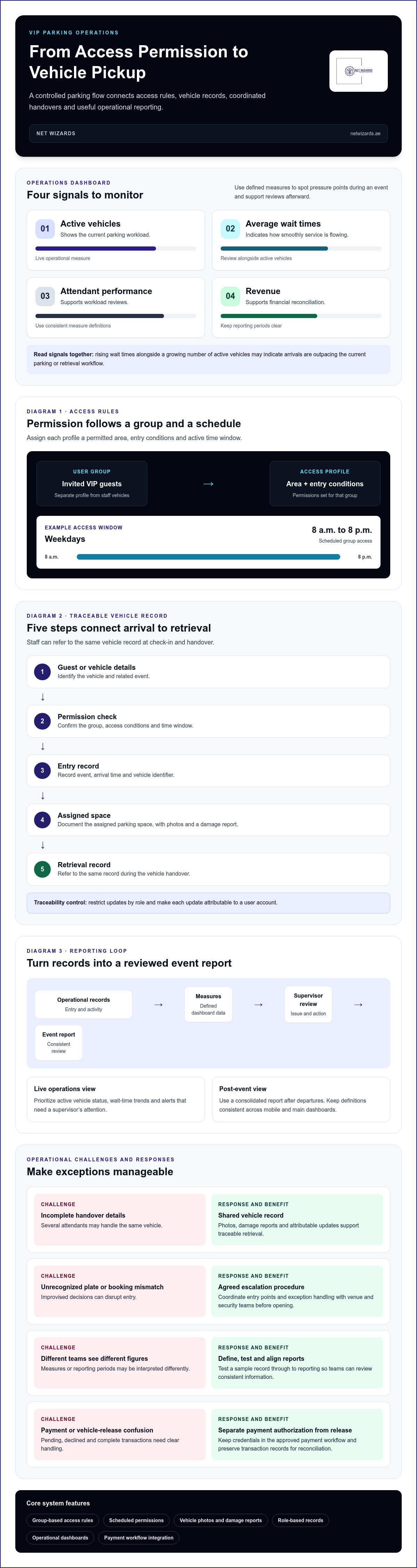
VIP parking is controlled access, not simply a reserved bay. An automated VIP parking management system applies access rules, records vehicle check-ins, and helps coordinate arrivals and pickups. A system can be configured to allow a user group access from 8 a.m. to 8 p.m. weekdays.
For UAE venues and event operators, secure vehicle handling depends on clear permissions and a traceable process from arrival to collection. This article explains how access control, vehicle records, security coordination, system integrations, and parking analytics work together. It also outlines common operational challenges, the features that support a controlled parking flow, and the factors that shape implementation, so you can assess the requirements for your venue or event.
Key Takeaways
- Set clear vehicle check-in procedures, including photo records and damage reports, to strengthen traceability.
- Use parking dashboards to monitor operational measures such as active vehicles, wait times, attendant performance, and revenue.
- Plan VIP drop-off, parking, and pickup flows around the venue layout, guest volume, and event requirements.
- Map system integrations with existing tools, including number-plate recognition, property management, and payment systems.
- Match access permissions to user groups and operating schedules to support controlled entry and organized vehicle movement.
Table of Contents
Parking security, traceability and access rules
In the UAE, plan compliance across personal-data handling, payment processing, venue access, and operational safety. The applicable requirements depend on the system’s functions and operating context, so define those controls before configuring access or collecting vehicle records.
Start with an access matrix that assigns permissions to identifiable groups. For example, organizers can reserve one access profile for invited VIP guests and another for staff vehicles. Set each profile’s permitted area, entry conditions, and active time window. A parking management system can be configured to allow a user group access from 8 a.m. to 8 p.m. on weekdays. That rule demonstrates how permissions can follow a schedule rather than rely on a manual list at the gate.
At check-in, record the event, arrival time, vehicle identifier, and assigned space. The valet system can document the vehicle with photographs and a damage report. Staff can refer to the same record at retrieval, supporting a traceable handover. Restrict access by role and ensure each update is attributable to a user account. This helps prevent incomplete handover details when several attendants handle the same vehicle.
Link access decisions to vehicle records in this sequence:
Guest or vehicle details → permission check → entry record → assigned space → retrieval record
Secure parking depends on coordinated operations, not software alone. Parking teams can work with venue and security teams to align entry points, reserved areas, escalation procedures, and vehicle movement. Before opening, walk through the arrival route together and agree who handles denied entry, an unrecognized plate, or a mismatch between a booking and the guest list. A defined response prevents improvised decisions at the entrance.
Separate payment authorization from vehicle release. Connect the parking software to the approved payment workflow and define what staff see when a transaction is pending, declined, or complete. Keep payment credentials within the payment-processing system, rather than copying them into vehicle notes. Limit staff permissions and preserve transaction records for reconciliation. The integration design determines how these controls work.
Quality and safety controls need clear evidence. The valet parking system identifies ISO 9001 as a quality management certification; use quality procedures to document staff tasks, incident escalation, and record handling. Keep emergency lanes clear in the venue layout, brief attendants on pedestrian crossing points, and assign a supervisor to resolve access exceptions. Data analytics can help review access events and incident patterns, but only defined records and permissions make those reviews useful. These controls turn automated VIP parking management into a governed operating process, with traceable decisions at each handover.
Requirements depend on the system’s functions and operating context. Address personal-data handling, payment processing, venue access, and operational safety. For VIP and automated valet operations, use role-based access and traceable vehicle records, coordinate entry and escalation procedures with venue security, and keep payment credentials within the approved payment workflow.
Parking analytics, dashboards and reporting
Parking analytics turn operational records into information managers can use during and after an event. A useful dashboard connects current activity to clearly defined measures, rather than presenting data without context.
Real-Time Dashboards and Reporting
A valet system can provide real-time reporting on active vehicles, average wait times, attendant performance, and revenue. Supervisors can use these measures to spot pressure points while operations are underway. For example, rising wait times alongside a growing number of active vehicles may indicate that arrivals are outpacing the current parking or retrieval workflow.
Match each measure to its purpose. Active vehicles show current workload; average wait times indicate service flow; attendant performance supports workload reviews; and revenue supports financial reconciliation. Make the reporting period and measure definitions clear. Otherwise, managers may compare different time windows or interpret an indicator differently. Use consistent definitions across event reports.
Cloud-Based Dashboard Access
Cloud-based access can let authorized teams view the same reporting environment from separate work locations. Set access by role: an event supervisor may need live operating measures, while a finance user may need revenue summaries. This keeps each view relevant and limits unnecessary exposure to operational records.
Before deployment, define what appears in each dashboard, who can access it, and how updates reach users. Test a sample event record from entry into the software through to its appearance in a report. If teams see different figures, resolve the data flow and definitions before using analytics for planning.
Mobile Dashboard and Reporting
A mobile dashboard is most useful when it presents decisions clearly on a smaller screen. Prioritize active vehicle status, wait-time trends, and alerts requiring a supervisor’s attention. Staff should be able to review information quickly without searching desktop-style tables during busy event operations.
Check that mobile reports distinguish live readings from completed-event summaries. An operations lead may need a live view during arrivals, followed by a consolidated report after departures. Keep measures consistent with the main dashboard so mobile and office teams can discuss the same figures. This helps supervisors make coordinated decisions across the venue.
Operational records → dashboard measures → supervisor review → event report
Use reporting to identify a specific process issue, assign an action, and review the next event’s results. To define dashboard requirements around your parking workflow, discuss reporting requirements.
What Is Automatic Parking Management?
Automated parking management uses software and operating procedures to coordinate vehicle access, parking, and retrieval. Compared with staffed valet parking, it can standardize records and access decisions, while attendants and marshals continue to manage physical vehicle movement and exceptions.
VIP Areas and Coordinated Vehicle Movement
A VIP parking plan defines where vehicles enter, stop, park, and return for pickup. Dedicated parking areas, drop-off points, and pickup zones help separate guest movements from general event traffic. Match the layout to the venue’s access points and expected guest volume. For example, a hotel entrance may need a clear drop-off lane and a separate route to assigned spaces.
Event requirements shape deployment. A wedding may need a small valet team and VIP parking, while a large exhibition may call for multiple valet points, supervisors, and traffic marshals. Map vehicle routes before the event and assign responsibility at each handover point.
Event Access and Traffic Flow
Event traffic marshals can manage entry and exit points, guide drivers, and help maintain orderly vehicle flow during busy arrivals and departures. Assign each marshal a post and route, then brief the team on movements between the entrance, parking area, and pickup zone. Clear directions help prevent congestion caused by competing vehicle movements.
In the UAE, event parking providers support corporate events, conferences, exhibitions, weddings, gala dinners, VIP and private events, government functions, hospitality and venue events, and large public gatherings. Organizers can coordinate parking technology and operational planning with venue teams around the event layout, guest volume, and parking requirements.
Digital Vehicle Check-In and Retrieval
At check-in, staff can create a digital record linking a vehicle to its event and retrieval process. The valet system can document the vehicle with photographs and a damage report. At pickup, staff use the record to locate the vehicle and complete the handover. Clear retrieval steps reduce confusion when several attendants support the same event.
Define how staff handle a missing ticket, incorrect vehicle details, or delayed pickup. Assign a decision-maker for each exception and require a consistent record update, so the digital trail reflects what happened.
Vehicle Tracking and Registration
In this context, vehicle tracking means following each vehicle’s operational status through its parking record, not assuming continuous location tracking. Registration details, check-in time, assigned area, and retrieval status show where a vehicle is in the process. Consistent fields also make event reporting more useful after operations close.
Plan installation and launch of an automated VIP parking system around the venue layout, software and hardware integration, access requirements, and expected guest volume. The sequence typically includes defining requirements, configuring the system, testing integrations, preparing staff, and completing a controlled operational handover.
Venue plan → vehicle entry → digital check-in → assigned parking → retrieval
Hardware compatibility, open APIs and system integration
A parking management system must exchange the right records with venue hardware and existing software. Map each connection before deployment, from vehicle identification to payment status, so teams can test how information moves.
Hardware Compatibility
Compatibility depends on how the parking system communicates with equipment such as automatic number-plate recognition systems and digital key cabinets. List each device, its role, and the event that should trigger an update. For example, define whether a plate match creates an arrival record or flags the vehicle for staff review.
Select hardware to match the operating workflow. A camera may capture a plate, while a key cabinet controls key storage; the management system must associate both actions with the correct vehicle record. Test the complete configuration before live use, including what happens if a device goes offline or returns incomplete data.
Open APIs can provide a structured way for separate systems to exchange information. The integration design should identify which system owns each record, which fields are shared, and how errors appear to staff. For example, agree whether payment status or a vehicle retrieval update becomes the authoritative event record.
Document each connection’s boundaries: the device or software name, data direction, required fields, and error-handling path. This helps prevent a common deployment problem: hardware that works individually but does not support the complete parking workflow.
Parking Management System Integrations
A parking management system can integrate with hotel property management systems, restaurant point-of-sale systems, payment gateways, digital key cabinets, and automatic number-plate recognition systems. Each connection serves a different purpose. A hotel PMS can exchange relevant guest or booking information, while a POS or payment gateway can link transaction status to the parking process.
Define the trigger and expected outcome for every connection. A completed payment, for instance, may update a transaction record, while a plate-recognition event may create an arrival event. Do not assume a connection automatically synchronizes every field. Confirm the required data flow through interface documentation and test cases.
Run a controlled integration test before launch. Test representative scenarios: a recognized vehicle, an unmatched plate, a declined payment, and a key-cabinet status change. Confirm that each event appears in the correct system and gives staff a clear next step.
Device or system → defined data fields → parking management system → staff action
For UAE venues, this integration map helps align parking workflows with hotel, restaurant, and event operations while keeping system responsibilities explicit.
Automated parking management and access control
Access control turns a parking plan into operational rules that software can apply consistently. For a corporate venue in the UAE, define who may enter, which area they can use, and when their permission applies. This approach reduces manual decisions at entry points while preserving staff oversight for exceptions.
Build permissions around user groups and event requirements. A parking management system can be configured to allow a user group access from 8 a.m. to 8 p.m. weekdays. The same principle supports event-specific rules: assign an access profile, identify its permitted area, and set its operating window. Staff can then review denied entries against the correct rule instead of relying on an informal list.
Effective capacity also depends on how well access rules match space allocation. Proper software management can increase a parking facility’s effective capacity by up to 47%. That figure describes a potential improvement, not a guaranteed result for every site. The practical mechanism is better coordination of permissions, available spaces, and vehicle movement. Review the site layout and operating pattern before changing access rules.
A common challenge is a mismatch between a reservation and a vehicle arriving at the gate. Set an exception process: pause entry, compare the vehicle record with the authorized group, and refer unresolved cases to a supervisor. This keeps decisions traceable while allowing staff to resolve legitimate changes. Record manual overrides in the system, including the reason and responsible user.
For revenue control, align access permissions with the relevant booking or payment status. A paid parking transaction, for example, can trigger an eligible access state when the systems share that information. Define how staff handle pending or declined payments, and make the release decision clear. This helps prevent disputes caused by conflicting records and supports accurate reporting.
- Define access groups and permitted areas.
- Apply time windows to each group.
- Test approved, denied, and exception cases.
- Review entry records and revenue outcomes after operations.
Consistent configuration can support corporate sites and event venues with different access needs. Review permission changes before each operating period, then compare actual entry records with the intended rules. This can reveal outdated profiles and recurring exceptions while preserving staff judgment for unusual cases.
Access group → time and area rule → entry decision → recorded outcome
Assess access rules, software workflows, and integration requirements for your parking operations.
NET WIZARDS L.L.C: Industrial Networking Equipment
NET WIZARDS L.L.C supports UAE operators aligning VIP parking workflows with connected infrastructure. Its Industrial Networking Equipment, Industry 4.0 Solutions, Industrial Cloud Platform, and AI Edge Computing can address connectivity, data handling, and system-integration requirements around parking operations.
Consider an integration-focused review when a venue needs to connect parking processes with broader operational systems or existing infrastructure. The right architecture depends on the site’s devices, data flows, access controls, and reporting needs. Defining these requirements helps identify where networking hardware and digital platforms fit within the parking environment.
Contact NET WIZARDS L.L.C to discuss your parking system requirements.
Define the Next Integration Step
The next step is to turn operational priorities into an implementation brief. Identify which access decisions need automation, which systems must exchange data, and which team owns each exception. This gives technical planning a defined boundary before hardware, software, and venue workflows are brought together. A well-scoped automated VIP parking management architecture can then be assessed against actual site requirements, rather than assumptions about how every venue operates.
For UAE organizations planning this work, NET WIZARDS L.L.C offers Industrial Networking Equipment, Industry 4.0 Solutions, and an Industrial Cloud Platform. These offerings are relevant when parking operations form part of a wider connected-system environment. Set out the required interfaces and operating priorities, then discuss how the architecture can support them.
A clearly defined starting point helps your team move forward with confidence and a practical integration plan.
Frequently Asked Questions
What is automated VIP parking management and how does it work?
Automated VIP parking management coordinates vehicle access and valet workflows using software, defined permissions, and digital records. An invited vehicle can be matched to an approved access profile, checked in, assigned a parking space, and retrieved through its recorded status. Automation structures these steps; attendants still handle physical vehicle movement and unusual situations. Define who can approve exceptions and how staff record their decisions.
What technologies are used in automated VIP parking systems?
Systems may combine parking management software with automatic number-plate recognition, digital key cabinets, and venue-platform integrations. Guest notifications can use SMS, an app, or a QR code. For example, a hotel could connect booking information with parking records, while a key cabinet supports controlled key handling. Choose technology to match the site’s workflow and the devices or business systems that need to exchange information.
What features should businesses compare when choosing a VIP parking management system?
Compare how each system handles access permissions, vehicle records, exceptions, integrations, and reporting. Check whether managers can assign distinct roles, review changes, and identify who approved an override. Assess whether reports present measures useful to venue operations and finance. A system suited to a single event may need a different configuration from one supporting recurring hotel or corporate parking workflows.
How do guests book, check in, and retrieve their cars with automated VIP parking?
The venue’s booking process determines how a guest receives parking authorization, such as through event registration or a hotel reservation. At arrival, staff or connected systems associate the vehicle with that authorization and record check-in. For retrieval, the guest presents the event’s designated identifier or request, and staff locate the matching vehicle record. Clear procedures for lost tickets or changed vehicles help prevent mistaken handovers.
How can automated VIP parking integrate with hotel, event, and payment systems?
Integration connects selected records between parking software and systems such as a hotel property management system, event platform, restaurant point-of-sale system, or payment gateway. Define which system supplies each field, such as booking status or transaction outcome, and what action follows an update. Test ordinary and exception scenarios before launch. For instance, confirm how staff handle a pending payment when a guest requests vehicle retrieval.
What are the security, liability, and data privacy risks of automated VIP parking?
Key risks include unauthorized access, inaccurate vehicle records, mistaken release, mishandled keys, and exposure of identifiable data or payment information. Reduce these risks with role-based access, reliable handover records, restricted payment data, and a documented incident process. Set retention and deletion procedures for photographs and vehicle details. Before operations begin, assign responsibility for reviewing disputes, correcting records, and escalating suspected security incidents.
What are the benefits and drawbacks of automated VIP parking compared with staffed valet parking?
Automated VIP parking management can standardize access decisions, vehicle records, and reporting, improving traceability and operational oversight. It does not replace attendants: staff still manage vehicle movement and exceptions.