
A BMS should see fire-system conditions without taking authority away from the fire alarm panel. That boundary is central to a safe, useful fire alarm bms integration gateway: it can make selected panel information available for building-wide monitoring while the fire alarm system retains its independent life-safety role. The practical challenge is that panels and BMS platforms may use different interfaces, and teams need to define exactly what information can be shared.
A clear integration plan resolves those questions before installation. This guide explains the gateway’s place in the architecture, compares hard-wired signals, protocol gateways and native panel interfaces, and outlines the engineering work required for data mapping, testing and commissioning. It also clarifies where visibility ends and system responsibility remains. NET WIZARDS supplies a Fire Alarm Gateway for building and facility integration, with the connection and data mapping defined around the systems involved.
Key Takeaways
- A fire alarm bms integration gateway can share selected panel information with the BMS while preserving the fire system’s independent authority.
- Choose an integration approach based on the panel and BMS interfaces, required data detail, and project scope, not on protocol assumptions.
- Define point mapping, testing, documentation and commissioning early to resolve naming and interpretation issues before deployment.
- Compare hard-wired signals, protocol gateways and native interfaces by the visibility each provides and the engineering effort involved.
- NET WIZARDS supplies a Fire Alarm Gateway for building and facility integration, with the connection planned around the project’s operational requirements.
Table of Contents
- What a Fire Alarm BMS Integration Gateway Does and Where Its Role Ends
- How the Fire Alarm Gateway Moves Data Between Panel and BMS
- Compare Hard-Wired Signals, Protocol Gateways, and Native Interfaces
- Resolve Integration Challenges with Defined Engineering and Commissioning
- Select a Fire Alarm BMS Integration Gateway Around Project Fit
What a Fire Alarm BMS Integration Gateway Does and Where Its Role Ends
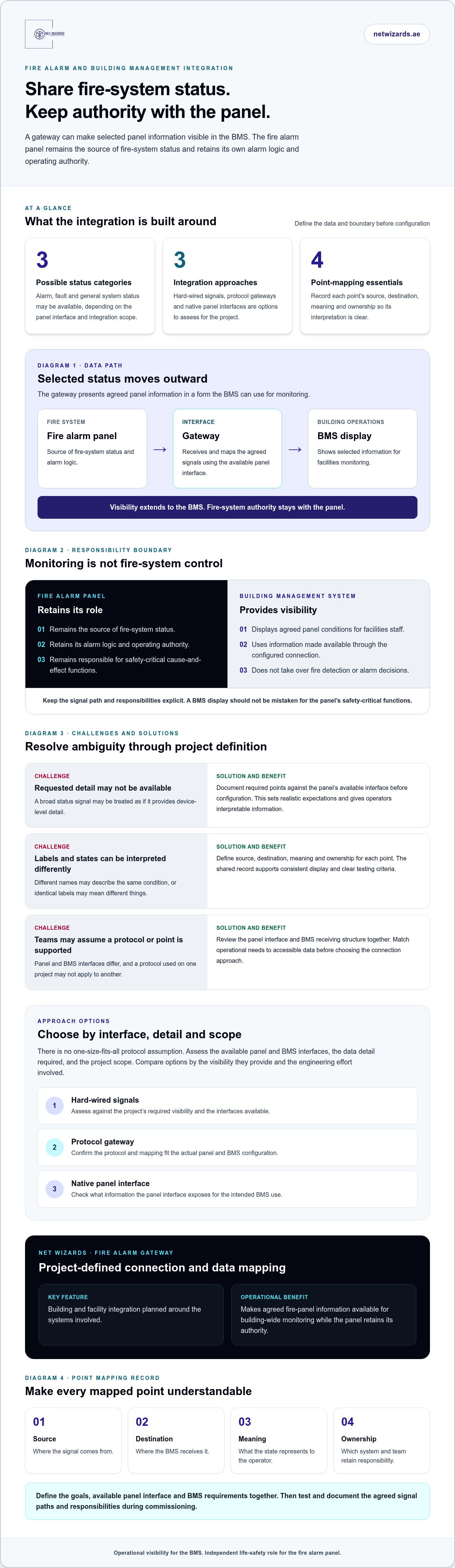
A fire alarm bms integration gateway provides an interface for sharing selected information from a fire alarm panel with a building management system. It presents agreed information in a form the BMS can use for monitoring, based on the panel’s available interface and the integration configuration. The gateway extends operational visibility. It does not replace the panel or determine how the fire alarm system responds.
The panel remains the source of fire-system status and the authority for its own alarm logic. A BMS may display selected conditions for facilities staff, but that display does not make the BMS responsible for detecting fire, deciding alarm actions or performing safety-critical cause-and-effect functions. Understanding the role of the Fire Alarm Control Panel helps establish why this boundary matters.
Diagram 1. Selected status data flows from the fire system to the BMS
FIRE SYSTEM BOUNDARY
[Fire alarm panel] → [Gateway interface] → Boundary → [BMS data model and operator display]
Selected panel information flows outward. The BMS provides visibility; the panel retains its alarm logic and operating authority.
Which fire alarm information can a BMS use?
Depending on the panel interface and integration scope, the BMS may receive categories such as alarm, fault or general system status. These are possible data categories, not a standard point list. The available information depends on what the panel exposes and how the connection is configured. Define which conditions are useful to facility operations and how they should appear in the BMS instead of assuming that every panel point will be available.
A common challenge is treating a broad status signal as if it provides device-level detail. Address this by documenting the required points and their meaning against the panel’s available interface before configuration. That gives BMS operators useful, interpretable information without suggesting that the connection provides more detail than it does.
How does integration preserve life-safety priority?
Monitoring and control are different responsibilities. A BMS can use agreed status information to inform building operations, but its display or automation logic should not be mistaken for the fire panel’s safety-critical cause-and-effect functions. Project engineers should define and validate signal paths and responsibilities, including what information crosses the interface and what remains within the fire system.
Establish the integration goals, panel interface and BMS requirements together. If teams define these separately, they may find that a requested BMS point is not available or that a displayed status has no agreed meaning. Early coordination closes that gap by matching operational needs to accessible data and recording the system boundary. NET WIZARDS supplies a Fire Alarm Gateway for building and facility integration, with the information exchange planned around project requirements while the fire panel retains its authority.
How the Fire Alarm Gateway Moves Data Between Panel and BMS
Integration depends on a defined data path, not on a protocol name chosen in isolation. The panel exposes information through an available interface; the gateway receives and maps agreed signals; the BMS then presents them within its own data model. For a fire alarm bms integration gateway, every step must match the panel configuration and BMS requirements. A protocol used in one project should not be assumed to apply to another.
Start by reviewing the panel interface and the BMS receiving structure together. Identify which source signals are available, which operational points the BMS needs, and how each condition should appear to an operator. The gateway’s role is to present or map agreed information, not to infer missing detail. For broader context on how industrial devices exchange information across protocols, see this industrial protocol converter guide.
What happens during interface and protocol mapping?
First establish what the panel can expose and what the BMS can receive. Then define each point’s source, destination, meaning and ownership. This record matters because identical labels can have different interpretations, while different labels can describe the same condition. The National Fire Protection Association (NFPA) provides fire-safety resources, but project teams still need to define specific integration responsibilities and signal paths for their systems.
Mapping should preserve the meaning of states and events as they pass between systems. For example, distinguish the source condition from the BMS label used to display it, and document whether a change represents an alarm, a fault or another agreed status. If a source signal does not provide enough detail for a requested BMS point, record the limitation and revise the point requirement rather than implying a level of visibility the interface cannot deliver.
How should teams define the BMS data model?
Build the receiving model around information the panel interface actually supplies. Where the source supports separate alarm, fault and normal-state information, retain those distinctions in the BMS. Agree point names, status interpretation and escalation ownership with the relevant fire-system and facilities teams. This reduces ambiguity during operation and gives testing teams clear acceptance criteria. The result is a BMS display that communicates agreed conditions consistently rather than simply reproducing unfamiliar panel labels.
Diagram 2. Project-level point mapping
[Panel interface and source signal] → [Agreed meaning and state] → [Gateway mapping] → [BMS point name and display] → [Assigned operational owner]
Document and validate each mapping against the available source and receiving data model. Labels shown are stages, not a product-specific point list.
Inconsistent naming between panel documentation and BMS schedules is a frequent challenge. Resolve it with a controlled mapping register that records the source label, agreed interpretation, destination point and responsible team. NET WIZARDS supplies its Fire Alarm Gateway for building and facility integration, including project-specific mapping and configuration. To discuss an integration requirement, use the NET WIZARDS L.L.C contact page.
Compare Hard-Wired Signals, Protocol Gateways, and Native Interfaces
The right interface depends on the information the BMS needs, the connection the panel can support and the project’s defined safety architecture. A simple signal link may be enough for limited status visibility. A protocol gateway may suit a broader data requirement, while a native panel interface may provide the required connection without a separate gateway when the capabilities are compatible. None is universally best. Evaluate the actual interfaces and engineering scope before selecting an approach.
Compare the options against four project factors: required data detail, interface availability at both ends, the extent of mapping and configuration, and the effort needed to test and maintain the integration. Wider system design matters too. The mission-critical industrial networking framework provides broader context for assessing how an integration fits within operational infrastructure.
When might hard-wired signals suit the integration?
Hard-wired signaling can suit a project that needs a limited, point-to-point status exchange and has suitable panel outputs and BMS inputs. It provides a direct way to convey defined conditions, but the information is limited to the signals available. A small set of connections does not become a detailed, mapped data set by default. Individual device context or additional states may not be available through that interface.
The challenge is expecting a few signals to support a much wider monitoring requirement. Define each signal’s meaning and destination, then keep safety-critical actions within the engineered and approved system design. This keeps the interface proportionate to the task and makes its limitations clear to operators.
When might a protocol gateway provide a better fit?
A protocol gateway may suit a project when the BMS needs structured panel information and the panel provides an interface for that exchange. Its value depends on actual protocol access, BMS compatibility, the points that can be mapped, and the configuration and testing required. The word “gateway” alone does not establish compatibility or data depth. Engineers need to assess both ends of the connection and define the supported scope.
More mapped information can make BMS monitoring more useful, but it also increases the need for clear point definitions and maintainable configuration. Agree how conditions are named, represented and verified. Record the mapping so later system changes can be assessed against it.
When can a native interface be considered?
Some panels provide a native communication interface. It is suitable only when its capabilities align with the BMS and the project’s data needs. Native connectivity may reduce external interface hardware, but it still requires configuration, point mapping and commissioning. Treat compatibility as a project-specific engineering decision, not an assumption based on a protocol name.
Diagram 3. Match the interface to required visibility
[Limited status points] → [Hard-wired signals]
[Structured data and mapped points] → [Protocol gateway, where interfaces align]
[Compatible panel and BMS communication] → [Native interface]
Use this comparison to narrow the architecture, then validate the selected path against the panel interface, BMS requirements and agreed system responsibilities. NET WIZARDS supplies a Fire Alarm Gateway for building and facility integration. Its engineers define the connection and mapping around the project’s interfaces and requirements.
Resolve Integration Challenges with Defined Engineering and Commissioning
A reliable integration is engineered in sequence, from agreed scope through to operational handover. This process exposes gaps early: requested points may not be available at the panel interface, labels may mean different things across systems, or responsibility for responding to a displayed condition may be unclear. A defined workflow gives each issue an engineering response and creates records that can be checked during commissioning.
- Confirm scope. Identify the monitoring purpose and the information the BMS is expected to receive. The challenge is an open-ended request for “fire system visibility.” Resolve it by agreeing the required signal categories and boundaries before configuration begins.
- Assess interfaces. Review the available panel interface and BMS receiving capability against the agreed scope. If a requested condition cannot be accessed through the source interface, revise the point requirement or integration design rather than assuming the gateway can provide it.
- Map data. Compare panel descriptions with BMS point names and state interpretations. Resolve inconsistent terminology through an agreed point schedule that records source, destination, meaning and ownership.
- Test. Verify each agreed point against source behavior and its BMS interpretation. A mismatch calls for investigation of the source signal, mapping or display configuration, followed by retesting against the same acceptance criteria.
- Document. Record the final configuration, mapping, test outcomes, known limitations and operational responsibilities. This gives facilities teams a usable reference for handover and later system changes.
Which integration challenges should the project team anticipate?
Address unclear panel data by establishing the interface and point scope before detailed configuration. Resolve mismatched names or states through a mapping review with the relevant fire-system and BMS teams. If ownership is unclear, assign responsibility for panel conditions, gateway configuration, BMS display and any operational response. These decisions reduce ambiguity without shifting fire-system authority to the BMS.
What should gateway testing and handover cover?
Use project-defined commissioning and acceptance procedures suited to the system design. Test agreed alarm, fault and status points where the source interface supports them, confirming both the originating behavior and how the BMS represents it. The test record should identify expected and observed results, corrective actions and retesting outcomes. Coordinate test conditions with the teams responsible for the fire system so verification follows the approved project process.
Handover should provide operators with more than a list of points. Include configuration and mapping records, test evidence, system boundaries and named operational owners. This is especially important where a BMS display could otherwise be mistaken for the source system’s indication or response.
Diagram 4. From integration challenge to operational handover
[Challenge identified] → [Engineering response agreed] → [Validation evidence recorded] → [Configuration and ownership handed over]
NET WIZARDS supplies its Fire Alarm Gateway as part of building and facility integration work. The integration is planned around defined interfaces, point mappings and commissioning needs.
Select a Fire Alarm BMS Integration Gateway Around Project Fit
Gateway selection should start with the project’s interfaces and operational requirements, not an assumed protocol or a generic feature list. NET WIZARDS L.L.C supplies a fire alarm bms integration gateway for building and facility integration. Its purpose is to support fire alarm integration; the applicable interfaces, data points and configuration are defined around the project scope. This keeps selection grounded in the panel and BMS requirements rather than assumptions about compatibility.
What should a gateway evaluation brief specify?
Prepare an engineering brief that defines the systems to be connected, the information the BMS needs and how the project team will assess whether the integration meets its purpose. Include:
- Panel and BMS interfaces: Record available interface documentation and identify details that need engineering assessment.
- Required data points: Identify conditions for BMS visibility and their intended meaning to operators.
- System boundaries: State what information is shared and distinguish BMS monitoring from fire-system operation.
- Configuration and testing: Assign responsibility for integration configuration, point verification and project acceptance activities.
- Handover records: Define the mapping and configuration documentation, test results and operational information facilities teams need.
This brief addresses a common challenge: a broad request for fire-system visibility may not specify which data the panel interface makes available. Record project constraints and match the required scope to the actual interfaces before finalizing the integration design. This helps teams set realistic expectations and plan focused commissioning.
How does NET WIZARDS L.L.C support integration projects?
NET WIZARDS L.L.C supplies a fire alarm bms integration gateway and provides facility and building management systems as part of its integration capabilities. The gateway is designed for fire alarm integration. Engineers define the applicable configuration around the systems and requirements involved, including the interfaces, point mapping and commissioning scope.
NET WIZARDS L.L.C’s in-house R&D and product development capability is supported by specialized research and development centres in international technology hubs, including China and Taiwan. This engineering resource supports project-specific integration work. The intended operational value is to make agreed information useful to building teams while maintaining clear system responsibilities, supporting operational efficiency and enhanced safety.
NET WIZARDS L.L.C has 20 years of experience. A project brief covering interfaces, requested data, system boundaries, configuration and commissioning provides a practical basis for planning an integration with its engineering team.
Set the Integration Up for Long-Term Clarity
Treat the integration decision as part of the facility’s long-term operating plan. A well-scoped fire alarm bms integration gateway should be supported by clear records that remain useful as building systems are maintained or changed. Preserve the agreed data definitions, system boundaries and responsibility assignments alongside the commissioning evidence. These records give project teams a practical reference for assessing future changes without assuming that new interfaces or requirements match the original design.
NET WIZARDS supplies a Fire Alarm Gateway and provides facility and building management capabilities for project-specific integration work. Start with a defined brief that sets out what the BMS needs to see and how the project will validate that exchange. Clear engineering ownership helps teams move forward while keeping system responsibilities distinct.
A disciplined project definition creates a stronger basis for dependable building operations. Keep the mapping, test records and responsibility assignments accessible for the teams who maintain the integration.
Frequently Asked Questions
Can a fire alarm BMS integration gateway connect any fire alarm panel to any BMS?
No, compatibility is not universal. The fire alarm bms integration gateway must match the panel’s available interface and the BMS’s receiving structure, and the panel must expose the information the project requires. For example, a panel may provide a general condition while the BMS team expects more detailed information. Identify such gaps during design, then adjust the requested scope or integration architecture to match the available data.
Does a BMS integration gateway replace the fire alarm control panel?
No, a gateway does not replace the fire alarm control panel. It supports an information exchange between systems, while the panel remains part of the fire alarm system and retains its operational role. A facilities operator may view an agreed condition on a BMS workstation, but that display does not make the BMS the source of the fire system’s indication. Document responsibility for interpreting and acting on each display.
Can a fire alarm gateway send alarm information to a BMS in real time?
Do not assume a particular update rate from the presence of a gateway. Information timing and presentation depend on the interfaces, configuration and BMS design, so state and verify any performance requirement for the project. Define which alarm, fault and status conditions matter, then observe their behavior during commissioning. The test record can capture whether each agreed condition appears as intended without implying an unverified response time.
What happens if the gateway or communication link stops working?
The system response depends on the designed architecture, so define how a communication interruption will be indicated and handled. For example, distinguish a lost connection from a normal panel state in the BMS display if the design supports that distinction. Agree who investigates the gateway, communication path and receiving system, and include the expected indication in testing. Do not assume a particular failover or backup behavior unless it is specified and validated.
Is BACnet or Modbus always required for fire alarm BMS integration?
No, neither protocol is universal for fire alarm BMS integration. The appropriate communication method depends on the panel interface, BMS requirements and selected integration design. A protocol name alone does not establish compatibility or determine which information can be exchanged. For example, a BMS may support a protocol that the panel interface does not expose. Base the decision on the actual connection details and agreed point requirements.
What information should be prepared before requesting a gateway integration proposal?
Prepare the panel make and interface documentation, BMS platform and interface details, and a preliminary list of required conditions. Add relevant drawings or point schedules, the intended monitoring scope, and the project’s testing and handover expectations. Note any constraints on system boundaries or operational ownership as well. This information helps engineers identify missing inputs early and develop an integration scope based on project requirements rather than assumed compatibility.
Does fire alarm BMS integration allow the BMS to control fire alarm functions?
Not automatically. Monitoring information and control of fire alarm functions are separate design considerations. If a project proposes control or cause-and-effect behavior, engineers must define the action, the system that owns it, and how the complete behavior will be reviewed and tested within the project’s safety architecture. Do not infer control capability from a monitoring connection. Keep fire-system responsibilities explicit in design records and commissioning evidence.
To plan a fire alarm BMS integration, contact NET WIZARDS about your project requirements.