
What if the strongest Industry 4.0 business case begins by showing what should not be scaled yet? Technology alone does not establish value. A proposal must explain how a defined operational problem affects performance, what a solution needs to integrate with, and how the result will be measured.
It is reasonable to question projected benefits before deployment. Legacy equipment, disconnected systems, workforce readiness, and uncertain returns can make even a promising proposal difficult to evaluate. Start with an agreed baseline, not a technology shortlist.
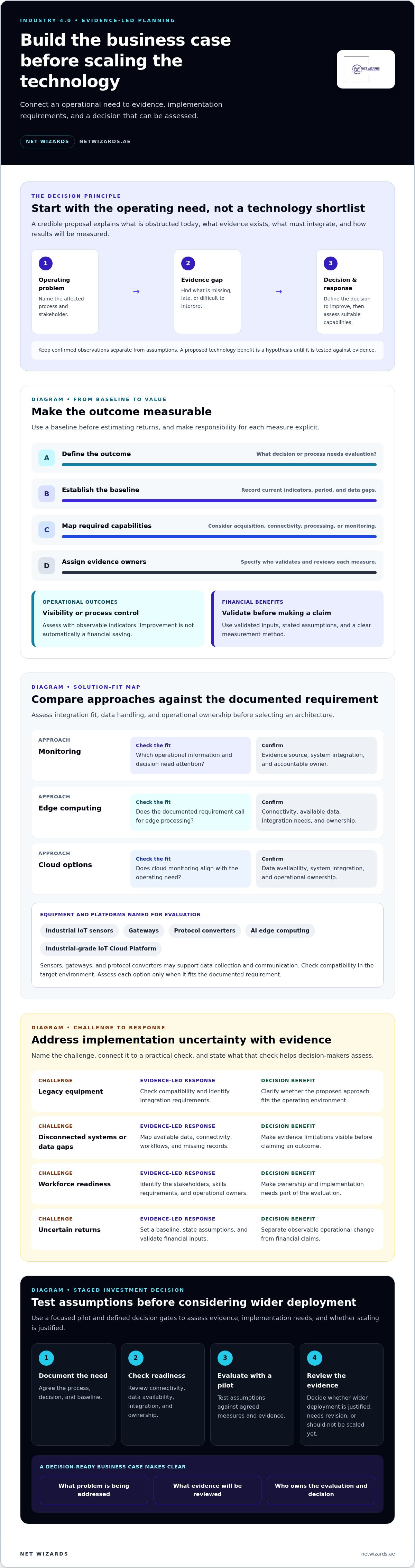
This guide explains how to connect an operating need to measurable outcomes, compare solution approaches, and account for implementation requirements such as connectivity, data availability, and system integration. It also shows how to structure a staged investment decision, using a focused pilot to test assumptions before considering wider deployment. The result is a business case decision-makers can assess against evidence, clear ownership, and the conditions required to proceed.
Key Takeaways
- Anchor an Industry 4.0 business case in a specific operating need, not a preferred technology.
- Set a measurable baseline and distinguish operational improvements from financial benefits that still need validation.
- Compare monitoring, edge computing, and cloud options against integration fit, data handling, and operational ownership.
- Use defined decision gates to test assumptions, address implementation challenges, and determine whether wider deployment is justified.
- Assess Industrial IoT sensors, gateways, and protocol converters, AI edge computing, and the Industrial-grade IoT Cloud Platform only when they fit the documented requirement.
Table of Contents
- Why an Industry 4.0 Business Case Must Start with an Operational Problem
- Connecting Industry 4.0 to Measurable Business Value
- How to Compare Industry 4.0 Solution Options Before Selecting an Architecture
- How to Build a Staged Industry 4.0 Business Case and Manage Its Challenges
- How NET WIZARDS L.L.C Can Support an Evidence-Led Industry 4.0 Business Case
Why an Industry 4.0 Business Case Must Start with an Operational Problem
An Industry 4.0 business case is an evidence-based proposal that connects a defined operational need to a technology-enabled response, implementation requirements, and a method for evaluating results. It explains why the operation needs to change before recommending a sensor, gateway, or cloud platform. The Fourth Industrial Revolution provides broader context for connected industrial technologies, but a business case must address a specific operating environment.
Start with a decision the operation cannot make reliably today. For example, a maintenance team may lack timely condition information for a critical asset. That points to a potential monitoring need. Selecting a sensor before confirming which asset, condition, and maintenance decision matter reverses the logic. Choose technology in response to a verified need, not as a substitute for defining one.
Which operational challenges justify evaluation?
Monitoring gaps, disconnected systems, delayed visibility, and maintenance uncertainty can justify evaluation when they obstruct a named process or decision. For each candidate issue, record the affected process, the responsible stakeholder, and the decision that is difficult to make. A production supervisor may need current process status, while a maintenance lead may need records that help determine when equipment requires attention.
Separate evidence from assumptions. A documented delay or missing record is a confirmed observation. The belief that a new platform will prevent the delay is a hypothesis to test. Trace the problem through the existing workflow and identify where information is unavailable, late, or difficult to interpret. This helps avoid investing in connectivity that does not resolve the operational constraint.
What evidence establishes a credible baseline?
Inventory operational records, existing system data, and documented workflows before setting targets. For each source, note what it measures, the measurement period, any missing or inconsistent entries, and who is accountable for validating it. If records cannot establish a reliable baseline, document that limitation and define how the evidence gap will be addressed before claiming a financial benefit.
Assign baseline validation to someone familiar with the process, and name the person who will measure outcomes during evaluation. Keep operational observations, such as improved visibility or process control, distinct from financial benefits. Financial claims require validated inputs and a clear measurement method.
Operational problem → Current process → Evidence gap and impact → Decision obstructed → Evidence needed to evaluate a response
For each step, record the process owner and supporting evidence. Use the map to clarify what must be verified before selecting technology or authorising a staged evaluation.
Connecting Industry 4.0 to Measurable Business Value
An Industry 4.0 business case becomes measurable when it connects an operational challenge to evidence, a system capability, and a decision. Use this workflow before estimating financial returns:
- 1. Define the outcome. State the operational decision or process the organisation needs to evaluate, such as identifying an asset condition sooner.
- 2. Establish the baseline. Record what happens now, which indicators describe it, the measurement period, and any data gaps or limitations.
- 3. Map required capabilities. Determine whether the need calls for data acquisition, connectivity, edge processing, or cloud monitoring. Industrial IoT sensors, gateways, and protocol converters may support data collection and communication, subject to compatibility checks in the target environment.
- 4. Identify evidence sources. Assign an owner to each measure and specify what evidence will support the review and decision.
Keep operational benefits separate from financial benefits. Improved visibility or process control can be assessed through observable indicators, but neither automatically establishes savings. Financial estimates require validated inputs and clearly stated assumptions. Adoption barriers can include integration complexity, skills requirements, and difficulty establishing a practical scope. The discussion of making Industry 4.0 accessible to all manufacturers provides additional context on these implementation considerations.
How should factory automation ROI be evaluated?
Evaluate ROI only after defining the baseline, selected benefits, costs to include, and agreed review period. Assess relevant cost categories such as equipment, integration, connectivity, software, training, and ongoing operation, using project-specific inputs rather than generic estimates.
Label results accurately. A calculation based on observed baseline data and recorded costs is not the same as a forecast based on expected outcomes. Document each forecast assumption and identify how a bounded pilot or further analysis could test it before a wider investment decision.
Which benefits can an Industry 4.0 case assess?
Choose benefits that match the operational need, then assign each an indicator and data owner. For visibility, assess whether the required status information is available to the responsible team. For predictive maintenance, define the equipment condition or maintenance indicator to evaluate. For energy optimisation, identify the relevant consumption data. For enhanced safety, specify an observable process or safety indicator. Confirm that the data exists and can be interpreted before setting targets.
Operational challenge → Required data → System capability → Observable measure → Review decision
If an assumption appears anywhere in this chain, mark it for validation. A bounded pilot can test whether the data is accessible and useful before treating a forecast benefit as an achieved result. To discuss the relevant data path, discuss your industrial data requirements.
How to Compare Industry 4.0 Solution Options Before Selecting an Architecture
Compare solution options against the operating requirement and the conditions of the plant. Targeted automation may address a defined process constraint. Connected monitoring may provide access to operational data, while edge computing or cloud-based monitoring may suit different processing and oversight needs. Treat each as an option to assess, not a ranked choice or a guaranteed source of savings.
For each approach, record the implementation evidence decision-makers need before selecting an architecture:
Targeted automation
Assess: process fit, equipment changes, and operational ownership.
Evidence: current workflow, constraints, and acceptance criteria.
Connected monitoring
Assess: available data, equipment interfaces, and intended users.
Evidence: required readings, access needs, and data ownership.
Edge computing
Assess: processing location, connectivity dependencies, and data handling.
Evidence: site-specific processing needs and system interfaces.
Cloud-based monitoring
Assess: data destinations, access governance, connectivity, and ongoing ownership.
Evidence: platform requirements, data-management responsibilities, and security review.
When do edge computing and cloud platforms fit?
Assess where processing, monitoring, and integration need to occur. AI edge computing may fit a documented requirement for processing near equipment. The Industrial-grade IoT Cloud Platform may be relevant when the case calls for cloud-based monitoring or integration across supported protocols, including MQTT, Modbus, NB-IoT, LoRaWAN, and TCP/UDP. Validate latency, connectivity, security, and data-management requirements in the actual operating environment before choosing either.
How should integration and delivery risk be assessed?
Legacy equipment can present interface or protocol mismatches. Map equipment, protocols, data destinations, and interfaces before selecting components. If systems cannot communicate directly, assess whether protocol conversion addresses the identified gap. Unclear data ownership requires defined governance, including who can access, validate, and maintain the information.
For each option, identify dependencies, operational owners, and commissioning responsibilities. Confirm who will verify interfaces and accept the resulting configuration. If network design forms part of the evaluation, consult the mission-critical industrial networking architecture guide.
Operational requirement → Equipment and interface map → Processing location and data destination → Ownership and evidence review → Option selected for evaluation
How to Build a Staged Industry 4.0 Business Case and Manage Its Challenges
A staged Industry 4.0 business case gives decision-makers a controlled route from an identified need to a possible wider deployment. Each gate should define its scope, accountable owner, evidence requirement, and exit decision. This keeps unresolved assumptions visible and prevents early technical interest from being treated as proof of operational value.
- Discovery: Define the operational issue, affected process, stakeholders, and current evidence. The process owner confirms the need. The exit decision is whether the problem merits further evaluation.
- Readiness review: Check baseline data, equipment interfaces, dependencies, and ownership. Operations and engineering validate the process and integration picture. Proceed only when material gaps are understood or assigned for investigation.
- Bounded validation: Test a limited use case with agreed scope, data, interfaces, measures, and stakeholders. The named operational owner records evidence and documents exceptions.
- Review and scale decision: Compare findings with the baseline and agreed criteria. Decision-makers choose to proceed with a proposed scale-up, revise the case, gather more evidence, or stop.
What belongs in a controlled validation phase?
Select a specific process or asset, then define the data required, the interfaces involved, and who will review the results. Agree beforehand how evidence will be collected and what would trigger a revised proposal, such as unavailable data or an integration dependency that changes the scope. A bounded test can establish whether assumptions hold in the selected environment. It does not guarantee a particular result or set a standard duration.
How should decision-makers manage adoption and ownership?
Assign review responsibilities according to the organisation’s structure. Operations should confirm the workflow and usefulness of results. Engineering should assess equipment and interfaces. IT should review relevant connectivity and data governance. Finance should scrutinise cost inputs and benefit assumptions. Name the ongoing system owner before making a scale decision.
Incomplete records require baseline validation, not invented estimates. Integration uncertainty calls for interface discovery before the proposal treats connectivity as resolved. Document training needs, support responsibilities, data access and maintenance, and any dependencies that remain open. A visible risk can be evaluated; a hidden one can undermine the decision.
Discovery → Readiness evidence → Bounded validation → Operational and financial review → Proceed, revise, gather evidence, or stop
At each gate: define scope, accountable owner, evidence checkpoint, and exit decision. Include operations, engineering, IT, and finance where their responsibilities apply.
For connected plants, interface discovery and network dependencies may shape the validation scope. Review the mission-critical industrial networking architecture guide when network architecture forms part of the case.
How NET WIZARDS L.L.C Can Support an Evidence-Led Industry 4.0 Business Case
Once the operational requirement and evidence are defined, NET WIZARDS L.L.C capabilities can be assessed against the proposed system architecture. The appropriate fit depends on the equipment, data, interfaces, and operating responsibilities documented for the case. Include a product in the proposal only when it addresses a stated requirement. Its inclusion does not establish savings or improved performance.
Which NET WIZARDS L.L.C capabilities may fit the proposed case?
For data acquisition from equipment or communication between systems using different protocols, assess Industrial IoT sensors, gateways, and protocol converters. These may support connected monitoring or protocol integration when compatible with the target equipment and interfaces. Verify the configuration against the actual operating environment.
Where the case establishes a need for processing near equipment, consider AI edge computing. Where it requires cloud-based monitoring or data integration, assess the Industrial-grade IoT Cloud Platform. It supports MQTT, Modbus, NB-IoT, LoRaWAN, and TCP/UDP. Confirm that the required protocols, data flows, and access arrangements align with the plant’s needs before selecting an architecture.
If standard hardware or software does not appear to address a documented requirement, clarify the gap and intended scope before considering further development. NET WIZARDS L.L.C provides in-house research and development capability. Assess its relevance against specific technical requirements rather than treating customisation as an assumed part of the solution.
What should stakeholders prepare before a consultation?
Prepare a concise description of the operational problem, current systems, known interfaces, data gaps, and the decision the organisation needs to make. Bring validated baseline evidence, its limitations, the intended measurement method, and the accountable owners. Identify uncertainties clearly, including any unverified protocol or system dependency.
Ask how each proposed capability maps to the requirement, which integration dependencies need investigation, and how the organisation can evaluate technical fit and outcomes. Clarify which teams will own the data, system operation, and measurement. NET WIZARDS L.L.C provides end-to-end delivery from sensor design through cloud integration and analytics, which stakeholders can assess against the proposed scope.
Move Forward with Evidence and Clear Decision Gates
A defensible Industry 4.0 business case starts with a specific operational problem, a validated baseline, and a clear method for measuring outcomes. Compare solution options against actual integration and ownership requirements, then use staged decision gates to test assumptions before considering wider deployment.
NET WIZARDS L.L.C brings 20 years in business, in-house research and development capability, and end-to-end delivery from sensor design through cloud integration and analytics. Its capabilities can be assessed against documented needs, including industrial data acquisition, connectivity, edge computing, and cloud monitoring. Establish fit against the operating environment rather than assuming it in advance.
With the right evidence, accountable owners, and a controlled route to implementation, your team can make the next investment decision with greater clarity. Start with the operational need, and build from what the evidence supports.
Frequently Asked Questions
What is an Industry 4.0 business case?
An Industry 4.0 business case is an evidence-based proposal that connects an operational need to a technology-enabled response and a way to assess its results. It should identify the affected process, document the current baseline, explain required capabilities and integration dependencies, and name accountable owners. It is not simply a request to purchase a sensor, gateway, or platform. The case should make clear what decision the evidence will support.
How do you build a business case for factory automation?
Start by defining the process problem and the outcome the operation needs to evaluate. Establish a baseline from available records, note gaps, and identify who will validate the data. Then compare suitable approaches, document equipment and system dependencies, and assign responsibility for implementation and measurement. Separate observed facts from assumptions. A staged evaluation can test unresolved questions before decision-makers approve a broader proposal.
How is factory automation ROI calculated?
Calculate ROI using validated financial inputs over an agreed evaluation period. One common expression is: (monetised benefits minus total costs) divided by total costs, multiplied by 100. Define which costs and benefits the calculation includes, such as relevant equipment, integration, operation, or verified financial gains. Distinguish measured results from forecast values, and record assumptions behind any forecast. If benefits cannot be reliably monetised, report operational measures separately.
Which benefits should an Industry 4.0 business case include?
Include benefits that match the documented operating need and can be assessed with observable evidence. Possible objectives include better operational visibility, maintenance planning, energy optimisation, process control, or enhanced safety. For each, identify an indicator, its data source, the measurement period, and the responsible owner. Treat these as intended outcomes, not achieved results. Validate the evidence before assigning financial value or claiming that a solution delivered a benefit.
Can Industry 4.0 systems integrate with legacy equipment?
They may integrate with legacy equipment, but compatibility depends on the equipment, available interfaces, protocols, and the proposed system architecture. Begin by inventorying assets, data sources, and existing connections. If systems use incompatible protocols, gateways or protocol converters may be options to assess. Confirm the actual interface requirements and test the proposed data path in the target environment before relying on integration in the business case.
What challenges can prevent an Industry 4.0 project from delivering value?
Unclear operational goals, incomplete baseline data, legacy interfaces, uncertain data ownership, and limited workforce readiness can weaken a project. Address these directly: validate the baseline, map interfaces before selecting components, assign data and system owners, and identify training needs. Keep unresolved dependencies visible as risks. If an expected benefit relies on an untested assumption, define how further analysis or a bounded evaluation will test it.
Should a company pilot an Industry 4.0 solution before scaling it?
A bounded pilot can be useful when it tests a defined operational use case or an important assumption before a wider commitment. Specify its scope, stakeholders, data, interfaces, measurement method, and decision criteria in advance. Review the evidence against the baseline, then decide whether to proceed, revise the proposal, gather more evidence, or stop. The appropriate scope and duration depend on the use case and operating environment.