
What if connecting more equipment still leaves decisions no clearer? For many industrial operators, operational data remains divided across assets, protocols and software systems. Industry 4.0 solutions UAE organizations consider need to do more than add sensors: they should move relevant, reliable data into workflows that support timely decisions.
Integration, security and deployment complexity can make modernization difficult to scope, especially when technology choices aren’t tied to operational needs. A practical architecture can connect Industrial IoT sensors, gateways, and protocol converters with edge computing and an Industrial-grade IoT Cloud Platform, while accounting for existing systems and site requirements. The objective is visibility that addresses a defined challenge, not technology for its own sake.
This article explains how assets, connectivity, data processing and monitoring fit together, then examines solution patterns for specific operational needs. It also outlines a phased path from assessment to deployment, including integration considerations and ways to define review criteria before selecting technologies. The guiding principle is straightforward: Industry 4.0 succeeds when connected assets become part of governed operational workflows.
Key Takeaways
- Assess Industry 4.0 solutions UAE by the operational problem they address, not by the number of devices or platforms they add.
- Map how data moves from assets through gateways and networks to edge or cloud platforms, so integration gaps are visible before deployment.
- Match fragmented data, legacy protocols, remote assets and limited visibility to relevant solution components, with the architecture shaped by site requirements.
- Use a phased assessment and deployment process, then evaluate findings against your organization’s objectives rather than assumed savings.
- Explore how NET WIZARDS’ sensors, gateways, protocol converters, edge computing, cloud platform and in-house R&D can support an integrated solution.
Table of Contents
What Industry 4.0 Solutions in the UAE Actually Connect
Industry 4.0 solutions UAE organizations assess should connect industrial assets, operational data and decisions, rather than simply add devices or software. A sensor may capture a condition, but its value depends on whether the information can reach the right systems and people and inform an appropriate response. This connected approach draws on technologies associated with the Fourth Industrial Revolution (Industry 4.0), including the Internet of Things, artificial intelligence and cyber-physical systems.
Definition: Industry 4.0 connects industrial assets, communications, data processing and applications so teams can turn operational information into insight and action. Its purpose is to support better-informed operations, not to deploy technology without a defined need.
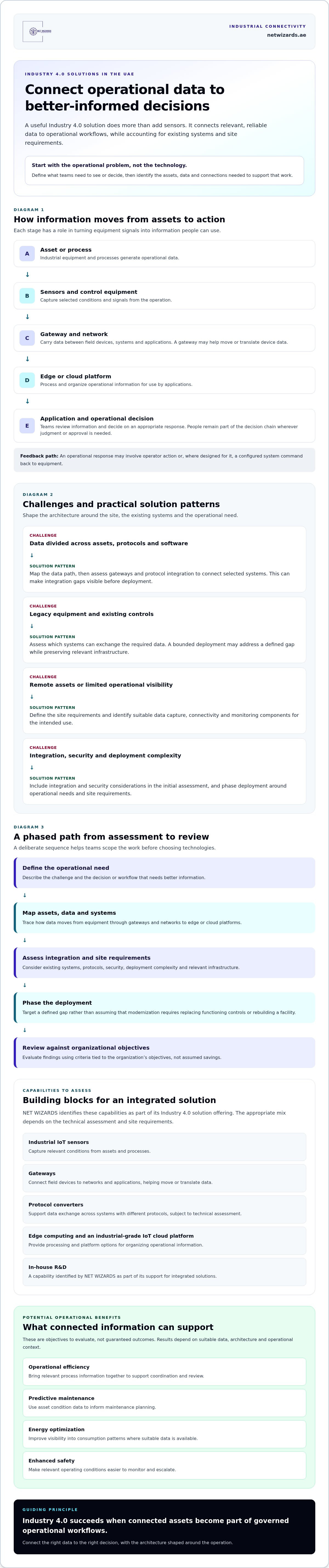
The system spans five connected elements: operational assets generate data; sensors and control equipment capture it; connectivity carries it; edge or cloud platforms process and organize it; and applications present it for review or an operational response. A person remains part of the decision chain wherever judgment, approval or intervention is required.
At a glance: Asset or process → Data capture → Connectivity → Edge or cloud processing → Application → Operational decision
How Industry 4.0 differs from basic industrial automation
Industrial automation controls a process, such as maintaining an operating condition or executing a defined sequence. Industry 4.0 connects operational information across assets and systems so teams can interpret conditions beyond the control loop. Depending on the site’s architecture and objectives, equipment data may then inform monitoring, analysis or maintenance planning.
Existing automation can remain part of this architecture. Gateways and protocol integration may help selected systems exchange data with newer platforms, subject to technical assessment. Modernization doesn’t automatically require replacing functioning controls or rebuilding an entire facility. A bounded deployment can target a defined gap while preserving relevant infrastructure.
Why UAE organizations assess Industry 4.0
Industrial plants are only one setting. Utilities, facilities, transport operations and critical infrastructure also rely on distributed assets and timely operational information. Organizations may assess connected systems to address priorities such as:
- Operational efficiency: bring relevant process information together to support coordination and review.
- Predictive maintenance: examine asset condition data to inform maintenance planning.
- Energy optimization: improve visibility into consumption patterns where suitable data is available.
- Enhanced safety: make relevant operating conditions easier to monitor and escalate.
These are potential objectives, not guaranteed outcomes. Define the operational problem first, then identify the assets, data and decisions a solution must connect. This helps distinguish a useful Industry 4.0 initiative from an isolated technology purchase.
How an Industry 4.0 Solution Moves Data from Assets to Decisions
A connected architecture turns equipment signals into information people can use. The path typically runs from an asset or sensor through a gateway and network to edge or cloud processing, then to an application where an operator reviews the information and decides what to do. The return path matters too: an approved response may involve a human action or, where the system is designed for it, a command back to equipment.
Data flow: Asset or sensor → Gateway → Network → Edge processing and/or cloud platform → Dashboard or application → Operational response
Decision feedback: Operational response → Operator action or configured system command → Asset or process
An industrial gateway connects field devices to networks and applications, helping move or translate their data so other parts of an industrial system can use it. Its precise role depends on the devices, protocols and data requirements in the proposed architecture.
Connecting industrial equipment and protocols
Industrial IoT sensors can capture information that existing equipment may not provide in a useful digital form. Gateways and protocol converters can help bring data from different devices into a connected architecture. Modbus and M-Bus are examples of industrial communication protocols, but compatibility must be confirmed for the specific equipment and configuration.
Start by documenting installed controls, devices, available data and required applications. This review can show where existing systems can remain in place and where an integration component may be needed. Heriot-Watt University’s research offers context on challenges to Industry 4.0 adoption in the UAE, while a site-level assessment determines the technical response for each operation.
Choosing between edge processing and cloud monitoring
Edge computing handles data nearer to connected operations. This can suit use cases that require local processing, subject to the application’s requirements. An Industrial-grade IoT Cloud Platform can support remote monitoring, data integration and analytics across connected assets. Edge and cloud aren’t mutually exclusive: an architecture may use edge processing for selected tasks and cloud services for broader visibility.
Define what data must be available, where it needs to be processed, who will use it and what action it should inform. Then assess connectivity, system interfaces and operational constraints before selecting components. NET WIZARDS L.L.C provides Industrial IoT sensors, gateways, and protocol converters, industrial networking, AI edge computing and an Industrial-grade IoT Cloud Platform. Organizations assessing a suitable configuration can discuss an Industry 4.0 architecture against their operational requirements.
Industry 4.0 Challenges and Solution Patterns for UAE Operations
Industrial sites can collect more data without gaining better operational awareness. Sensors alone don’t create an Industry 4.0 operating model: teams also need suitable connectivity, integration with existing systems, useful presentation of the data and a defined response. The right architecture depends on site requirements, equipment, data needs and operating workflows.
| Challenge | Possible solution components | Operational use | Assess first |
|---|---|---|---|
| Fragmented data | Gateways, protocol converters and cloud integration | Bring selected information together for monitoring | Data ownership, interfaces and required data |
| Legacy protocols | Protocol conversion and compatible gateways | Connect suitable existing equipment with applications | Device protocols, configuration and compatibility |
| Remote assets | Industrial IoT sensors and suitable network connectivity | Support remote monitoring and maintenance workflows | Coverage, asset conditions and communications needs |
| Limited operational visibility | Data processing and an industrial cloud platform | Present relevant information for review and response | Users, operational indicators and response procedures |
Challenge-to-action pathway: Operational gap → Enabling technology → Monitoring or maintenance use → Site and system assessment
Example: Disconnected meter data → compatible gateway and integration → consolidated metering information → confirm interfaces, data needs and responsible users.
Integration and visibility across existing systems
Disconnected equipment may use different protocols or expose data through different interfaces. Protocol conversion, gateways and cloud integration can help connect selected systems, but teams should first establish who owns each system, what information is needed and which interfaces are available. For metering requirements, an M-Bus gateway or an AMI sub-metering platform may be relevant options to assess. The appropriate configuration depends on the devices, data requirements and integration needs.
Remote monitoring, predictive maintenance and safety
Remote sensing can make selected asset conditions available for operational review. Teams may use that information to inform maintenance planning or monitoring workflows; sensor deployment alone doesn’t predict failures or improve safety. Those outcomes depend on suitable data, analysis and clear procedures for acting on alerts.
For remote assets, assess the required coverage, communications method, sensor conditions and integration with existing applications before selecting connectivity. NET WIZARDS supplies industrial networking equipment, including industrial 4G and 5G routers, and satellite asset trackers for monitoring mobile and remote equipment. These options address different connectivity and tracking needs, so selection should follow the specific asset and operating requirements.
How to Assess and Phase an Industry 4.0 Initiative
A practical Industry 4.0 initiative starts with an operational requirement, not a preferred device or platform. For organizations evaluating Industry 4.0 solutions UAE deployments, a phased approach makes assumptions visible before they become part of the system design. Keep the scope bounded, document current conditions and agree on how stakeholders will review the result.
Phased roadmap: Assessment → Architecture → Bounded deployment → Operational review
Decision gate: Proceed, adjust or pause based on documented requirements and findings.
Start with an operational use case and baseline
Describe the operating problem in terms the people responsible for the process can verify. Identify the asset or process, the monitoring gap and the decision the initiative should support. For example, a team may need condition information to inform an existing maintenance review. Record current data sources, system interfaces and how staff handle the information today.
Agree on review criteria with operational, engineering and information technology stakeholders before choosing components. Criteria might address whether the required data is available, whether it reaches the intended users and whether the resulting information supports the defined decision. Keep measures specific to organizational objectives; don’t assume a particular saving or performance improvement.
Plan integration, deployment and operational ownership
Use the baseline to define the proposed system’s boundaries. Document which devices capture data, what gateways or connectivity are required, where processing occurs and which application presents the information. For connectivity decisions, consult this guide to mission-critical industrial networking architecture. Assess cybersecurity, system access and interfaces as part of the design, without treating them as a substitute for site-specific review.
- Define the problem: State the operational gap and the decision to support.
- Map assets and data: Record equipment, data sources, interfaces and information owners.
- Assess integration: Check protocols, connectivity, access requirements and existing system boundaries.
- Design a bounded deployment: Select a limited scope that can be evaluated against the agreed criteria.
- Review findings: Compare observed results with the objectives, document constraints and decide what should change before any next phase.
Assign operational ownership before deployment. Identify who will monitor the application, maintain relevant components, manage access and act on the information. Without clear responsibilities, a technically connected system may not become a dependable operating workflow. A phased plan helps teams expose integration issues early, limit the scope of initial decisions and make expansion contingent on evidence from the review.
How NET WIZARDS Supports End-to-End Industry 4.0 Solutions
NET WIZARDS L.L.C brings together industrial hardware, integration, edge computing, cloud capabilities and in-house R&D for organizations assessing Industry 4.0 solutions UAE. The right combination depends on the operational requirement. A monitoring gap may call for sensor data and connectivity; a system integration requirement may need gateways or protocol converters; a defined data-processing use case may benefit from edge computing or an industrial cloud platform.
Matching solution components to operational requirements
Industrial IoT sensors, gateways, and protocol converters support data capture and integration across selected equipment and systems. NET WIZARDS L.L.C’s multi-protocol capabilities can help address environments with differing interfaces, but device and protocol compatibility should be verified during architecture design. AI edge computing and the Industrial-grade IoT Cloud Platform have distinct roles, so include them only where the use case calls for local data handling, monitoring, integration or analytics.
This approach can help teams scope components around a defined operational need rather than acquire disconnected technology. NET WIZARDS L.L.C’s capabilities span industrial automation, utilities, facilities, transportation, smart cities and critical infrastructure. These are application categories, not assurances of a particular result at a given site.
Solution lifecycle: Sense operational conditions → Connect devices and systems → Process data at the edge or in the cloud → Monitor through applications → Review information and determine an operational response
Design principle: Match each component to a documented requirement, interface and responsible user.
When in-house R&D and project experience matter
Some requirements may not align with standard hardware or software configurations. NET WIZARDS L.L.C’s in-house R&D capabilities can be relevant when an organization needs to assess a tailored approach to industrial automation or communication requirements. The company’s stated delivery scope extends from sensor design through cloud integration and analytics, linking the physical data source with the systems used to review information.
When defining scope, document the operational problem, existing interfaces and intended users, then assess which components fit. A clear assessment can help determine whether available industrial networking, gateway, edge computing or cloud capabilities address the requirement, or whether further engineering work needs to be considered.
Build a Clear Path from Connected Assets to Action
Industry 4.0 depends on more than connected equipment. Assets, data, connectivity, processing and applications must work together to inform decisions. Start with a specific operational need, assess existing systems and interfaces, then phase deployment so each step can be reviewed against objectives your organization has defined.
For organizations considering Industry 4.0 solutions UAE, the right architecture is the one that fits the site and its operational requirements. NET WIZARDS has 20 years in business and delivers solutions from sensor design through cloud integration and analytics. Its industrial networking equipment, gateways, edge computing and cloud platform capabilities support assessment of different operational requirements without prescribing a single design for every facility.
Define the requirement, identify the data and systems involved, and assign responsibility for reviewing and acting on the information. A measured, integration-conscious approach gives teams a practical basis for deciding what to deploy next.
With a clear scope and operational objective, your organization can move forward one informed decision at a time.
Frequently Asked Questions
What are Industry 4.0 solutions?
Industry 4.0 solutions connect industrial assets, communication systems, data processing and applications so operational information can support decisions and action. They may combine sensors, gateways, networking, edge computing and cloud platforms, depending on the operational requirement. The objective isn’t simply to install more devices. It’s to make relevant data accessible and useful within defined workflows, while considering existing systems and the people responsible for responding to the information.
How can Industry 4.0 support UAE businesses?
Industry 4.0 solutions UAE businesses assess can support operational efficiency, predictive maintenance, energy optimization and enhanced safety when designed around specific site needs. For example, connecting relevant asset data to a monitoring application can help teams review operating conditions and inform maintenance workflows. Benefits depend on suitable data, integration and follow-up procedures; they aren’t automatic. Organizations should define the operational objective first, then determine which connected technologies can support it.
What technologies are used in Industry 4.0 solutions?
Common components include Industrial IoT sensors, gateways, protocol converters, industrial networking, edge computing and industrial cloud platforms. Sensors capture selected asset or environmental data, while gateways and converters can help integrate devices and systems using different interfaces. Edge computing handles data nearer to connected operations, and cloud platforms can support monitoring, integration and analytics. The appropriate combination depends on the use case, existing infrastructure and required data flow.
How do Industry 4.0 systems connect to existing industrial equipment?
Integration typically begins by documenting installed equipment, communication protocols, available interfaces and required data. Gateways or protocol converters may connect compatible equipment to networks or applications. Modbus and M-Bus are examples of protocols that may be relevant, but compatibility must be checked for the specific devices and configuration. Existing automation can remain part of a modernized architecture when suitable. A technical assessment helps identify integration needs before new components are selected.
Can Industry 4.0 solutions support predictive maintenance?
Yes. Connected sensors and equipment data can give teams information to review as part of maintenance planning. Analytics may help identify patterns or changes in operating conditions, depending on data quality, system design and the maintenance use case. This does not mean sensors alone predict failures or prevent downtime. Define what condition should be monitored, how staff will interpret the information and what maintenance workflow will follow before deployment.
How should an organization start an Industry 4.0 project?
Start with a specific operational problem and the decision the project should support. Identify relevant assets, current data sources, system interfaces and information owners. Then assess integration, connectivity, access and cybersecurity requirements before designing a bounded deployment. Agree on review criteria with stakeholders and evaluate findings against the organization’s objectives. This phased approach helps expose constraints early and gives teams a clear basis for deciding whether to adjust or expand the scope.
What is the role of edge computing in Industry 4.0?
Edge computing processes or handles data closer to connected equipment and operations. It can be appropriate when a use case calls for local data handling, while an industrial cloud platform can support broader monitoring, integration and analytics. The two approaches can complement one another. Their roles should be determined by the data involved, application requirements, connectivity and operational workflows. Select an architecture based on assessed site needs, not on the assumption that every system requires edge or cloud processing.