
An IoT project should earn approval through operational evidence, not speculative savings. Justifying IoT project investment starts with a clear account of current performance: where downtime, energy use, material waste, or manual monitoring affect operations, and how those impacts are measured. Without a baseline, finance and operations teams cannot reliably compare expected results with current performance.
The concern is valid. Hardware is only one part of the investment. Connectivity, integration, cloud services, commissioning, and ongoing support also shape total cost. Security, interoperability, and unclear ownership of success measures can add further risk. A defensible case makes these factors visible before deployment.
This article explains how to build a decision-ready industrial IoT business case by setting measurable baselines, defining success criteria, and assessing the full investment alongside expected benefits. It also outlines a staged evaluation path, from mapping sensors, gateways, industrial networking, and cloud integration to setting decision gates before scaling. The aim is a transparent proposal that stakeholders can assess against operational needs, implementation risks, and agreed measures of success.
Key Takeaways
- Start with an operational decision or constraint, then define the evidence needed to assess whether IoT can address it.
- Use a consistent scoping sequence to map the use case, system architecture, lifecycle costs, and accountable owners.
- Make justifying IoT project investment more rigorous by calculating ROI with disclosed assumptions and comparing results against a documented baseline.
- Pair project-specific risks, including data quality, cybersecurity, connectivity, and adoption, with practical mitigations before approval.
- Evaluate solution features against approved requirements so the selected architecture supports a credible implementation and scaling path.
Table of Contents
- When does an IoT project investment make a defensible business case?
- How to scope IoT project investment and establish a baseline
- How to calculate IoT project ROI without overstating benefits
- How to address IoT investment challenges before approval
- Selecting an IoT Solution: From Business Case to Action
When does an IoT project investment make a defensible business case?
A defensible IoT business case connects a defined operational need to a scoped investment, measurable benefits, and delivery risks that decision-makers can assess. The question is not whether connected devices could produce more data. It is whether that data can support a specific operational decision, and whether the expected change justifies the full project scope.
Start with the operation, not a preferred sensor, gateway, or platform. For example, a team may spend time taking manual readings but still lack timely information to decide when to investigate an abnormal condition. Identify the affected team, how often the constraint occurs, and which decisions depend on the missing information. This grounds justifying IoT project investment in a specific operational need rather than a technology demonstration.
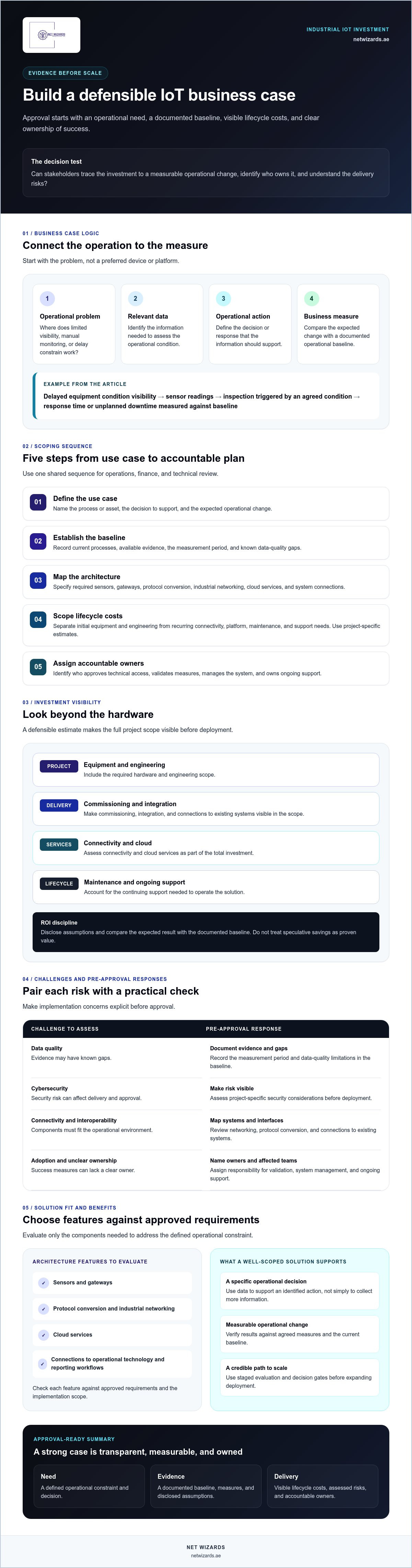
Business case logic: Operational problem → relevant data → operational action → business measure
Example: Delayed equipment condition visibility → sensor readings → inspection triggered by an agreed condition → change in response time or unplanned downtime, measured against the baseline.
Which operational problem is worth funding?
Look for a recurring constraint such as limited asset visibility, manual readings, or delayed maintenance decisions. Record who experiences it, when it occurs, and its consequences for the process. Then distinguish an ongoing operational need from an isolated request to test new technology.
Be precise about the expected outcome. “Improve maintenance” is too broad to evaluate. A stronger statement identifies the decision that should change, such as helping the responsible team prioritise inspections using current equipment data. Separate outcomes that can be measured and attributed from strategic aims, such as future readiness, that may matter but cannot yet be quantified reliably.
What makes an IoT business case decision-ready?
Name the accountable business owner, the operational teams affected, and the stakeholders responsible for technical and financial approval. State the expected operational change before selecting technical measures, then specify how the organisation will verify it. This makes assumptions visible and clarifies who owns results after deployment.
An IoT architecture may combine sensors, gateways, protocol conversion, industrial networking, and cloud services. The Internet of Things spans many technologies and applications, so broad capability alone does not establish project value. Evaluate only the components needed to address the stated constraint. For wider modernization context, see this Industry 4.0 solutions architecture guide.
The approval test is straightforward: can stakeholders trace the proposed investment to a measurable operational change, identify its owner, and understand the main delivery risks? If not, refine the problem and assumptions before committing to a solution.
How to scope IoT project investment and establish a baseline
A credible scope connects the operational use case to the systems, people, and recurring costs required to deliver it. Use this sequence before requesting final project estimates. It gives finance, operations, and technical teams a shared basis for reviewing assumptions.
- Define the use case. Specify the process or asset in scope, the decision the project should support, and the operational change expected.
- Baseline current operations. Record the existing process, available evidence, measurement period, and known data-quality gaps. Select indicators the system could influence and the organisation can verify.
- Map the architecture. Document required sensors, gateways, protocol conversion, industrial networking, cloud services, and connections to existing operational technology and reporting workflows.
- Scope lifecycle costs. Separate initial equipment and engineering from recurring connectivity, platform, maintenance, and support needs. Request project-specific estimates rather than relying on generic cost assumptions.
- Assign owners. Identify who approves technical access, validates operational measures, manages the system, and owns ongoing support.
Scope infographic
Baseline: Current process, records, and data limitations → Deployment scope: Devices, interfaces, connectivity, and platform → Operating model: Access, responsibilities, training, and support → Measurement points: Verified indicators before and after deployment
Which costs belong in the IoT investment?
Set the cost boundary across hardware, integration, connectivity, cloud, cybersecurity, commissioning, training, and ongoing support. Include the effort to connect existing OT systems, manage data workflows, and produce required reports. A gateway or platform quote alone may not represent the full delivery requirement.
Separate one-time project inputs from recurring operating needs. Ask suppliers and internal teams to identify assumptions, dependencies, and exclusions in their estimates. For justifying IoT project investment, the aim is not to force uncertain items into false precision. Disclose what remains unconfirmed and assign someone to resolve it.
How should teams establish the baseline?
Capture how the process works today, where its records come from, and how consistently teams collect them. Note gaps such as manual entries, missing readings, or inconsistent timestamps. Define data sources, collection intervals, access requirements, system interfaces, and the operational indicators to compare after deployment.
Connectivity and interface assumptions can affect the architecture and cost. Document where data needs to travel, which systems must exchange it, and what evidence is needed to verify that the proposed connections will work. For a related perspective on benefit measurement, Quantifying the ROI of IoT can inform the next stage, but project estimates and baselines must remain specific to your operation.
If internal teams need to validate architecture and scope assumptions, they can discuss relevant requirements with NET WIZARDS L.L.C.
How to calculate IoT project ROI without overstating benefits
A credible ROI calculation links a verified operational change to a financial value, then compares that value with the complete project investment over a stated period. Use a consistent formula:
ROI formula
ROI (%) = attributable net benefit during the stated period ÷ total investment for that period × 100
Attributable net benefit means measured benefits that can reasonably be linked to the project, less the costs included in the calculation. Validate every input, disclose assumptions, and state the measurement period.
For example, if a monitoring use case aims to reduce manual data-gathering effort, compare recorded staff time before and after deployment. Count a benefit only when the evidence supports the change and the project plausibly contributed to it. Do not claim the full improvement if another process change, staffing adjustment, or external factor also influenced the result. This discipline is central to justifying IoT project investment.
Which IoT benefits can a project credibly measure?
Choose indicators that match the approved use case and can be checked against operational records. Possible measures include effort spent collecting readings, energy use, asset availability, or maintenance response. A measure is not automatically a benefit: define its baseline, source, owner, and method of comparison first.
Keep benefit categories distinct. Direct savings may have a documented financial value; capacity effects may release staff time without reducing expenditure. Risk reduction and strategic benefits can matter, but do not assign them a financial value unless the organisation has an agreed, supportable method.
Benefit validation register
Benefit: Manual reading effort | Evidence source: Time or work records | Owner: Operations lead | Confidence: High, medium, or low with rationale
Benefit: Energy use | Evidence source: Meter records | Owner: Facilities or energy lead | Confidence: Record data limits
Benefit: Maintenance response | Evidence source: Work orders and timestamps | Owner: Maintenance lead | Confidence: Note other causes of change
Use one source of value for each claimed benefit. For instance, do not count the same avoided inspection as both labour savings and released capacity unless those are separate, evidenced effects.
How should teams test assumptions and uncertainty?
Build conservative, expected, and upside scenarios using organisation-approved inputs. Record attribution limits, implementation dependencies, and factors outside the project’s control. The IoT implementation challenges discussed by Siemens Advanta can prompt questions about dependencies such as adoption and cybersecurity, but they do not replace project-specific evidence.
Calculate payback only when verified project data supports the inputs. State the period, included costs, and assumptions alongside the result. If key data remains uncertain, present the gap plainly and set a measurement gate before treating projected benefits as achieved.
How to address IoT investment challenges before approval
Risk review should inform the investment decision, not sit apart from it. For each material uncertainty, name an owner, identify the evidence needed, define a mitigation, and set the point at which stakeholders will review the result. This gives finance and operations a shared basis to stop, revise, or proceed instead of relying on an untested forecast.
What if the projected IoT benefits are uncertain?
Separate confirmed baseline evidence from assumptions that require a pilot, interface test, or other technical validation. Before committing to broader deployment, agree what result would support proceeding, what would require redesign, and what would make the business case no longer viable. Record the measurement method and review period. Treat uncertain outcomes as uncertain, not as guaranteed savings.
Use approval gates to limit commitment as evidence develops:
- Scope gate: Confirm the operational need, baseline, accountable owner, and initial cost boundary.
- Validation gate: Check that data can be collected, interfaces work as required, and the proposed measure can be verified.
- Deployment gate: Review measured results, operating responsibilities, and updated risks before deciding to proceed, revise, or stop.
Set the evidence requirements before each gate. Otherwise, teams may redefine success after seeing the results, weakening the basis for approval.
How can teams manage integration and ownership risk?
Map existing systems, protocols, data destinations, access needs, and operational owners before choosing components. An interface review can expose dependencies between operational technology, gateways, connectivity, cloud services, and reporting. Confirm who will maintain devices, connectivity, integrations, and dashboards after implementation, including how teams will handle data-quality issues and user adoption.
Risk-and-response register
Unclear benefits: Operations owner | Baseline and indicator records | Agree measurement method | Review at validation gate
Integration risk: Technical owner | System and protocol inventory | Review interfaces and dependencies | Review before deployment approval
Data quality: Data owner | Sample records and known gaps | Define checks and exception handling | Review before benefit claims
Cybersecurity or connectivity: Assigned technical owner | Project-specific requirements and coverage evidence | Validate controls and connection assumptions | Review before deployment
Adoption or operating responsibility: Business owner | Workflow and responsibility review | Assign training, support, and maintenance ownership | Review before scale-up
For justifying IoT project investment, a risk register is useful only when its evidence and actions influence a real decision. Keep unresolved items visible, assign an accountable owner to each, and do not approve wider deployment until stakeholders accept the remaining exposure.
Selecting an IoT Solution: From Business Case to Action
Select the architecture against the approved use case, baseline, and acceptance measures. A feature is relevant only if it addresses a documented requirement, fits the existing environment, and has a clear implementation and ownership plan. More components do not establish more value.
Which solution features belong in the evaluation?
Check that sensors and gateways suit the assets and operating conditions in scope. Confirm protocol support and interfaces against existing systems, then assess connectivity based on where data must travel and how reliably operations need to access it. Decide whether processing belongs at the edge, in the cloud, or across both, based on the project’s data, integration, and operating requirements.
Evaluate security responsibilities and lifecycle ownership alongside technical fit. NET WIZARDS provides Industrial IoT sensors, gateways, and protocol converters, as well as an Industrial-grade IoT Cloud Platform with multi-protocol support including MQTT, Modbus, NB-IoT, LoRaWAN, TCP, and UDP. These capabilities can inform an architecture review, but the project team should verify specific interfaces, feature availability, and implementation responsibilities against its requirements before approval.
What should an approval-ready implementation plan include?
Document the delivery scope, accountable owners, dependencies, acceptance measures, and staged deployment decisions. Specify how teams will monitor results against the baseline, record exceptions, and decide whether to proceed, revise the design, or pause. A decision record should connect the evidence and assumptions to lifecycle investment, expected benefits, unresolved risks, and the next approval gate.
Solution selection and approval checklist
- Requirement: Is each proposed component tied to an approved operational need?
- Architecture: Are sensors, gateways, protocols, connectivity, edge or cloud processing, and system interfaces verified for the use case?
- Security and ownership: Are responsibilities for access, maintenance, integration, and ongoing operation assigned?
- Acceptance: Are measures, evidence sources, and exception reporting defined against the baseline?
- Decision gate: Is there enough verified information to proceed, or should the scope be revised or validated further?
This review keeps justifying IoT project investment grounded in fit and evidence rather than feature volume. Record any unverified requirement as an open item with an owner and resolution point. That gives procurement, operations, and technical stakeholders a consistent basis for comparing options and assessing implementation readiness.
Turn a measured use case into a confident next step
A sound IoT decision begins with an operational need, a documented baseline, and a full view of investment and delivery risk. Keep projected benefits tied to evidence, disclose assumptions, and use stage gates to validate uncertainty before expanding deployment. This is the foundation for justifying IoT project investment without relying on speculative savings.
Choose an architecture that meets approved requirements, not one with the longest feature list. Confirm how sensors, gateways, connectivity, integration, and cloud services will support the intended operational change, and assign clear ownership for ongoing operation.
NET WIZARDS L.L.C has 20 years in business and provides end-to-end solution delivery from sensor design through cloud integration and analytics. Its Industrial-grade IoT Cloud Platform supports multiple protocols, including MQTT, Modbus, NB-IoT, LoRaWAN, TCP, and UDP. Assess these capabilities against your project scope and decision criteria without assuming a particular return.
With clear measures, accountable owners, and a staged implementation path, your team can move forward with a business case grounded in operational evidence.
Frequently Asked Questions
How do you justify an IoT project investment to finance?
Show finance the operational problem, documented baseline, full investment scope, measurable benefits, and delivery risks. Explain which assumptions remain unverified and who owns each input. A decision-ready case for justifying IoT project investment links proposed spending to an operational measure, such as manual reading effort or maintenance response, then defines how the organisation will verify change. Include staged approval points so stakeholders can review evidence before committing to wider deployment.
How do you calculate ROI for an industrial IoT project?
Calculate ROI as attributable net benefit divided by total investment, multiplied by 100, and disclose the measurement period. Define net benefit consistently, including the costs and operational benefits counted in the calculation. Use verified baseline and post-deployment data, and exclude gains that cannot reasonably be attributed to the project. If the organisation cannot support an input with records or an approved valuation method, present it as an assumption rather than a realised benefit.
What costs should an IoT business case include?
Include equipment and engineering, system integration, connectivity, cloud services, cybersecurity, commissioning, training, and ongoing maintenance and support. Account for work needed to connect operational technology, data workflows, and reporting requirements. Separate initial expenses from recurring costs, and document estimates, dependencies, exclusions, and the team responsible for confirming each item. Request project-specific figures from relevant suppliers and internal cost owners rather than relying on generic market averages.
Can an IoT project be justified without a pilot?
Yes, if existing records and technical evidence are sufficient to validate the need, architecture, and expected measures. A pilot can help resolve specific uncertainties, but it is not a substitute for a defined business case. Identify which assumptions need testing and what evidence could change the decision. If interface compatibility, data quality, or operational benefit remains uncertain, consider a limited validation stage before approving broader deployment.
How do you measure IoT project benefits?
Choose indicators that the use case can influence and the organisation can verify. Compare pre-deployment and post-deployment records using the same definitions and a disclosed measurement period. For example, work orders and timestamps may help assess maintenance response, while meter records can support energy analysis. Assign an owner to each measure, record data limitations, and account for other changes that may have contributed to the result.
What are the main risks when investing in industrial IoT?
Common project-specific risks include weak data quality, integration problems, uncertain connectivity, cybersecurity gaps, low user adoption, unclear ownership, and underestimated ongoing responsibilities. Mitigate them before approval: review interfaces, validate data sources and network assumptions, define security requirements, and assign owners for devices, integrations, and operations. Track each risk with evidence, a mitigation, and a review gate so decision-makers can proceed, revise the scope, or pause.
Which IoT solution features should a business evaluate before investing?
Assess sensor and gateway suitability, protocol and interface compatibility, connectivity, edge or cloud requirements, integration needs, security responsibilities, and lifecycle ownership. Match each feature to an approved operational requirement and confirm implementation responsibilities during technical review. For example, NET WIZARDS’ Industrial-grade IoT Cloud Platform supports protocols including MQTT, Modbus, NB-IoT, TCP, and UDP. Verify that any relevant capability fits the project architecture instead of treating a longer feature list as proof of value.