
The gateway with the right label can still be the wrong fit for your system. A modbus gateway project depends on how existing Modbus devices communicate, which protocols the upstream platform accepts, and how operational teams will use the data. If these requirements are unclear, compatibility gaps and avoidable integration work can emerge after procurement.
Modbus gateways can connect devices using serial Modbus RTU or Ethernet-based Modbus TCP with upstream networks and platforms. The right choice depends on the complete architecture, not just a protocol name. Before selecting a solution, map your devices, interfaces, network path, and data requirements. This guide explains how to assess those elements, address deployment challenges, and evaluate an M-Bus / Modbus Gateway within a wider industrial integration. NET WIZARDS L.L.C brings 20 years in business and industrial networking equipment, including M-Bus / Modbus gateways, to the discussion.
Key Takeaways
- Start with the integration task: identify the Modbus devices, destination application, required data, and operating context.
- Map the full communication path from each field device, through the gateway and network, to the system that uses the data.
- For a modbus gateway dubai project, compare interfaces, protocol requirements, operating conditions, and destination systems rather than relying on the product label alone.
- Reduce deployment risk by documenting communication settings, checking register mappings, and testing data paths before integration.
- Assess the M-Bus / Modbus Gateway against documented project requirements and operational priorities.
Table of Contents
- Why Modbus Gateway Selection Starts With the Integration Problem
- How Modbus Gateway Architecture Connects Field Devices to Applications
- Modbus Gateway Evaluation Criteria for Industrial Procurement
- Common Modbus Gateway Deployment Challenges and Practical Responses
- NET WIZARDS M-Bus / Modbus Gateway: From Requirements to Solution
Why Modbus Gateway Selection Starts With the Integration Problem
Start with the task: connect Modbus devices to a supervisory, monitoring, or control environment. Choose the gateway based on the connection required, not the product label. A utility may need to bring field-device readings into an existing application, support operational visibility, or make data available to a control workflow. Each goal can create different requirements for interfaces, data mapping, and system boundaries.
Before comparing hardware, define four things: the source devices, destination systems, data to be transferred, and conditions in which communication takes place. For a modbus gateway dubai project, this project-level view establishes what the integration needs to do before procurement.
Define the operational requirement before comparing hardware
Build an inventory from equipment schedules and system documentation. Record device types, current communication methods, the receiving application, and who owns each part of the connection. Then state whether the project requires monitoring, control integration, or both. Collecting readings for a dashboard is not the same requirement as incorporating data into a control environment.
- List the field equipment and its current communication method.
- Name the supervisory, monitoring, or control system that must receive the data.
- Identify the required information and how the application will use it.
- Document operating constraints and responsibility boundaries across device, network, and application teams.
Unclear ownership can delay an integration even when the devices and destination are known. Assign responsibility for source configuration, network access, data mapping, and application-side interpretation. This defines the scope and gives procurement a consistent basis for comparing solutions.
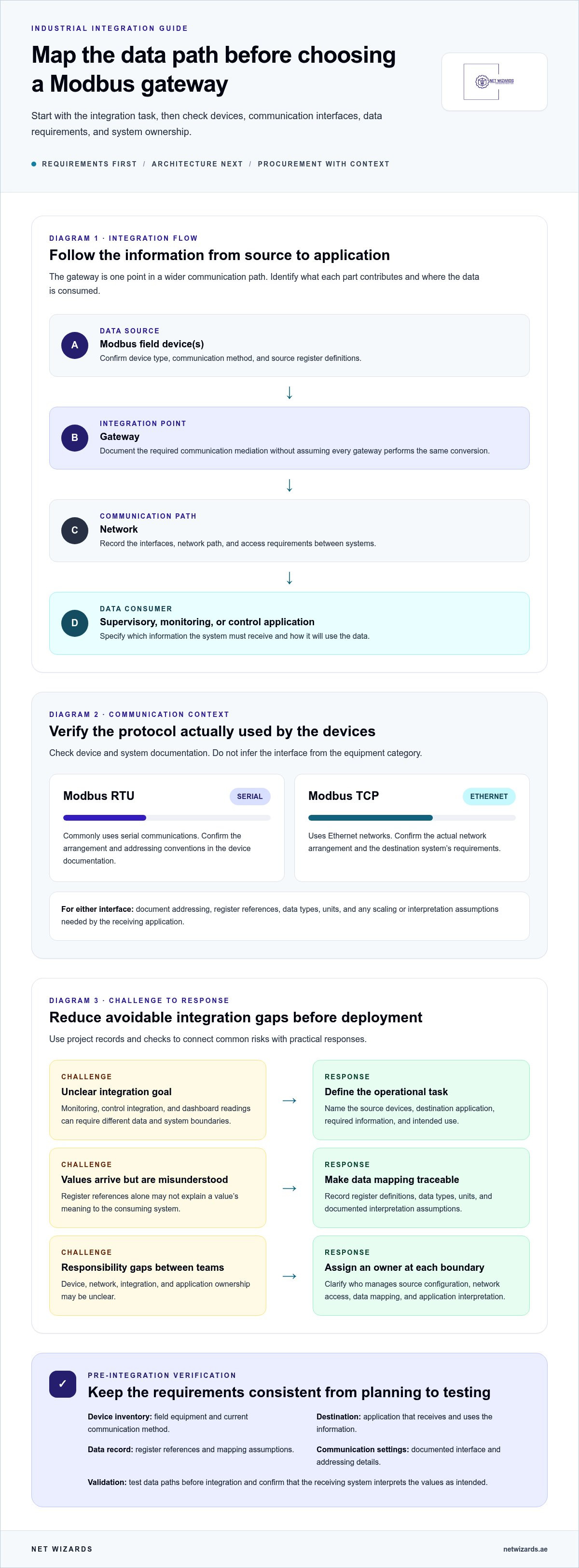
Diagram 1. Basic integration data flow
Modbus field device(s) → Gateway → Communications network → Supervisory, monitoring, or control application
Use the diagram to locate the data source, gateway, and consuming system. During planning, add the interface and owner at each boundary.
Identify the Modbus communication context
Check whether connected equipment uses Modbus RTU, Modbus TCP, or both. Modbus RTU commonly uses serial communications, while Modbus TCP uses Ethernet networks. Confirm the actual arrangement in device and system documentation rather than inferring it from the equipment category. The Modbus protocol overview provides background on the protocol and its variants.
Next, record the interfaces in use, addressing conventions, and data-mapping information required by the receiving application. Register references, data types, and scaling assumptions affect how the upstream system interprets a value. Keep source documentation with application expectations so mapping decisions are traceable.
A gateway describes an integration role between devices, a communications path, and an application. A protocol converter describes a role focused on translating communication between protocols. The terms can overlap in industrial projects, so define the required outcome instead of assuming every gateway performs a particular conversion. The industrial protocol converter architecture guide explains how protocol conversion fits into system communication.
How Modbus Gateway Architecture Connects Field Devices to Applications
A Modbus gateway sits within an integration path, connecting field devices with an application that needs their data. It does not replace the devices or determine what the receiving application does with each value. Its role depends on the architecture: which systems communicate, what information passes between them, and where responsibility for interpreting that information sits.
Consider a utility installation where a field instrument provides readings through Modbus and an operations application needs to display them. The instrument is the data source, the gateway is an integration point, the network carries the communication, and the application consumes the information. For a modbus gateway dubai project, documenting these boundaries helps operations and IT teams align technical requirements and data ownership.
Diagram 2. Data flow, protocol boundaries, and ownership
Field device (measurement and source register definitions) → Modbus device interface (RTU or TCP) → Gateway (integration boundary and any required communication mediation) → Network path (transport between systems) → Destination application (data interpretation, processing, and visualization)
Assign an owner at each point. Device documentation defines source values; integration records describe the gateway and communications path; application documentation explains how the received data is used.
Trace data from the Modbus device to the consuming system
Trace every required value from its origin to the system that uses it. A register address alone may not explain the value’s meaning. The project record should include the corresponding register definition, data type, units, and documented interpretation assumptions for the device and application. If source and destination teams use different assumptions, a value may arrive but be misunderstood.
Keep responsibilities distinct. The gateway is part of the communications integration; application-level processing and visualization belong to the consuming system unless the project architecture assigns them elsewhere. Confirm who maintains register references, validates values, and manages application configuration. This makes troubleshooting clearer and helps distinguish a display or calculation issue from a communications fault.
Understand when RTU-to-TCP conversion is relevant
RTU-to-TCP conversion may be relevant when equipment communicates through serial Modbus RTU but the receiving system connects through a TCP network. The integration must account for both sides of that boundary. Other systems may already use Modbus TCP or a different topology, so select conversion only when the documented architecture requires it. The Modbus TCP to RTU integration guide explores this connection pattern.
Confirm the intended data path with the teams responsible for devices, networking, and the consuming application. The Official Modbus protocol information can support protocol-level reference work, while project documentation should govern register mapping and system responsibilities. NET WIZARDS supplies industrial networking equipment and gateways, including an M-Bus / Modbus Gateway, for industrial integration projects.
Modbus Gateway Evaluation Criteria for Industrial Procurement
Compare each candidate against a defined system requirement, not an isolated feature list. Match the documented field interfaces and Modbus variant to the equipment already in place, then assess how the upstream system will receive and use the data. For a modbus gateway dubai project, this evidence-led approach helps distinguish essential requirements from preferences before selecting hardware.
Require traceable support for specifications. Treat numeric limits and performance claims as specific to the manufacturer and configuration, and review the documentation for the exact configuration under consideration. A general product description cannot establish suitability for a particular network, application, or operating environment.
Compare gateways against the system requirements
Build a comparison record that links each requirement to evidence and an acceptance check. Classify every item as mandatory, preferred, or outside the current scope. This makes trade-offs visible and prevents an optional feature from masking a missing interface or protocol required for integration.
Gateway evaluation matrix
Interfaces and Modbus variant: Record the field and upstream interfaces, plus the required Modbus variant. Evidence: manufacturer documentation. Acceptance: documented interfaces align with connected equipment and destination systems.
Destination systems: Name the application or platform that will consume the data. Evidence: system integration requirements. Acceptance: the planned communication path is defined.
Data requirements: List required registers, data types, units, mapping assumptions, and data-quality expectations. Evidence: device and application documentation. Acceptance: representative values can be checked against agreed definitions.
Environment and numeric limits: Document the operating context and project-specific limits. Evidence: manufacturer specifications for the proposed configuration. Acceptance: each mandatory limit has documented support.
Cybersecurity and access: Define network segmentation, access boundaries, and ownership. Evidence: project network and security requirements. Acceptance: responsibilities and permitted communication paths are recorded.
Maintainability: Identify configuration ownership, documentation needs, and lifecycle support expectations. Evidence: project handover and maintenance requirements. Acceptance: owners and change processes are agreed.
For register mapping, specify who prepares and validates the mapping, how data quality will be assessed, and how communication errors will be handled. Avoid assuming these are guaranteed gateway functions. State expected behavior in the procurement record and assign responsibility for testing it.
Assess integration and lifecycle implications
Gateway selection affects more than initial connectivity. Establish who supplies configuration inputs, approves commissioning records, maintains system documentation, and manages later changes to devices or applications. Define cybersecurity boundaries with the network team, including access requirements and which systems may communicate. Base these controls on the project architecture, not on an assumed product certification.
Where metering integration is in scope, the M-Bus to Modbus converter selection guide can help frame related protocol and integration requirements.
Diagram 3. Requirement-to-acceptance path
Requirement → Evidence source → Mandatory / preferred / out of scope → Project test or review → Acceptance record
Use the same sequence for every candidate. It gives engineering, operations, and procurement a shared basis for evaluating fit and recording unresolved items before approval.
Common Modbus Gateway Deployment Challenges and Practical Responses
A suitable gateway can still fail to deliver usable data if the surrounding integration is poorly defined. Mismatched communication settings may stop a device and gateway from exchanging information. Incorrect register assumptions can make a value appear missing, inconsistent, or incorrectly interpreted. Unclear boundaries between device, gateway, network, and application teams can also leave faults unresolved because no one owns the next diagnostic step.
For a modbus gateway dubai deployment, reduce these risks with traceable requirements, verified data mappings, and tests that follow the actual communications path. Commissioning procedures should reflect the selected architecture and connected equipment documentation. Avoid relying on generic settings or assumptions from a different installation.
Resolve data and protocol mismatches systematically
Compare configured protocol settings, addressing, and register definitions with the relevant device documentation. If a value is missing or unexpected, trace it from the originating device through each communication boundary to the consuming system. Record approved mappings and configuration changes with clear document ownership so teams can identify what changed and assess its impact.
- Communication mismatch: Compare the configured protocol and addressing details with equipment documentation, then verify the connection at the relevant boundary.
- Unexpected or absent values: Check the register definition, data type, and interpretation at the source and destination before changing configuration.
- Unclear fault location: Test each segment of the data path and record the results instead of changing multiple settings at once.
Reduce operational handover and maintenance friction
Define system boundaries and dependencies in the handover record. Name who owns gateway configuration, who approves changes, and which team investigates device, network, or application faults. Include escalation paths and the location of current device records, approved mappings, and commissioning results. This helps maintenance teams distinguish a communications issue from a data interpretation problem.
A disciplined integration can support operational efficiency by making data paths and responsibilities easier to understand. Where teams use device data for condition monitoring, consistent mappings can also support predictive maintenance practices. These are project benefits, not guaranteed outcomes; results depend on the wider system, data quality, and operational processes.
Use a controlled pre-deployment sequence:
- Confirm the approved architecture and identify equipment and application boundaries.
- Reconcile protocol, addressing, and register details with device documentation.
- Review each required data mapping with the responsible device and application owners.
- Test representative data paths and record expected and observed values.
- Document commissioning results, approved configuration, fault ownership, and change procedures for handover.
Make the test record actionable. Note the test point, expected result, observed result, and any corrective action. If a test fails, isolate the relevant segment before revising settings. This avoids changes that obscure the original fault and gives operations a clear baseline for future maintenance.
NET WIZARDS M-Bus / Modbus Gateway: From Requirements to Solution
Select a gateway as part of an integration path, not as a standalone hardware purchase. NET WIZARDS supplies an M-Bus / Modbus Gateway within its wider portfolio of Industrial IoT sensors, gateways, and protocol converters. For a modbus gateway dubai requirement, start with the project record: which devices will connect, how they communicate, which network carries the data, and which application needs to receive it.
This approach grounds the solution in the actual installation. It also helps define the work before procurement, including required interfaces, relevant data points, and how the receiving application will use them. The gateway’s role and integration scope follow from those requirements, not from the product name alone.
Where the gateway fits within industrial integration
The M-Bus / Modbus Gateway is one component in an industrial integration architecture. Its relevance depends on the relationship between the source equipment, its communications, the network path, and the destination system. NET WIZARDS supplies industrial networking equipment and gateways, so the gateway can be considered alongside the surrounding system rather than as an isolated specification.
Document whether the project involves M-Bus, Modbus, or a defined combination, then identify the connected devices and destination application. Establish the required data and system interfaces. This gives project teams a basis for planning tests and assigning responsibility, while reducing the risk of selecting equipment before agreeing on the data path.
Prepare a clear project brief for evaluation
A concise brief translates operational intent into integration requirements. Include information available from device and system records, and distinguish confirmed requirements from open decisions. NET WIZARDS supplies the M-Bus / Modbus Gateway as part of its industrial networking equipment portfolio.
- Devices: Identify the equipment that will supply or receive data and record its documented communications.
- Protocols and interfaces: Note the Modbus variant, any M-Bus requirements, and relevant network connections.
- Data and application: List required data points, their documented meanings, and the destination system.
- Operating context: Describe relevant installation conditions, system boundaries, ownership, and known integration challenges.
- Operational goals: State whether the project supports monitoring, control integration, operational efficiency, predictive maintenance, energy optimization, or enhanced safety.
These outcomes depend on the wider system, data quality, and operational practices. A clearly scoped integration can help teams align data use with those goals, but no gateway alone guarantees them. A documented brief gives teams a practical basis for evaluating the solution against installation requirements and priorities.
For project discussion, discuss a Modbus gateway requirement with NET WIZARDS.
Turn Your Integration Scope Into a Confident Next Step
Before procurement moves forward, make the project brief a shared reference for engineering, operations, and application teams. A clearly defined modbus gateway dubai requirement can guide the initial integration and later decisions about data use, system changes, and responsibility for maintaining the connection.
Use the brief to frame the project around your operating goals and the architecture you need to support. NET WIZARDS supplies industrial networking equipment, including an M-Bus / Modbus Gateway and Industrial IoT sensors, gateways, and protocol converters.
A well-scoped decision gives your team a stronger foundation for industrial integration. Move forward with requirements that reflect how your systems need to work.
Frequently Asked Questions
What does a Modbus gateway do in an industrial system?
A Modbus gateway provides an integration point for exchanging information between Modbus equipment and another part of an industrial system. Depending on the documented architecture, it may mediate communication between network or protocol environments. For example, a utility may need field readings available to a supervisory application. The project must define how readings are identified, transported, and consumed rather than assuming the gateway determines their operational meaning.
How do I choose a Modbus gateway for an existing OT network?
Choose against the network and application already in service. Document the field-side connection, the upstream system’s accepted communications, network access boundaries, and configuration ownership. For a modbus gateway dubai project, include relevant installation conditions and responsible operating teams in the project record. Compare product documentation with mandatory requirements, then plan a representative data test before approving the integration.
Can a Modbus gateway connect Modbus RTU devices to a TCP network?
Yes, a gateway intended and configured for RTU-to-TCP integration can bridge serial Modbus RTU equipment and a TCP network. The implementation depends on the devices, network arrangement, and receiving system. Confirm how serial communication is presented to the TCP-side application, and document addressing and data interpretation. A TCP connection alone does not establish that the upstream application will read or interpret device values correctly.
What information should I prepare before specifying a Modbus gateway?
Prepare device manuals, network drawings, and the receiving system’s integration requirements. Include the communication variant, interface details, device addressing, register references, data types, units, and known interpretation assumptions. Identify which values matter to operations and who can approve configuration changes. Mark missing records as open items in the specification rather than treating an assumption as confirmed.
What are common causes of Modbus gateway integration problems?
Common causes include communication parameters that differ between connected equipment, incorrect address or register references, and incompatible assumptions about data types or units. A network path that blocks or misroutes communication can also prevent values from reaching the consuming system. Troubleshoot one boundary at a time, compare settings with device documentation, and record observed results. Avoid changing several configuration items at once, which can make the original fault harder to isolate.
Can a Modbus gateway connect metering devices to a monitoring platform?
It can form part of a metering integration when the meter’s communications, gateway interfaces, and monitoring platform requirements align. Confirm which measurements the platform needs, how the meter represents them, and whether their definitions map correctly into the monitoring system. NET WIZARDS offers an M-Bus / Modbus Gateway and an AMI Sub-Metering Platform. The system design determines how these components fit the intended application.
How does NET WIZARDS support Modbus gateway requirements?
NET WIZARDS supplies an M-Bus / Modbus Gateway alongside Industrial IoT sensors, gateways, and protocol converters. Frame the project around equipment, communications, data, network boundaries, and the destination application so the gateway is assessed within the wider integration requirement. Prepare device and system documentation, required data points, and known constraints to give the project a clear technical basis.