
Oil and gas asset tracking is useful when location data shows what equipment is doing, not just where it is. By linking an asset’s identity with location, utilization, and idle-time records, it gives teams a clearer view of fixed assets, mobile equipment, and heavy machinery across dispersed operations. Connected operational systems can bring this information together instead of leaving it in isolated logs.
Knowing where equipment is matters, but so does knowing whether it is deployed, available, moving, or idle. Tracking data can support equipment searches, resource allocation, and maintenance planning. The right connection method depends on the asset and the coverage available across its route or site.
This guide explains how tracking works for fixed, mobile, portable, and heavy equipment, and how GPS, Bluetooth, cellular, and satellite connectivity contribute to visibility. It also covers utilization and idle-time monitoring, integration with ERP and maintenance systems, and operational challenges that affect data reliability. The aim is to show what connected tracking can reveal, where each technology fits, and how teams can use the information to make decisions.
Key Takeaways
- Separate assets by type and operating environment to build a tracking approach that reflects how fixed, mobile, portable and heavy equipment is actually used.
- Remote coverage gaps can interrupt visibility; matching GPS, Bluetooth, cellular or satellite connectivity to each operating context helps address that challenge.
- Use location and status data to distinguish active equipment from idle assets and support more informed allocation decisions.
- Connecting tracking data with ERP, maintenance and procurement systems can reduce information silos and make records more useful across operations.
- Industrial networking equipment, Industry 4.0 solutions, industrial cloud platforms and AI edge computing can support connected asset-monitoring architectures.
Table of Contents
What is oil and gas asset tracking?
Oil and gas asset tracking links an asset’s identity with its location, status, use, and maintenance record. It gives organizations visibility across fixed facilities and remote operations, where connectivity can be challenging.
The assets that need tracking vary across upstream, midstream, and downstream operations. An upstream team may need to locate portable inspection tools near a wellsite; a midstream operator may track equipment along pipeline corridors; a refinery may monitor pumps and other fixed assets. Tracking systems combine asset identifiers, location signals, status updates, and shared records to help teams locate equipment and improve operational efficiency across different environments.
Remote Connectivity and Operational Visibility
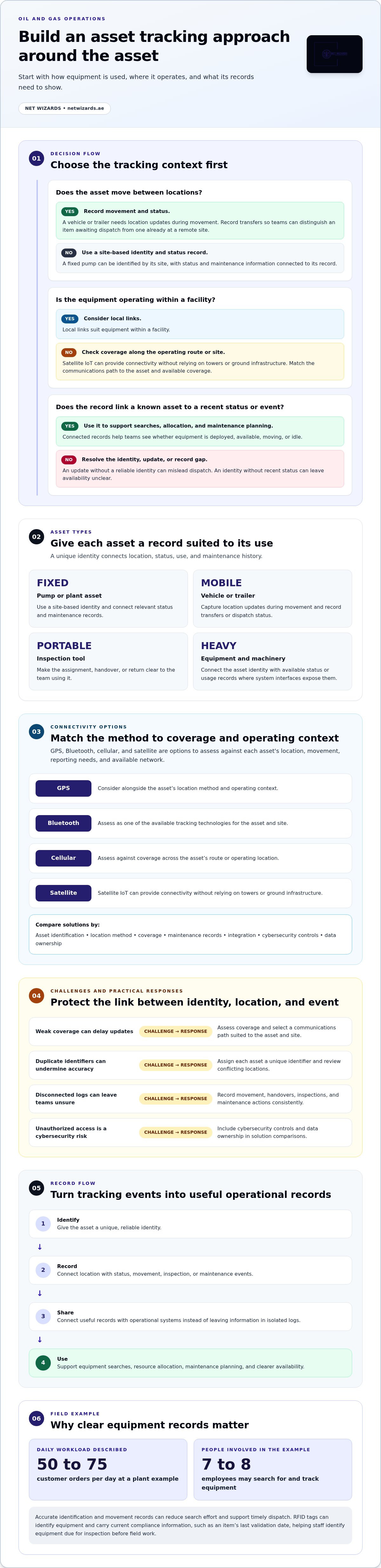
Remote connectivity and operational visibility help teams identify asset position and status when sites lack consistent network coverage. A tracker can report only through its available communications path. Satellite IoT can provide connectivity without relying on towers or ground infrastructure, while local links suit equipment within a facility. Match each asset’s movement, location, and reporting needs to the network available.
A mobile asset moving between a wellsite and a service base, for example, may need a different connectivity approach from a pump fixed inside a plant. Compare solutions by asset identification, location method, coverage, maintenance records, integration, cybersecurity controls, and data ownership. The right fit depends on how these features work with the operator’s sites and existing systems, not on feature count alone.
A useful record connects a known asset to a location and an operational event. A location update without a reliable asset identity can mislead dispatch; an identity without a recent status can leave teams unsure whether equipment is available. A defined process for recording movement and exceptions helps preserve that connection across remote locations.
Audit Trails and Accountability
An audit trail is a time-ordered record linking an asset identity to inspections, use, location, and maintenance actions. It lets teams trace who recorded a change and when, rather than relying on disconnected logs. For example, a tagged valve’s inspection date and status can help prevent its assignment when inspection is due. These records support audit evidence for safety and environmental procedures.
Consistent records also clarify operational accountability. When an asset moves between a field crew and a maintenance team, recording the handover, status, and inspection event helps establish its history. Tracking records can support compliance reviews, but they do not replace the operator’s inspection process or site procedures.
Requirements, Costs, and Operational Risks
Applicable UAE requirements depend on the facility, activity, asset, and operator procedures. Tracking should support relevant safety and environmental records, not replace those procedures. Cybersecurity risks include unauthorized access; weak coverage can delay updates, while duplicate identifiers undermine accuracy. Assess coverage, data controls, integration, and ownership. UAE deployments can combine GPS, Bluetooth, cellular, or satellite methods according to the asset and site, with local requirements shaped by the operating context.
Tracking hardware and software costs depend on device quantities, connectivity, integration, and installation. Project pricing is determined case by case and provided after a quote request. To maintain reliable records, assign each asset a unique identifier, record inspections and movements consistently, and review exceptions such as missing updates or conflicting locations.
Tracking fixed, mobile, portable, and heavy equipment
Tracking works best when each asset type has an identity, location method, and status record suited to its use. This helps teams monitor equipment, improve efficiency, and optimize fleet deployment.
Tracking Equipment and Field Assets
Equipment tracking links fixed, mobile, portable, and heavy assets to unique records, helping teams locate them and understand their availability. A fixed pump may need a site-based identity, while a vehicle or trailer needs location updates during movement. Teams can include containers, tools, valves, and oilfield equipment by assigning identifiers and recording transfers.
Operational context matters. A trailer arriving at a remote site should be distinguishable from one awaiting dispatch, while a portable tool needs a clear assignment or return record. At a plant handling 50 to 75 customer orders daily, 7 to 8 employees may search for and track equipment. Accurate identification and movement records can reduce search effort and support timely dispatch.
RFID can identify equipment, tools, valves, pipelines, safety gear, vehicles, and personnel. Tags can also carry current compliance information, such as an item’s last validation date, helping staff identify equipment due for inspection before assigning it to field work.
Equipment Integration and Ruggedness
Equipment integration combines tracking records with available data from heavy equipment and manufacturer systems. Where interfaces expose relevant information, teams can associate an asset’s identity with status or usage records. Shared identifiers help prevent duplicate entries as asset data moves between maintenance, operations, and procurement platforms.
Harsh environments bring practical challenges: equipment moves between remote sites, vehicles, and facilities, and devices face the conditions at their installation points. Select tracking hardware according to asset type, mounting location, movement, and required connectivity. A fixed installation and a frequently transferred tool may need different approaches.
Define how equipment data will be matched before connecting platforms. For example, a fleet record should map the manufacturer’s asset reference to the organization’s own identifier. This keeps location and usage records tied to the correct machine, even when related information is held in several systems.
Utilization, Fleet Optimization, and ROI
Utilization monitoring compares an asset’s recorded activity with its assigned operational role. Managers can use location, status, and usage information to identify equipment that is idle, underused, or due for reassignment. Fleet optimization then becomes a resource-allocation decision based on actual records, rather than assumptions about availability.
The business case can include fewer equipment searches, better use of existing stock, reduced duplicate purchases, and maintenance planning informed by usage. For example, companies managing 10,000 equipment units may hold at least 5% excess stock to offset missing or misplaced items. Better visibility can help review that buffer, but realized return depends on how records change procurement and deployment decisions.
Start by comparing tracked assets with dispatch, maintenance, and purchasing records. Review recurring idle time, unavailable equipment, and repeated replacement requests. These findings help quantify operational benefits using the organization’s own costs and utilization data, without assuming a universal return.
To map equipment categories, data sources, and connectivity needs into a deployment plan, discuss your tracking requirements.
Asset utilization and idle-time monitoring
Utilization monitoring compares an asset’s recorded activity with its assigned operational role. In gas industry operations, it helps managers distinguish equipment in productive use from equipment awaiting dispatch or maintenance.
Location and Condition Monitoring
Location and condition monitoring combines an asset’s position with operational signals, such as status or equipment health. Location alone cannot show whether a pump is ready for service. For example, a maintenance team can compare a pump’s reported status with its planned assignment before dispatching a replacement.
Managers can use these records to identify idle equipment, repeated movement, and changes in condition. A vehicle that remains at a service base while a field team reports a shortage may indicate an allocation mismatch. Reviewing its assignment and status helps determine whether it can be redeployed or needs inspection.
Use the same asset identifier across location and condition records. This helps operations teams distinguish an actual equipment change from a delayed or conflicting update. The resulting view supports maintenance planning and utilization decisions without treating every stationary asset as available.
Remote Asset Monitoring
Remote asset monitoring collects status information from equipment at distant or distributed sites and makes those records available to operations teams. It is valuable when travelling to inspect every asset could delay decisions. Cellular connectivity can carry updates where coverage is available; remote sites may need a different communications path.
Set reporting expectations according to operational needs and connection quality. A change in status can prompt a review, while a missing update should remain distinguishable from a normal reading. This helps teams avoid treating a communications gap as proof that equipment has stopped or moved.
For example, a remote pump’s status can be reviewed alongside its assigned work and maintenance history. If records indicate an anomaly, staff can prioritize investigation and coordinate a site response. Remote visibility supports decisions but does not replace physical inspection or established operating procedures.
Pipeline monitoring requires a related but distinct view. Pipelines can extend across thousands of kilometers, so operators need to associate monitoring points with precise locations and relevant events. Asset location records can show where equipment or personnel are assigned; monitoring data can help flag anomalies or potential hazards for investigation.
Leak and access monitoring should use appropriate pipeline sensors and site controls, with alerts linked to the correct location. An anomaly from a monitoring point, for instance, should be routed with its location and timestamp, while an access event should be reviewed against authorized activity. Clear records help teams prioritize responses and maintain operational accountability.
To assess utilization, compare planned assignments with reported status, location changes, and maintenance events. Review recurring idle periods and unavailable equipment across remote sites. This gives managers a practical basis for reallocating assets, scheduling inspections, and improving fleet decisions across gas operations.
Integration with ERP, CMMS, and procurement systems
Integrating tracking records with SCADA, ERP, CMMS, and procurement systems connects equipment status to operational decisions. In oil and gas operations, this can make inspection, maintenance, inventory, and reporting records more consistent across teams.
SCADA systems support operational monitoring, while ERP systems manage business records such as assets and purchasing. Integration can pass selected status or event data into relevant workflows. For example, an equipment alert may prompt a review in the maintenance system, while the ERP asset record retains the equipment’s assigned identifier. Define which system owns each field to prevent conflicting updates.
CMMS integration links equipment identification and usage information with maintenance history. A technician reviewing a pump can use its asset record to find previous work, inspection status, and reported faults. Usage data can also inform maintenance scheduling and alerts. These connections help teams respond to emerging maintenance needs, but results depend on accurate identifiers and timely source records.
Procurement integration gives purchasing teams a clearer view of asset availability and demand. For example, a request for a replacement valve can be compared with inventory and existing asset records before purchase. ERP systems can support this review by connecting asset information with procurement workflows. Clear approvals and reporting responsibilities help avoid duplicate records and unnecessary orders.
Integration challenges often start with inconsistent asset names, disconnected platforms, and legacy data. Deloitte found that more than 60% of field data remains trapped in legacy systems. A practical response is to map identifiers, define required data fields, and test a limited workflow before expanding. Preserve source timestamps and flag incomplete records rather than treating them as current information.
For implementation, first select the assets and operational events that matter, such as a maintenance alert or location update. Map each asset identifier across tracking, SCADA, ERP, and CMMS records. Then configure data exchange, permissions, exception handling, and reporting ownership. Validate results against source records before relying on them for procurement or downtime decisions.
Integration should account for field conditions, too. A rugged tracker may operate where connectivity is intermittent, so systems need to distinguish delayed updates from current status. Teams can define how queued records are reconciled and duplicate events handled after reconnection. This reduces confusion when maintenance or procurement staff review asset history.
Oil and gas companies implement tracking by defining asset records, selecting operational data to capture, and connecting relevant systems through controlled interfaces. They then validate identifier mapping, permissions, alerts, and reporting against real maintenance and procurement workflows.
GPS, Bluetooth, cellular, and satellite tracking
Tracking architecture separates location technology from the network that carries telemetry. For UAE operations, choose each method according to asset movement, site coverage, reporting needs, and installation environment.
GPS and Bluetooth Tracking
GPS estimates an asset’s outdoor position, while Bluetooth supports local identification or proximity within a facility. This distinction matters when teams need to locate a vehicle across a site and find a tagged tool inside a workshop.
GPS can provide coordinates for a moving service vehicle, while Bluetooth readers can record a tool entering a storage area. Neither method answers every question: GPS may not identify nearby indoor equipment, and Bluetooth presence does not provide broad-area positioning. Combining their records can help distinguish a site arrival from a specific asset handover.
Map the required event before selecting hardware. A dispatch team may need a vehicle’s position; a stores team may need to confirm which tagged equipment entered a controlled area. These use cases call for different location detail and reader placement.
Cellular and Satellite Tracking
Cellular tracking sends telemetry through available mobile network coverage, while satellite IoT can provide connectivity without relying on towers or ground infrastructure. This matters on remote routes where cellular coverage may not reach an asset’s operating area.
A satellite asset tracker can suit assets operating beyond terrestrial coverage, while cellular connectivity can serve locations with a usable network. Match reporting frequency and message requirements to the asset’s route and communications path. A tracker cannot deliver timely updates when its chosen connection is unavailable.
Connectivity selection also affects how teams interpret data. A delayed cellular message may describe an earlier location, not the asset’s current position. Telemetry records should retain timestamps and clearly separate the event time from the time data reaches the monitoring platform.
Powered equipment may allow a different installation approach from portable tools, which may need independent tracking hardware. Compare power access, mounting location, movement, and communications coverage for each asset class. A fixed pump and a mobile tanker, for instance, may need different reporting intervals and network paths, even at the same operating site.
Telemetry protocols define how devices format and exchange asset readings with receiving platforms. Keep the data model consistent across GPS coordinates, Bluetooth identification events, cellular messages, and satellite reports. A shared asset identifier and timestamp help operations teams reconcile records and avoid treating different updates as conflicting positions.
Digital transformation does not remove regulatory or cybersecurity responsibilities. UAE operators should align tracking records with applicable site procedures and control who can access, change, or export telemetry. Before relying on alerts for dispatch or inspection decisions, review device identity, data timestamps, communications availability, and exception handling.
Use a site-and-route coverage assessment to assign GPS, Bluetooth, cellular, or satellite connectivity to each asset group. This makes the trade-offs visible and supports a deployment architecture grounded in operating conditions.
NET WIZARDS L.L.C: Industrial Networking Equipment
NET WIZARDS L.L.C supports industrial telemetry architectures with Industrial Networking Equipment, Industry 4.0 Solutions, an Industrial Cloud Platform, and AI Edge Computing.
Field sensors → industrial router or gateway → monitoring platform
Its industrial 4G and 5G routers are designed for mission-critical enterprise telemetry and field operations. M-Bus and Modbus gateways provide protocol integration, while the industrial cloud platform supports MQTT, Modbus, NB-IoT, LoRaWAN, TCP, and UDP.
Device protocols → AI edge computing → cloud platform
AI edge computing nodes support operational intelligence and predictive maintenance. They are relevant when operators need to connect field devices, process operational data, or bring different protocols into a monitoring architecture.
Connectivity + protocol integration + data platform
Contact NET WIZARDS L.L.C to discuss an industrial telemetry architecture for your operation.
Build the Next Stage of Operational Visibility
The next step is to connect tracking data to a specific operational decision. Identify where teams need clearer asset status, which records must inform that decision, and how the resulting information should reach the people responsible. This gives oil and gas asset tracking a defined purpose within the wider operating model, rather than treating telemetry as an isolated technology project.
For UAE operators, a deployment plan should reflect actual site conditions, asset movements, network coverage, and existing systems. Starting with these requirements establishes a practical foundation for expansion and gives technical and operations teams a shared basis for evaluating progress.
NET WIZARDS L.L.C can discuss industrial connectivity and connected-system requirements in the context of your operation. Bring your priority use case and the systems it needs to work with.
With a clear operational objective and considered technical design, your team can move forward with greater confidence.
Frequently Asked Questions
How does tracking work in oil and gas operations?
Tracking links equipment identity with operational records, using tags or connected devices to collect information. A system can associate a location update or status reading with an asset record and make it available for review. When a tool changes custody, for example, staff can record the handover against its identifier, preserving a traceable history for later maintenance or inventory decisions.
What assets are tracked in oil and gas operations?
Tracked assets can include fixed equipment, mobile machinery, portable tools, vehicles, containers, pipelines, valves, safety gear, and personnel. Oil and gas asset tracking can organize records by function, such as production equipment, transport assets, or inspection resources. This classification helps teams apply suitable ownership and status fields. A pipeline valve may need an inspection history, while a container record may focus on assignment and movement.
Which technologies are used for oil and gas asset tracking, such as RFID, GPS, and IoT?
RFID identifies tagged items, GPS provides outdoor location information, and IoT connects devices that report readings or status. Bluetooth can support proximity detection, while cellular and satellite links transmit data where coverage is available. These technologies serve different roles rather than replacing one another. A tag can identify a tool, for example, while a connected device reports its operating condition to a monitoring platform.
How does asset tracking integrate with ERP, EAM, and maintenance systems?
Integration maps a consistent asset identifier between tracking records and ERP, EAM, or maintenance software. This lets teams connect location or usage events with asset ownership, work history, and inventory decisions. A maintenance planner, for example, can associate an equipment record with a work order and update its status after service. Clear field ownership and access permissions help prevent inconsistent records across systems.
What regulations and safety standards affect asset tracking in the oil and gas industry?
Requirements depend on the facility, activity, asset, and operator procedures. In the UAE, relevant rules include ADNOC and national petroleum standards, UAE transport authority guidelines for hazardous materials, Ministry of Climate Change and Environment emissions standards, and local municipality fleet compliance mandates implemented through NET WIZARDS L.L.C solutions. Tracking records can support safety and environmental audits but do not replace inspections or site procedures.