
Meter readings create little operational value if they stop at a dashboard. For facilities evaluating smart energy sub metering dubai, the key question is how to turn consumption data from buildings, tenants, and equipment into information teams can use. A utility bill gives a site-wide total. Sub-metering can show where consumption occurs, provided the readings connect reliably to the systems and people responsible for reviewing them.
That connection takes planning when meters, networks, and building platforms use different protocols. Start with the decisions the data needs to support, then map the facility’s existing infrastructure and reporting needs. This helps avoid adding another isolated data source.
This guide explains how smart sub-metering works, compares deployment approaches, and outlines common challenges with practical responses. It also covers multi-utility monitoring for energy, water, gas, and district cooling. NET WIZARDS L.L.C's AMI Sub-Metering Platform and Industrial-grade IoT Cloud Platform support protocols including MQTT, Modbus, NB-IoT, LoRaWAN, and TCP/UDP. Use the guidance to assess how a project’s meters, interfaces, and reporting requirements fit together.
Key Takeaways
- Assess how consumption readings can reveal patterns across facility areas, tenants, and equipment.
- Map the path from meter to monitoring platform, including where gateways or protocol converters may support integration with existing systems.
- Compare area-by-area, building-wide, and phased deployment against site boundaries, reporting requirements, and operational priorities.
- Plan for fragmented readings, protocol mismatches, unclear meter boundaries, and reporting needs before deployment.
- Assess how the AMI Sub-Metering Platform and Industrial-grade IoT Cloud Platform can support multi-utility visibility and project-scoped integration.
Table of Contents
What Smart Energy Sub-Metering Reveals Across a Facility
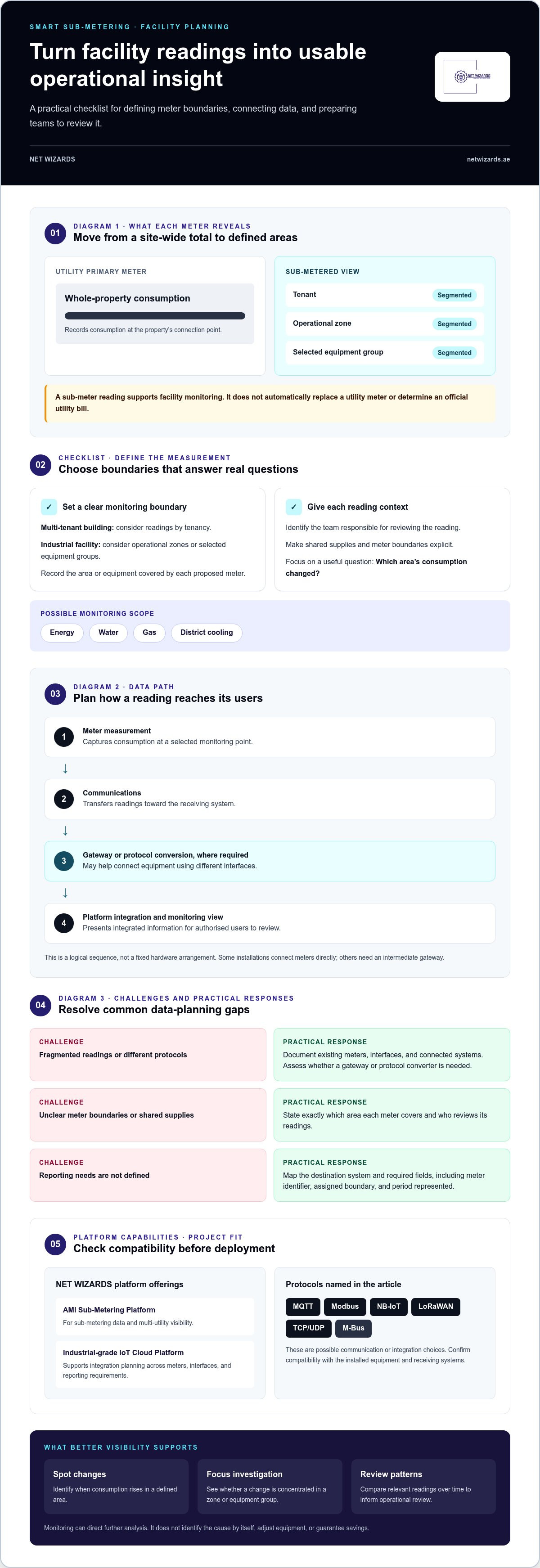
A utility’s primary meter records consumption at a property’s connection point. That total is essential, but it does not show how demand is distributed inside the facility. Sub-metering adds measurement points downstream, so teams can examine consumption by tenant, operational zone, or selected equipment group. A sub-meter reading does not automatically replace a utility meter or determine an official utility bill.
Sub-metering measures utility use within defined parts of a property, using meters downstream of the utility’s primary meter to make local consumption visible. The primary meter measures the site’s overall intake; submeters provide a more segmented view for facility monitoring and, where applicable, internal allocation. The broader concept of utility submetering includes measurement across multi-tenant properties and individual equipment.
Facility view: Utility primary meter → whole-property consumption
Sub-metered view: Defined zones, tenants, or equipment groups → segmented consumption data
For smart energy sub metering dubai projects, the design question is not simply how many meters to install. It is which operational decisions need a more precise boundary than a property-wide total can provide.
Which facility areas can sub-metering help monitor?
Useful meter boundaries follow how a site is managed. A multi-tenant building may need readings by tenancy; an industrial facility may focus on operational zones or selected equipment groups. Monitoring can cover energy, water, gas, and district cooling. Choose boundaries that answer a specific question, such as which area’s consumption changed, rather than dividing the site into segments with no clear operational purpose.
Before deployment, record the area or equipment each proposed meter covers and the team responsible for reviewing its readings. If tenants or systems share a supply, make the boundary explicit so users do not misinterpret what the meter measures. The meter provides a reading; the facility’s allocation and review practices determine how teams use it.
What operational questions can better readings support?
Segmented readings can help teams investigate when consumption rises, whether a change is concentrated in one area, and how usage patterns differ between zones or equipment groups. Comparing relevant readings over time gives teams evidence for an operational review. The value is in directing investigation toward a defined part of the facility, not in assuming a meter reading explains the cause.
Clearer visibility can inform operational efficiency and energy optimization by showing where further analysis may be useful. Monitoring alone does not adjust equipment, change operating practices, or guarantee savings. Staff still need to interpret readings in context, assess possible causes, and decide what response is appropriate. This distinction keeps expectations grounded and makes the data more useful.
How Smart Energy Sub-Metering Moves Data Into Monitoring Systems
A sub-meter produces a reading, but that reading becomes useful only when it travels through a defined data path and reaches the people or systems that need it. A facility architecture has four distinct responsibilities: the meter measures consumption, communications carry readings, integration aligns data from different sources, and a monitoring platform presents information for review. Keeping these roles clear helps teams locate gaps or mismatches in the data flow.
How do meters, gateways, and platforms work together?
Meters capture consumption at selected monitoring points. A communications path transfers the readings, while a gateway or protocol converter may help connect meters and systems that use different interfaces. The platform receives and presents integrated information for authorised users to review in the context of facility operations. The AMI sub-metering platform architecture guide explains how to structure these data flows.
Facility data path: Meter measurement → communications → gateway or protocol conversion, where required → platform integration → monitoring view for users
This is a logical sequence, not a fixed hardware arrangement. Some installations connect meters directly to a receiving system; others need an intermediate gateway. The right architecture depends on the installed meters, their interfaces, the destination platform, and how facility teams will use the readings. A gateway carries or helps translate information. It does not replace the meter’s measurement role or determine how users interpret the data.
What should teams consider when connecting facility systems?
Start by documenting existing meters and connected systems. Then identify where readings need to go and what information each reporting team needs. A Building Management System, operational monitoring platform, or other destination may have different interface requirements. Define the fields needed for each use case, such as the meter identifier, assigned boundary, and period represented by each reading. Consistent mapping helps prevent data from arriving without enough context to interpret it.
Protocol needs depend on the installed equipment and receiving systems. Options may include Modbus, M-Bus, MQTT, NB-IoT, and TCP/UDP. These are different communication or integration choices, not a guarantee that every meter or platform supports every option. NET WIZARDS L.L.C’s stated multi-protocol capabilities include MQTT, Modbus, NB-IoT, LoRaWAN, and TCP/UDP. Its offerings also include an M-Bus / Modbus Gateway. Map each interface to the specific devices and data destination in the project. For more on this integration layer, see the industrial protocol converter guide.
For smart energy sub metering dubai projects, treat integration as a design task, not a final connection step. Record the meter inventory, protocol at each interface, destination system, and reporting requirements before selecting the data path. This makes mismatches easier to spot early and gives technical and operations teams a shared architecture to review. Discuss your project requirements with NET WIZARDS L.L.C’s integration team.
How to Compare Smart Sub-Metering Deployment Approaches
Set deployment scope according to facility boundaries, integration requirements, reporting needs, and operational ownership. A defined tenant-level project may need a different architecture from a programme covering several buildings and utilities. Compare approaches by the questions they need to answer, not by meter count alone.
| Approach | Site boundaries | Integration and reporting | Operational fit |
|---|---|---|---|
| Individual-area | A tenant, operational zone, or selected equipment group | Focused connection to the relevant monitoring destination; reporting stays within the defined scope | Useful when a specific allocation or consumption question is the priority |
| Building-wide | Multiple areas or systems across one building | Requires a broader view of meter interfaces, data destinations, and reporting consistency | Fits teams responsible for coordinated monitoring across the building |
| Phased deployment | Begins with selected boundaries, with later stages considered separately | Initial integration can establish a pattern for review before additional areas are included | Can help manage implementation priorities, but later phases still require design and integration work |
Comparison rule: Match the deployment boundary to the operational decision, then confirm that the integration and reporting scope supports it.
When does a focused sub-metering deployment fit?
A focused deployment suits a defined objective, such as monitoring one tenant, operational zone, or equipment group. Its limited scope helps teams prioritise the relevant meter points, data destination, and review responsibilities. This can make design decisions clearer, but it does not mean one meter configuration fits every site. Existing infrastructure and the question being investigated still shape the design.
A focused project may also start with energy when electricity use is the immediate concern. If the facility needs a wider resource view, teams can assess energy alongside water, gas, or district cooling. Define the intended coverage and reporting purpose before fixing the deployment boundary.
When is a broader AMI approach more suitable?
A broader AMI approach is worth evaluating when teams need coordinated visibility across multiple areas, assets, or utility types. Consider how the platform will accommodate the required meter data, existing systems, and reporting responsibilities. Centralised visibility can bring information into a shared monitoring context. A phased rollout may instead let teams establish priorities and review an initial scope before planning further coverage. Both approaches still require clear interfaces, data ownership, and operational use.
For facilities considering smart energy sub metering dubai options, weigh the value of a unified view against the work of integrating existing systems. Broader connected-operations planning is discussed in the Industry 4.0 solutions architecture guide. Use that context to assess how sub-metering fits into the facility’s wider monitoring architecture, without assuming expansion will happen automatically.
Smart Sub-Metering Challenges and Practical Responses
Sub-metering projects can run into obstacles before readings reach a useful monitoring view. Meter records may be scattered across systems, interfaces may differ, and teams may not agree on what each meter represents. Address these risks by defining requirements and mapping interfaces before integration. These steps make uncertainties visible, although they do not guarantee compatibility or operational results.
| Challenge | Practical response |
|---|---|
| Fragmented readings | Inventory meters, existing records, and intended data users. Map which readings belong in the monitoring environment. |
| Protocol mismatch | Document interfaces at both ends. Define whether a gateway or protocol converter belongs in the planned data path. |
| Unclear meter boundaries | Record the area, tenant, or equipment represented by each meter and align that boundary with its intended use. |
| Unfocused reporting | Specify who needs each report, what question it must answer, and who reviews the readings. |
Challenge-to-response path: Inventory → map interfaces and boundaries → define reporting use → assign review ownership
How can teams address fragmented readings and interfaces?
Begin with an inventory of meters, protocols, connected systems, and data users. Record each meter’s intended boundary and destination, then map the interfaces between them. This can show where a gateway or converter may be needed. Treat unverified compatibility as a design item to resolve rather than an assumption to carry into implementation.
For smart energy sub metering dubai projects, this groundwork gives technical and operations teams a shared picture of the system. It also helps identify missing information before integration begins. The inventory supports planning, but does not prove that every device will connect as intended.
How can teams make monitoring data operationally useful?
Define reporting audiences and consumption questions before configuring dashboards. A facilities team may need to investigate changes across an operational area, while another user may need a view aligned with a particular asset or tenancy. Assign responsibility for reviewing readings and deciding whether a pattern warrants investigation. Clear ownership makes monitoring actionable without implying that the platform itself corrects operating conditions.
Meter data is evidence for decisions, not proof of savings. Teams need to interpret readings in context, assess possible causes, and determine an appropriate response. A disciplined review process can connect visibility to operational efficiency and energy optimization, while keeping outcomes dependent on analysis and action rather than monitoring alone.
Define your project’s meter boundaries, interfaces, and reporting responsibilities with NET WIZARDS L.L.C’s sub-metering team.
How NET WIZARDS L.L.C Supports an Integrated Sub-Metering Solution
NET WIZARDS L.L.C brings 20 years in business to facility monitoring projects that need sub-meter data to work within a wider operational architecture. Its AMI Sub-Metering Platform and Industrial-grade IoT Cloud Platform support energy monitoring and sub-metering across stated applications for energy, water, gas, and district cooling. Project scope determines which utilities, assets, and interfaces are included.
The aim is to give facility teams a connected view of readings in context. A platform can bring data into a monitoring environment, but its practical value depends on the measurements selected, systems involved, and how teams use the information. This visibility can inform operational efficiency and energy optimization, without guaranteeing savings or automatic corrective action.
Which confirmed platform capabilities are relevant to facility teams?
Multi-utility applications let teams assess consumption across different resource types within a facility. Stated protocol support includes MQTT, Modbus, NB-IoT, LoRaWAN, and TCP/UDP. Consider these capabilities against the project’s installed meters and connected systems. They do not mean every device supports every protocol. The architecture should account for actual interfaces and intended data destinations.
The platforms can form part of an integrated monitoring approach, bringing relevant readings into a shared operational context. Teams can use that visibility to review patterns and inform decisions. The value depends on defining what each meter represents and who will act on the information. The platform does not itself establish operational boundaries or guarantee a particular outcome.
Project flow: Facility assets and utility meters → project-scoped interfaces → AMI Sub-Metering Platform and Industrial-grade IoT Cloud Platform → monitoring information for operational review
What should a project discussion establish?
A productive project discussion starts with facility requirements, not an assumption that one architecture suits every site. Set out the assets and areas in scope, utility types to monitor, existing meter and system interfaces, reporting needs, and the boundary between the initial project and any future work. These details help shape an architecture around the facility’s integration requirements.
For smart energy sub metering dubai projects, use this scope to align technical planning with operational priorities. It gives stakeholders a shared basis for deciding where readings should flow and how the resulting information will be reviewed. Define these points early so the proposed solution reflects facility needs rather than assumed compatibility.
Set the Next Measurement Priority
Move from concept to a defined project brief. Identify the operational decision that better consumption visibility should support, the assets or facility boundaries involved, and the people responsible for reviewing the information. A clear priority gives technical planning a practical reference point and keeps the initial scope aligned with facility needs.
For smart energy sub metering dubai projects, use that brief to guide decisions about integration, reporting, and operational ownership before implementation. Treat the architecture as a working plan that connects measurement requirements to intended use, with room to refine details as project requirements are assessed.
A disciplined start gives your team a stronger basis for informed decisions. Define the next measurement priority and move forward with clarity.
Frequently Asked Questions
Is smart sub-metering different from a utility smart meter?
Yes. A utility smart meter records consumption at the utility connection, while sub-meters measure selected points within a facility. For example, a primary meter may show total electricity entering a site, while additional meters track separate operational areas. The devices serve different purposes and may feed different systems. Distinguish readings used for utility billing from those used for internal monitoring or allocation.
Can one sub-metering platform monitor energy, water, gas, and district cooling?
A platform can support monitoring across these utility types when the project includes the appropriate meters and integrations. NET WIZARDS’ AMI Sub-Metering Platform covers stated applications for energy, water, gas, and district cooling. Define which utilities matter, how each meter’s readings will be identified, and which teams need the information. Multi-utility coverage depends on project scope and connected equipment.
What information should a facility define before planning sub-metering?
Document the assets and areas to measure, the utility types involved, and why each reading is needed. For smart energy sub metering dubai planning, also record meter identifiers, existing interfaces, data destinations, reporting audiences, and who owns follow-up. A register linking each meter to its physical location and operational purpose helps reduce ambiguity during integration and later review.
Will installing smart sub-meters automatically reduce energy consumption?
No. Meters provide readings; they do not automatically change equipment settings or operating practices. A rise in consumption may prompt a facilities team to investigate schedules, equipment condition, or changes in site use, but the data alone does not establish the cause. Teams need to review findings and decide whether action is appropriate. Treat monitoring as an input to operational decisions, not a guaranteed energy-saving measure.
Can sub-metering data connect with existing building or industrial systems?
It can when the architecture accounts for the interfaces used by the meters and receiving systems. A facility may route readings to a monitoring platform or connect them with existing building or industrial systems. Before design, identify the destination, required data fields, and interface expectations. This helps teams plan around actual project conditions rather than assuming that every system exchanges data in the same way.
What can teams do when meter protocols or interfaces differ?
Document each meter’s communication interface and the requirements of the system that will receive its readings. Then map where a gateway or protocol converter may be needed and treat compatibility as a design item to resolve. NET WIZARDS’ stated protocol support includes MQTT, Modbus, NB-IoT, LoRaWAN, and TCP/UDP. Protocol support does not mean every device using that protocol is automatically compatible.
How should facility teams use sub-metering data after deployment?
Establish a review routine that connects readings to operational responsibilities. Teams can compare consumption across relevant periods, investigate unusual changes, and record whether follow-up is needed. Keep meter identifiers and area assignments consistent so reviewers know what each reading represents. Assign responsibility for reviewing results and escalating concerns. This makes monitoring a repeatable decision process, while leaving diagnosis and corrective action to the facility team.