
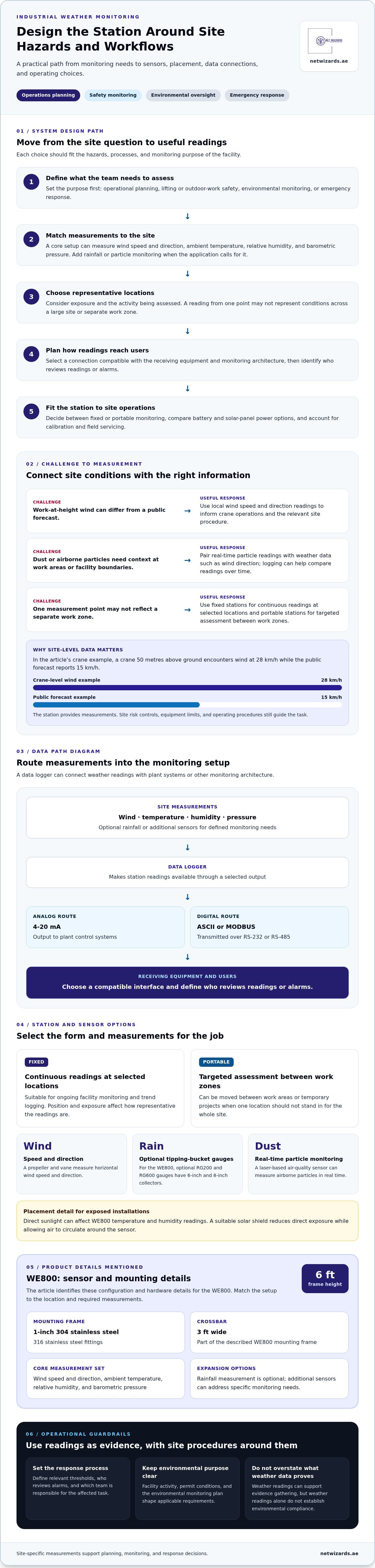
A public forecast can miss the conditions that matter at the worksite. A weather station for industrial sites gives operators local measurements for decisions involving wind, heat, humidity, dust, and changing weather. For example, a crane operating 50 metres above ground on an exposed site may encounter wind speeds of 28 km/h while a public forecast reports 15 km/h.
Industrial teams need dependable, site-specific data for operational planning, safety monitoring, environmental oversight, and emergency response. The right setup depends on site hazards and processes, so sensor selection, placement, communications, and power all matter.
This guide explains how automatic weather monitoring can support industrial operations in the UAE, which sensors suit different applications, and how installation, calibration, field servicing, and power options shape a system. It also covers connections to plant monitoring and control systems, helping operators assess a solution against their operating requirements.
Key Takeaways
- Use on-site weather measurements to inform operational planning, safety monitoring, environmental oversight, and emergency response.
- Match sensors to site hazards and processes, then plan their placement to capture representative conditions.
- Assess how weather data will connect with plant systems and reach the people who need it.
- Compare battery and solar power options against the station’s location, communications needs, and operating demands.
- Apply weather monitoring to practical site challenges, from crane wind conditions to dust, heat, and environmental monitoring.
Table of Contents
Why do many industries require a good, automatic weather station?
Industrial sites need local weather data to inform operations, environmental monitoring, and safety decisions. An automatic station records changing conditions at the facility, giving teams site-specific evidence instead of relying solely on a public forecast.
Environmental Site Monitoring
At a plant, refinery, or construction site, monitoring can track ambient conditions alongside dust, emissions, and fenceline impacts. Power plants may use weather data with measurements of SO2, NOx, and particulate matter to assess emissions and environmental conditions. A laser-based air-quality sensor can monitor airborne particles in real time, while logging helps teams compare readings over time and identify changes that need investigation.
Which UAE regulations or standards apply depends on the facility’s activity, permit conditions, and environmental monitoring plan. Define the monitoring purpose first, then select sensors and reporting methods that meet the requirements for the site. A weather station can support evidence gathering, but weather readings alone do not establish environmental compliance.
Industrial weather monitoring can also inform dust or odour mitigation, reclamation work, and assessments of evaporation, soil saturation, or wind-gust effects. Choose measurements based on site exposure and processes. Wind direction, for example, helps teams interpret where airborne particles may travel, while temperature and humidity add context to changing environmental readings.
Weather Monitoring for Industrial Safety
Weather monitoring supports safety teams when conditions can affect lifting, outdoor work, or emergency response. Wind speed and direction can inform crane operations, while temperature and humidity help characterize heat conditions for exposed work areas. A crane 50 metres above ground may experience 28 km/h winds even when a public forecast reports 15 km/h, showing why site-level readings matter.
Use a clear operating procedure: define relevant thresholds, identify who reviews alarms, and connect readings to the team responsible for the affected task. The station provides measurements, not a replacement for site risk controls or equipment limits. For hazardous-gas response, weather data can add wind direction and speed context to monitoring of gases such as SO2 or NOx.
Fixed and Portable Station Options
Fixed stations provide continuous readings at selected locations, making them suitable for ongoing facility monitoring and trend logging. Portable stations can move between work zones or temporary projects, helping teams assess local conditions without assuming one measurement point represents the entire site.
Choose between fixed and portable stations by deciding whether you need continuous coverage or targeted assessment. A large site, for example, might use fixed monitoring near a process area and portable readings in a separate work zone. Position and exposure affect how accurately a station represents the activity being assessed.
How do industrial weather stations connect to SCADA, PLC, or cloud monitoring systems? A data logger can send a 4-20 mA output to plant control systems, or transmit digital ASCII or MODBUS data over RS-232 or RS-485. Select the interface that fits the receiving equipment and monitoring architecture; a compatible connection makes weather readings available alongside operational data.
Industrial weather station components and sensors
Choose sensors to match the site’s hazards, processes, and monitoring objectives. For a weather station for industrial sites, assess each sensor’s specifications, calibration, exposure, and installation separately. These factors affect the accuracy of wind, temperature, humidity, and rainfall measurements.
Rainfall and Dust Sensors
Rainfall measurement can be added when precipitation matters to site operations or environmental assessments. For the WE800, optional RG200 and RG600 gauges use tipping-bucket designs with 6-inch and 8-inch collectors, respectively. Choose a gauge suited to the monitoring application, then keep its collector clear so debris does not obstruct measurement.
Dust monitoring requires a sensor suited to airborne particles. A laser-based air-quality sensor measures particles in real time, helping teams track dust near active work areas or facility boundaries. Pair particle readings with weather data, such as wind direction, to put observations in useful environmental context.
Included Sensors and Installation Hardware
A core weather station setup can measure wind speed, wind direction, ambient temperature, relative humidity, and barometric pressure. Rainfall measurement is optional, and additional sensors can address specific monitoring needs. The listed barometer uses a digital sensor, while the temperature and humidity instrument measures both conditions.
For the WE800, the mounting frame uses 1-inch 304 stainless steel with 316 stainless steel fittings. It stands 6 feet tall and has a 3-foot-wide crossbar. These dimensions and materials describe that station’s hardware, not every industrial system. When selecting a weather station for industrial sites, match the configuration and mounting hardware to the location and required measurements.
Direct sunlight can affect WE800 temperature and humidity readings. Use a suitable solar shield to reduce direct exposure while allowing air to circulate around the sensor. This placement detail matters in exposed UAE installations, where unrepresentative readings can weaken environmental logging.
Sensor Operation and Wind-Gust Measurement
A propeller and vane measure horizontal wind speed and direction. Some wind-direction sensors have a dead zone of three to five degrees, which teams should account for when interpreting changes near that direction. For gust monitoring, check that logging and reporting settings capture short-lived peaks relevant to site operations.
Temperature and humidity sensors measure ambient conditions, while a tipping-bucket gauge records rainfall through collected water. Accuracy varies by sensor and setup. Direct sunlight, obstructions, placement, and calibration can all affect readings. Review the specifications and calibration records for the selected configuration instead of assuming one accuracy figure applies to every measurement.
For remote monitoring, consider how readings will reach operators and how the program will display trends or alarms. A defined sensor schedule and logging approach can help teams distinguish a brief change from a persistent condition. If you’re planning a configuration, discuss your weather station requirements with the engineering team.
Station installation, calibration, and field support
Installation affects whether a station measures representative conditions and produces usable records over time. Plan the ground position, mounting method, calibration checks, and data logger review as a single commissioning process.
Installation Location and Safety
Choose a location that represents the area being monitored, not a sheltered corner or a spot beside an obstruction. Buildings, exhaust outlets, machinery, and other structures can alter wind flow or temperature readings. Record nearby features so operators can interpret measurements from that position.
Review site access, vehicle routes, overhead work, and exposure before installation. A fixed frame suits a permanent monitoring point; a tripod can support temporary deployment across changing work zones. Keep sensors accessible for maintenance without placing routine service tasks in active operational areas.
Wireless transmission also depends on the station’s surroundings. Metal structures and equipment can affect signal paths, so assess the communication route between the logger and receiving system during site planning. A clear installation record helps field teams understand sensor location, orientation, and access conditions later.
Installation and Servicing
Install the mounting assembly on stable ground and secure the station according to its equipment design. The WE800 frame uses a 1-inch 304 stainless steel structure, 316 stainless steel fittings, a 6-foot height, and a 3-foot-wide crossbar. Those dimensions define that frame, while tripod systems require their own suitable setup.
Commissioning should verify the installation and every measurement channel. Check that sensors are secure, the wind instrument moves freely, the temperature and humidity sensor is suitably exposed, and the logger records expected values. Compare readings with appropriate calibration references, then document adjustments, results, and the date.
Field servicing helps preserve the integrity of continuous monitoring. Inspections can cover mounting stability, sensor cleanliness, cable condition, logger storage, and wireless transmission. A blocked rain collector or loose wind vane, for example, can distort site records even when the logger is powered.
- Record sensor locations and installation details.
- Check logger readings and transmission during commissioning.
- Maintain a service log for inspections, calibration checks, and corrective work.
Follow the equipment manufacturer’s calibration procedures and service intervals for the installed configuration. If a reading changes unexpectedly, compare it with recent logging history, inspect the sensor and mounting, and document corrective actions before relying on the data for site decisions.
Battery and solar-panel power options
Power design affects whether a remote weather station can continue measuring and logging conditions without a nearby supply. The WE800 includes a rechargeable 12-volt DC, 2-amp-hour battery, with solar panels available as optional power support.
Battery-only operation can suit installations where periodic access for recharging is practical. The WE800 data logger’s internal battery can operate the station for several months before recharging is needed. That operating duration helps assess a remote location, but the actual power plan should account for the full station configuration and its communications demands.
Solar power is useful where the station needs sustained operation away from mains power. With solar panels, the WE800 data logger can be powered continuously. Its optional SP101 panel is rated at 80 mA, while the optional SP102 is rated at 350 mA. These are distinct panel options, not a promise that every installation receives identical energy throughout operation.
The sunlight reaching a solar panel varies with its position, shading, dust, and surrounding structures. In UAE industrial environments, dust on the panel can reduce the sunlight reaching its surface. Choose a suitably exposed position, keep the panel accessible for cleaning, and include its condition in routine field checks.
Power planning should account for more than the sensors. A data logger needs power to collect and store measurements, and a wireless interface may also use energy to transmit them. A station that sends data remotely, for example, has different operating demands from one that records locally. Compare battery and panel options against the complete configuration and intended reporting pattern.
Use this sequence to assess the power arrangement:
- Identify whether the station has a mains supply or must operate remotely.
- List the measurement, logging, and communication functions in the configuration.
- Compare battery-only operation with solar-panel support for the installation.
- Plan access for recharging, panel cleaning, and power-system inspection.
The main challenge is maintaining power through changing solar exposure while preserving continuous monitoring. A practical solution combines an appropriate panel option with battery backup, accessible installation, and scheduled inspection. The WE800’s battery and optional solar panels provide these configuration choices, while the required balance depends on site exposure and station use.
For a weather station at an isolated facility, document the power source, logger storage needs, communication interface, and maintenance access together. This provides a clear basis for commissioning and helps field teams determine whether missing readings stem from power, measurement, or transmission.
Industrial weather station applications
Weather data is operationally useful when teams connect it to a defined decision. Across UAE facilities, the application determines which conditions to review, which records to compare, and who acts on the findings. Start by identifying the process or work area exposed to changing conditions, then decide how observations will inform its operational or environmental assessment.
Application pathway: Site activity → relevant weather context → operational assessment
Environmental monitoring can help teams interpret site observations alongside weather conditions when assessing dust or odour mitigation. Reclamation work may involve examining evaporation, soil saturation, and wind-gust effects. These are distinct questions, so a general weather summary will not answer every environmental concern. Define the assessment objective and compare records in that context.
Environmental assessment: Monitoring objective → related site observations → contextual analysis
At power plants, teams may consider weather observations alongside measurements of SO2, NOx, and particulate matter. The weather record adds context for understanding environmental conditions around the process; it does not replace emissions measurements. A practical approach is to review relevant records together, note changes in operating conditions, and use that analysis to support the facility’s environmental assessment.
For crane operations, local wind readings can inform work decisions. Typical safe-hoisting wind limits range from 45 km/h to 72 km/h, depending on crane type, load weight, and site conditions. Treat this as a decision tied to the specific equipment and load, not a universal threshold. The responsible team should interpret site readings against applicable operating limits and work procedures.
Lifting decision: Site wind reading → crane and load context → operating decision
Outdoor work planning can use temperature, humidity, and configured heat-stress measurements to assess exposed work areas. Check whether readings represent the actual activity location, then apply them within the site’s existing procedures. During extreme conditions, connecting weather data to a defined review helps teams assess conditions without treating a single reading as a complete risk assessment.
The key is turning accurate observations into consistent decisions. Define the application, responsible team, and intended use before expanding monitoring. This keeps analysis relevant to the process and gives each measurement a clear operational purpose.
NET WIZARDS L.L.C: Industrial Networking Equipment
NET WIZARDS L.L.C supports industrial teams planning how monitoring information fits into their wider systems. Industrial Networking Equipment and Industry 4.0 Solutions can help address the challenge of connecting operational technologies within an industrial architecture. An Industrial Cloud Platform provides a central environment for industrial data, while AI Edge Computing supports processing closer to operational equipment.
These offerings help teams plan data connectivity and access around their operational needs, rather than treating monitoring as an isolated system. The right combination depends on the existing infrastructure and how teams intend to use the information.
Contact NET WIZARDS L.L.C to discuss your industrial monitoring requirements.
Build the Next Step Into Your Site Plan
A weather station for industrial sites is most useful when its readings inform a defined operational decision. Before expanding monitoring, identify which teams need the data, how they will use it, and where it should connect within the site’s information architecture. This provides a practical basis for integration as operational needs evolve.
NET WIZARDS L.L.C offers Industrial Networking Equipment, Industry 4.0 Solutions, and an Industrial Cloud Platform. These offerings can be relevant when industrial teams are considering how monitoring data fits within a wider network or cloud environment. The right architecture starts with the site’s existing systems and the intended use of its data.
Use your monitoring objectives to guide the next discussion, whether your priority is connectivity, data access, or integration with industrial workflows.
A clear plan turns local weather observations into a more useful part of site operations. Take the next step with confidence.
Frequently Asked Questions
What features should an industrial-site weather station measure?
Select measurements according to the decisions teams need to make. A facility assessing airborne emissions may need particle and gas readings alongside weather observations, while an exposed work area may prioritize conditions relevant to lifting or outdoor tasks. Consider whether operators also need rainfall or pressure data. Define the intended use first, then choose sensors and logging that provide useful context rather than unrelated readings.
Which industrial weather stations are suitable for harsh environments?
Suitability depends on the site’s heat, dust, exposure, access, and communication conditions. NET WIZARDS L.L.C offers Weather & Air Quality Monitoring Stations with solar-powered enclosures rated for ambient temperatures above 50°C, traceable calibration, and field-replaceable sensor modules. Data can be transmitted through LoRaWAN, 4G, or satellite. These features support monitoring in demanding locations, while sensor selection should still match the specific site conditions.
What are the installation and maintenance requirements for industrial weather stations?
Plan installation around safe access, representative exposure, stable mounting, and routes to power and communications. During commissioning, document sensor positions and confirm readings reach the intended monitoring system. Set maintenance schedules to suit the installed instruments and operating environment. Review data gaps, inspect exposed components, and record calibration and servicing so teams can distinguish equipment issues from genuine environmental changes.
How can weather stations support worker safety and severe-weather alerts at industrial sites?
Weather data can support worker-safety procedures when teams connect readings to clear actions. Site management, for example, can define who receives a high-wind alert, which activity requires review, and how supervisors communicate the response. Heat-related monitoring can also help teams assess outdoor conditions. Assign alert recipients and an escalation process so a threshold crossing prompts an operational decision rather than an unattended notification.
What are the common failure risks and calibration requirements for industrial weather stations?
Dust buildup, obstructed sensors, loose mounting, damaged cables, power interruptions, and communication loss can affect readings or data availability. Calibration requirements depend on the instruments and their intended use. Follow the relevant sensor procedures, retain calibration records, and compare readings with established references during scheduled checks. If a value changes abruptly, review measurement history and inspect the sensor before treating it as a genuine site condition.